
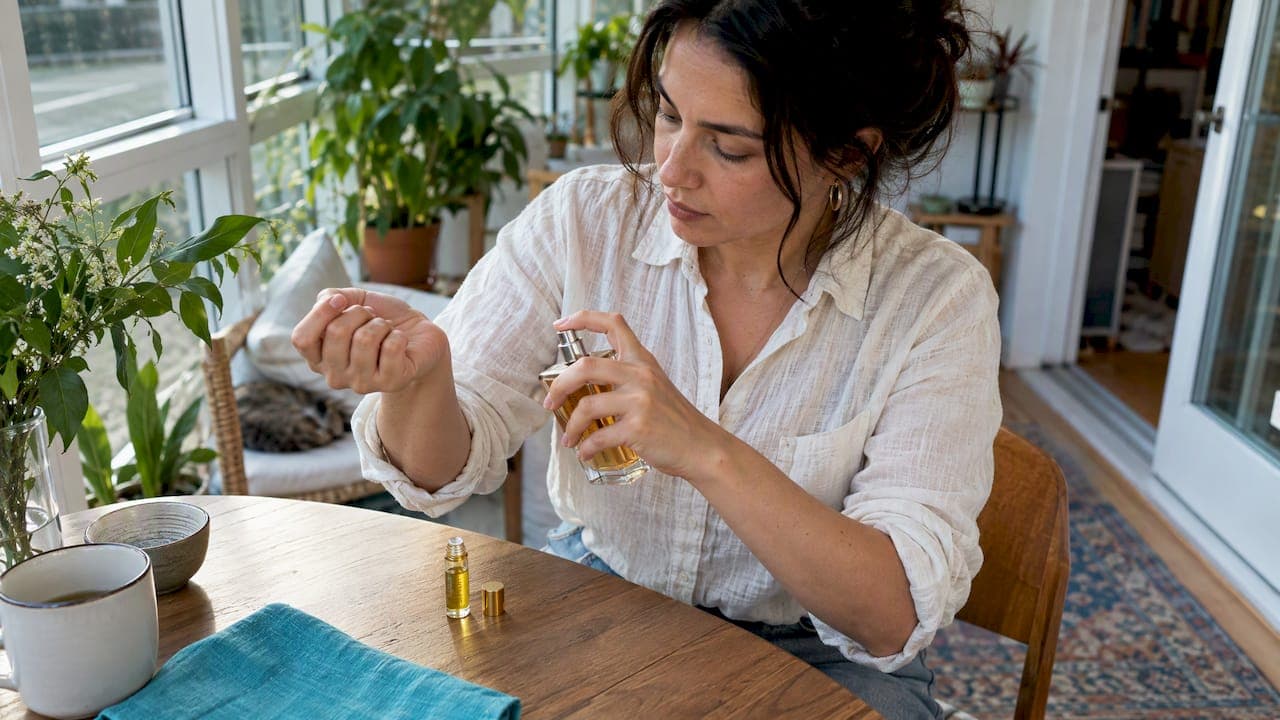
Attar is a concentrated, alcohol-free perfume oil that stays close to the skin; a conventional perfume is alcohol-based and built to project. Pick attar for long-lasting, skin-close wear or if you avoid alcohol. Pick perfume when you want projection and spray convenience. Industry guidance such as IFRA's shapes how both formats are made, and at Parfumla we help you sample fragrances before you commit.
TL;DR:
- Very cheap attar may be a synthetic blend rather than a distillate, so check its ingredients and ask about the base oil.
- Attar can remain on skin for hours without projecting far, while perfume often opens more brightly; judge staying power and reach separately.
- Choose a lighter eau de toilette or cologne in summer, use less fragrance in heat, and reserve richer attars or parfums for cold weather.
- Test one dab of attar or one perfume spray on clean skin, let each develop, then compare its scent and reach after a few hours.
Table of Contents
- What is an attar and how is it made?
- What is a conventional perfume?
- How do attar and perfume differ side by side?
- Which one suits your skin, beliefs, occasion, and season?
- How do you decide and test before buying?
- Our perspective: sample both formats before you decide
- Try samples first, then buy with confidence
- FAQ
- Sources
What is an attar and how is it made?
An attar (also spelled ittar) is a concentrated, alcohol-free perfume oil. Traditionally it is distilled into sandalwood oil, which acts as the receiving base that holds and slows the release of the scent. You apply a tiny amount to your pulse points, it warms with your skin, and it tends to bloom slowly rather than announce itself with a bright opening.
The classic production method is called deg-bhapka. Botanicals are hydrodistilled directly into a base oil, and the finished oil is often aged before it is sold. That patience is part of why artisan attars cost what they do. The format also has deep roots: attar has been used across the Middle East, Persia, and South Asia for personal fragrance, gifting, and ritual use.
Here are the botanicals you will see most often:
- Rose: the best known attar material, soft, green, and slightly honeyed.
- Jasmine: rich and floral, often used in warmer blends.
- Oud: dark, woody, and resinous, usually the most expensive.
- Kesar (saffron): leathery and warm, with a golden tone.
- Kewra: a sweet, fresh floral from the pandan flower.
Not everything labeled "attar" is made the traditional way. Some products are authentic small-batch distillates. Others are blended perfume oils in neutral carriers, sold in the same style of bottle. The difference shows up in scent depth and in price: distillates with real sandalwood or oud and long aging cost more, while synthetic or mass-produced "attar-style" blends cost less.
Pro Tip: If a bottle labeled attar is very cheap, check the ingredient list and ask what the base oil is. A real sandalwood base will usually smell warmer and drier than a neutral carrier.
What is a conventional perfume?
A conventional perfume is a fragrance dissolved in alcohol, usually with water and a smaller share of aromatic oils. The more aromatic material in the bottle, the stronger the scent. The usual ladder runs from cologne at the light end, through eau de toilette (EdT) and eau de parfum (EdP), to parfum at the richest end. General ranges are enough for shopping: each step up tends to be stronger and longer lasting, though the actual performance depends on the formula, not just the label.
The alcohol does real work. It carries the scent molecules into the air, which creates the bright, lifted opening perfume lovers expect. Alcohol-based perfumes move through distinct top, heart, and base phases, so the scent you smell at the first spray is not the one you smell hours later. A modern EdP uses alcohol as a carrier to help the scent diffuse and project, which is why it makes a strong first impression.
Here is what you should know about how modern perfume is built:
- Natural and synthetic ingredients: most modern perfumes blend natural extracts with aroma chemicals, which allows scents that are hard to get from plants alone, such as clean musks or fresh marine notes.
- Spray application: a nozzle gives you an even, fast, repeatable dose without touching the liquid.
- Concentration choice: you can pick a lighter EdT for office hours or a richer EdP or parfum for evenings.
- Wide scent range: the format covers everything from citrus colognes to heavy gourmands.
In practice, perfume gives you quick, noticeable sillage the moment you spray. An attar gives you a subtle, skin-warmed glow that you notice mostly when someone is close. Neither is better in the abstract. They do different jobs, and the next section lines them up.
How do attar and perfume differ side by side?
Start with the carrier, because everything else follows from it. Attar uses oil. Perfume uses alcohol. Oil evaporates slowly, so an attar sits on the skin and releases scent gradually. Alcohol evaporates fast, which lifts the scent into the air quickly and then leaves the heart and base notes behind.

Opening and development. An attar warms with the skin and may bloom slowly instead of showing a bright opening. Perfume does the opposite: the first minutes are the loudest, then the scent settles.
Projection and sillage. Perfume projects farther. An attar is built on intimacy rather than announcing across a room. Attar tends to stay close to the skin, while a well-sprayed EdP may project more noticeably. If you want to understand why this matters, our explainer on fragrance projection and sillage breaks it down.
Longevity. Attar often lasts longer on skin because of the oil carrier and the concentration. Keep two ideas apart here: perceived strength and projection are not the same as staying power. An attar can stay on your skin for a long time while barely reaching anyone beyond close range. Our comparison of perfume oil and spray wear time looks at the same trade-off.
Application. Attar is dabbed or smeared in tiny amounts on pulse points. Perfume is sprayed, on skin, clothing, or hair. That changes how you test: use a very small amount of attar, while perfume is applied as a spray.
Price and availability. Artisan attars can be expensive because of raw materials like real sandalwood or oud and long aging. Synthetic or mass-produced attar-style blends are cheaper. Perfumes cover an equally wide price range, from affordable everyday sprays to luxury and niche bottles.
The practical differences at a glance:
- Carrier: oil for attar, alcohol for perfume.
- Opening: slow, skin-warmed bloom versus bright, alcohol-lifted top notes.
- Projection: close and intimate versus room-filling.
- Longevity on skin: often longer for attar, varying by formula for perfume.
- Application: a small dab versus a spray.
- Price: very wide for both, driven by ingredients and aging for attar.
Attar is valued for slow development and long skin-time, while alcohol-based perfumes lift and change in top, heart, and base phases. That one contrast explains most of what you will notice when you wear them side by side.
Which one suits your skin, beliefs, occasion, and season?
Match the format to your situation, not to a trend. These are the cases where each one tends to win.
When attar suits you. Attar is often preferred by people with sensitive skin or those seeking alcohol-free options for religious or personal reasons. It also suits you if you like a scent that stays on skin for hours and that only people close to you notice. If dryness is your concern, see our guide to alcohol-free perfumes for sensitive skin. Skin-care brands that focus on dry and sensitive skin can help with your wider routine, though you should still patch test any fragrance.
When perfume suits you. You want a wide choice of scent profiles, the speed of a spray, and the option to apply to clothing or hair so the scent travels with you. Perfume is also the stronger pick for first impressions, since the alcohol-driven opening is built for that.
A few combinations work well for both:
- Layer them. Dab attar on your skin for a long, warm base, then spray perfume on your clothing or hair for outward projection.
- Match the event. Choose attar for quiet dinners, prayer, or close company, and perfume for parties, offices with open layouts, or outdoor events.
- Match the season. Use less of either in heat, since warm skin amplifies both. Lighter EdT or colognes often feel better in summer, and richer attars or parfums feel natural in cold weather.
- Start small. Whatever you choose, apply conservatively the first time and sample before you buy a full size.
Pro Tip: Apply attar to clean, slightly moisturized skin. A thin layer of unscented lotion gives the oil something to cling to, and you will often need even less than you expect.
How do you decide and test before buying?
Use this short checklist first. Answer each point honestly and the choice usually makes itself.
- Projection: do you want people to notice you across a room, or only up close?
- Longevity: do you want all-day skin presence or a bright, shorter lift?
- Alcohol-free: is this a requirement for religious, personal, or skin reasons?
- Texture: do you like touching the product, or prefer a mist?
- Budget: are you comparing a bottle of artisan attar with an EdP, and what is each worth to you?
- Samples: can you try it first? If yes, always do.
Then run this test. Our full guide on how to test perfume properly goes deeper, but the core routine is short:
- Start with clean skin. Skip other scented products on the test area.
- Apply a small amount. One dab of attar, or one spray of perfume, on a pulse point such as your inner wrist.
- Give it time to develop. Attar may bloom slowly, and perfume changes after its opening.
- Test on fabric separately. Spray perfume on a clothing sleeve or your hair and compare it with the skin result.
- Check again after a few hours. Notice what remains and how far it reaches.
- Compare formats. Use samples or decants to try an attar and an EdP side by side on different days.
Choose a perfume concentration over an attar when you need outward sillage, for example a social event, a large room, or a long commute where you want the scent to stay noticeable. Choose the attar when you want something personal that lasts. If you are unsure, sampling both removes the guesswork, and our samples and decants make that low risk.
Our perspective: sample both formats before you decide
At Parfumla we see the same pattern all the time: shoppers treat attar and perfume as rivals, when the better question is which job you need done today. Most people end up owning both. We think the format debate is less important than testing on your own skin, because the same oil or spray can behave very differently from one person to the next.
That is why we encourage sampling before buying a full bottle. Our blog covers testing, projection, and alcohol-free options. When you do decide, you can order knowing we stand behind authenticity and ship reliably across the US and EU.
— Parfumla
Try samples first, then buy with confidence
The lowest-risk path is simple: sample, decant, then full bottle. Our Decants & Samples let you try fragrances in real conditions before you commit. If you are shopping for a spray, browse women's, men's, or unisex fragrances.
Here is what we offer: a wide catalog of fragrances, discounts, an authenticity guarantee, and shipping across the US and EU. If you are looking for the best price for your favorite fragrance or wondering where to buy original perfume online, you can start with our Decants & Samples and pick a sample today.
FAQ
Why do many people prefer attar over perfume?
Attar suits people who want an alcohol-free, skin-close scent that lasts. It is often chosen by people with sensitive skin or for religious and personal reasons. Perfume is better if you want projection and spray convenience, so neither is better for everyone.
Is attar only for Muslims?
No. Attar has deep roots across the Middle East, Persia, and South Asia, but anyone can wear it. It has long been used for personal fragrance, gifting, and ritual use, and many people choose it simply for its oil base and slow development.
Why is attar so expensive?
Cost follows the ingredients and the process. Authentic small-batch distillates use costly materials like real sandalwood or oud and may be aged, while cheaper attar-style blends use synthetic or neutral carriers. Price alone does not tell you which one you are buying, so check the ingredients.
How do I choose between attar and perfume?
Start with projection, longevity, and whether you need an alcohol-free formula. Choose attar for intimate, long skin-time wear and perfume for outward sillage and easy spraying. Try samples of both before buying a full size.
Sources
- Attar vs perfume: Which one is safer for your skin and lasts longer in the heat? | Fashion Trends
- Making scents of attar: the story of traditional north Indian perfume
- What is attar (ittar), and how is it made? | PerfuMate