
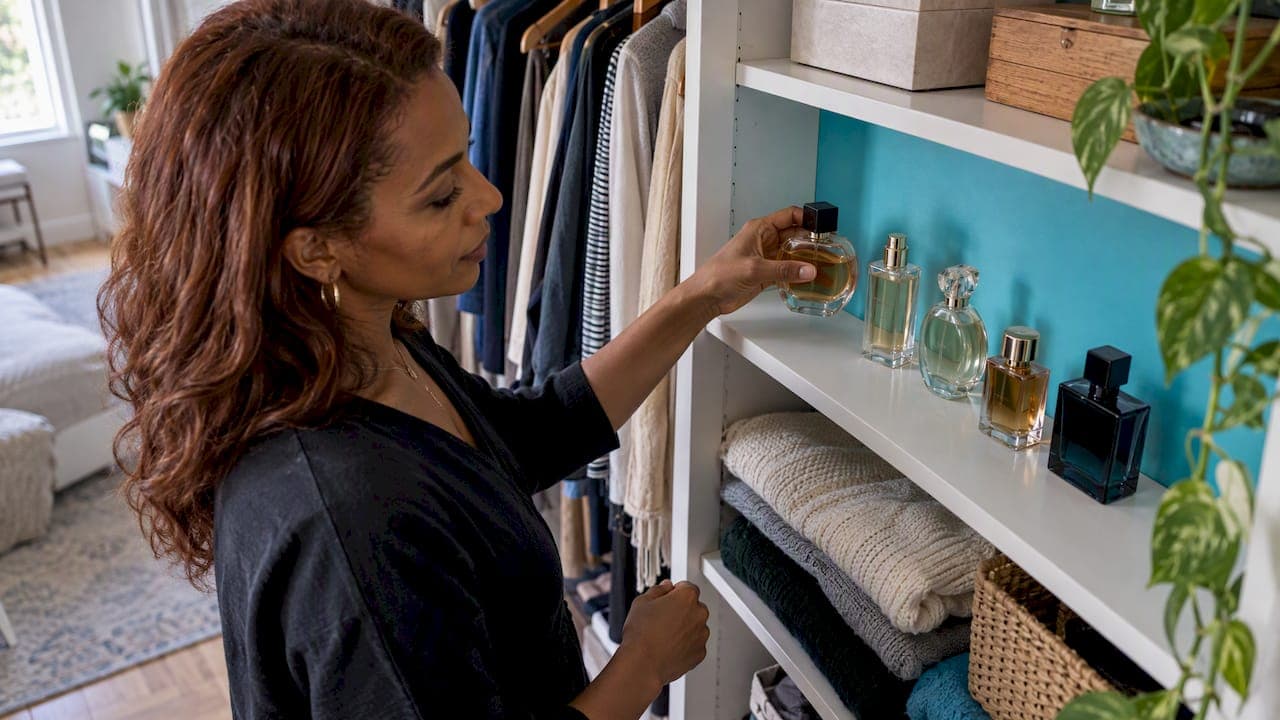
A capsule fragrance wardrobe is a short, deliberate lineup of perfumes, usually three to seven, that covers your whole year: workdays, evenings out, hot weather, cold weather and the occasional special event. Like a clothing capsule, every piece earns its place and nothing sits unworn. This guide shows how many scents you need, which roles to fill, how to rotate with the seasons and how to test before you spend on full bottles.
TL;DR
- Start with three scents: a day scent, an evening scent and one that bridges the two. Add more slowly, only to fill a real gap.
- Choose by role (daily, office, evening, warm weather, cold weather), not by how many bottles look good on a shelf.
- Season matters, but a fresh scent can work year-round, so you rarely need a separate bottle for every month.
- Sample first. Wear a candidate on skin on several different days before buying the full size.
- The "30/50/20 rule" is a rule of thumb for blending notes, not a standard for building a collection.
Table of Contents
- What a capsule fragrance wardrobe actually is
- How many perfumes do you need?
- The roles your scents should fill
- How to build your capsule, step by step
- Summer vs winter perfumes: how seasonal does a capsule need to be?
- Layering: how a small capsule stretches further
- Build without overspending: samples, decants and travel sizes
- What about the 30/50/20 rule?
- Keep the capsule in good shape
- Our view: fewer bottles, better ones
- Ready to start your capsule?
- FAQ
- Sources
What a capsule fragrance wardrobe actually is
The idea borrows from clothing. Vogue compares a fragrance wardrobe to a clothing wardrobe: different scents for different occasions, moods and moments, which you can also mix and layer. The capsule version adds a limit. You keep the collection small enough that you actually wear everything in it.
That is the main difference from a large collection. A big shelf of bottles is built around acquiring. A capsule is built around using. If you have ever owned a perfume you bought on impulse and wore twice, you already know the problem a capsule solves. Fragrance experts quoted by Vogue say there is no strict required number, and that the point is to avoid piling up bottles that go unused.
The same logic is behind the minimalist perfume collection many readers search for. Minimalist does not mean boring. It means each scent has a job, and you can name that job in one sentence.

How many perfumes do you need?
There is no magic number, but there is a sensible range.
- Three scents is the usual starting point. Vogue India's expert panel recommends beginners start with at least a day scent, an evening scent and one that moves between the two.
- Three to five scents is what the fragrance expert in Vogue's 2018 guide says many people rotate between.
- Two to start is the advice from Men's Health editors, who suggest adding others over the next year as you work out what you like.
- Five to seven is where most capsules top out once you want true seasonal coverage plus a dedicated evening or special-occasion bottle.
If you are unsure, go with the low end. Adding is cheap and fun. Owning a drawer of regrets is not. One expert in the Vogue India piece suggests growing gradually, adding one fragrance a month and comparing the collection as it develops, rather than buying many at once.
The roles your scents should fill
Think in jobs, not in brands. Here is a framework that works for a five-scent capsule, with the three-scent version marked.
| Role | What it needs to do | Typical style | In a 3-scent capsule? |
|---|---|---|---|
| Everyday signature | Feels like you, suits most days, not too loud | Skin-close musks, soft woods, light florals, clean ambers | Yes (day) |
| Office or close-quarters | Polite, low projection, never cloying | Tea, green, soft citrus, clean musk | Merged with everyday |
| Warm-weather scent | Bright and breathable in heat | Citrus, aquatic, green, fruity | Optional |
| Cold-weather scent | Richer, warmer, holds up in cold air | Amber, vanilla, spice, woods, resin | Optional |
| Evening or statement | Memorable, more projection, for dinners and events | Gourmand, oud, leather, rich florals | Yes (evening) |
| Bridge scent | Works from desk to dinner | Balanced woody-floral or fresh-amber | Yes (bridge) |
Notice that no role says "best seller" or "on sale." You decide the roles first, then fill them.
If you want a hand shopping by role, our edits by category make it easier to browse: women's perfumes, men's perfumes and unisex fragrances. Many scents cross those lines, so read the notes, not the label.
How to build your capsule, step by step
1. Audit what you own
Line up every bottle you have. Sort them into "I reach for this," "occasionally" and "never." Keep the first group as the seed of your capsule and note which roles are missing. A tray or accessible bin helps here: the Perfume Society points out that keeping a small collection visible lets you shop your own stash and rediscover scents you had forgotten, instead of defaulting to one bottle.

2. Write your three or four occasions
Be honest. If you work from home and go out twice a month, you do not need a boardroom scent. Write the situations you are actually in each week, and give each a role from the table above.
3. Pick your anchor first
Start with the scent you will wear most, the everyday signature. If your life is mostly casual, a skin-close musk or soft woody scent is a safe base. Our guide to why perfume completes an outfit helps you think about scent the way you think about the rest of what you wear.
4. Add by gap, not by impulse
After the anchor, add the missing role that will make the biggest difference. For most people this is either an evening scent or a seasonal counterweight (something bright if the anchor is warm, something warm if the anchor is bright). A good approach to building a wardrobe of any kind, including a capsule wardrobe built around real routines, is to buy for the life you have, not the one you imagine.
5. Test properly before you commit
Buying blind is how capsules fill up with mistakes. Men's Health advice is not to test too many scents at once, since the nose tires: test two, then judge them in a different environment. Our walkthrough on how to test perfume properly covers the full routine. Skin matters too, because the same scent can smell different on different people. We explain this in our piece on skin chemistry and fragrance matching.
A practical rule: wear each candidate on your skin on at least three separate days, at different times, before you buy the bottle. A scent that thrills you for ten minutes can turn sharp or flat by hour four.
Summer vs winter perfumes: how seasonal does a capsule need to be?
Seasonal rotation is the part most people picture when they hear "fragrance wardrobe," and it is real. Heat tends to amplify rich, sweet and heavy scents, so many wearers reach for citrus, aquatic, green and fruity profiles in summer, and for amber, vanilla, spice, woods and resins in winter.
But seasons are not a strict rulebook. Vogue's fresh-perfume roundup notes that fresh fragrances are versatile year-round: refreshing in summer, and crisp, mood-lifting accents in colder, grayer months. Guerlain's creative director Delphine Jelk is quoted there saying fresh scents have texture and light, which makes them useful for mood regardless of season.
So here is a smart way to handle it:
- Make one scent fresh and flexible. It is your summer lead and your winter pick-me-up.
- Make one scent warm and enveloping. It covers cold months and evenings.
- Let the bridge scent flex between the two, wearing it lighter in summer and in a heavier season with a second spray.
That gives you seasonal coverage with three bottles, not twelve.
A sample five-scent year
| Scent | Season and moment | Why it earns its place |
|---|---|---|
| Soft musk or woody signature | Daily, all year | Your default, low-risk |
| Bright citrus or green | Hot weather, errands, gym bag | Breathes in heat |
| Clean tea or light floral | Office, close quarters | Polite and unobtrusive |
| Amber, vanilla or spice | Autumn and winter days | Holds up in cold air |
| Rich floral, leather or gourmand | Evenings and events | Your statement |
Swap in what suits your taste. The structure is what matters.
Layering: how a small capsule stretches further
Layering is the capsule builder's best trick. Combine two scents and you get a third, which makes five bottles behave like many more. Jean Madar of Interparfums says in Vogue that layering offers freedom to curate a scent profile for your daily mood rather than relying on one prescribed set of notes.
If you are new to it, start with our beginner's guide to fragrance layering, then see layering combinations that actually work. A simple starting pair: put a fresh citrus over your warm winter scent on a mild day to lighten it.
Build without overspending: samples, decants and travel sizes
The fastest way to waste money on a capsule is to buy full bottles of scents you have only smelled on a paper strip. Samples fix that.
Allure reports that discovery kits hold miniatures you can wear over several weeks, so you learn whether you really like a style before upgrading, which may help you avoid buyer's remorse. Vogue's guide to discovery sets adds that they narrow a huge marketplace by letting you try several scents at once. Minis have a caveat: Vogue notes that packaging can make them relatively pricey, and buying a lot of them can undercut the sustainability benefit. So sample with purpose. Pick your two or three finalists per role, not everything in sight.
A few ways to do it:
- Decants and samples: small amounts of the real juice, ideal for a wear-test week. See our explainer on what a sample decant is.
- Discovery sets: several scents in one box. We cover how they work in what a perfume discovery set is.
- Travel sprays and gift sets: multi-mini sets double as a trial and a portable capsule. Examples on our site include the Christian Dior for Women gift set 3x20ml and the Tom Ford Velvet Orchid gift set 5x11ml.
For a full plan on trying more for less, read our budget guide to sampling perfumes, and if you are starting from zero, the 3-scent starter guide for beginners pairs well with a capsule mindset. When you are ready to commit to bottles, our smart buyer's guide to perfume shopping on a budget helps you spend where it counts.
What about the 30/50/20 rule?
You may see a "30/50/20 rule for perfume" in search results. It does not apply to building a collection. According to PerfuMate, it is a hobbyist rule of thumb for balancing top, heart and base notes when blending, not a perfumery standard, and the guides that mention it cite no source. For a capsule, ignore it and use roles and seasons instead.
Keep the capsule in good shape
Small collections only work if the perfume stays good. The Perfume Society advises keeping bottles and samples away from direct sunlight and heat sources, which can make fragrance evaporate or turn. A drawer, closet shelf or a box away from the window beats a sunny bathroom counter. Rotate by moving the bottle you wore last to the back of the tray.
Our view: fewer bottles, better ones
We sell more than 14,000 fragrances, so you might expect us to tell you to buy more. We would rather you buy right. The people who are happiest with their perfume are rarely the ones with the biggest shelves. They are the ones who know why each bottle is there.
Our approach to a capsule is simple. Define the jobs first. Sample before you pay for a full size, which is why we carry decants, samples and travel sprays alongside full bottles. Then spend on the roles you wear most. A signature you use four days a week deserves the better bottle. A once-a-month evening scent can start as a small size, and you can always upgrade once it proves itself.
And keep authenticity non-negotiable. A capsule has so few scents that each one has to be the real thing, which is why we source from trusted distributors and stand behind every bottle as 100% authentic.
— Parfumla
Ready to start your capsule?
If you want to buy designer or niche perfume online, you can browse our catalog by category and try scents in small sizes first. Looking for where to buy original Gucci perfume, or the best price for a Creed fragrance? Both sit alongside thousands of other houses on our site, with savings of up to 60% off retail. Start with decants and samples to test your shortlist, then move up to full bottles for the scents you reach for most. For something more distinctive, explore niche picks such as Ex Nihilo Citizen X for your statement slot.
FAQ
How many perfumes should be in a capsule fragrance wardrobe?
Most people do well with three to seven. Three covers a day, evening and bridge scent, which is the starting point experts recommend for beginners. Add more only when a specific gap appears, such as a dedicated hot-weather or cold-weather scent.
Do I need different perfumes for summer and winter?
Not necessarily. Many people like brighter citrus, green or aquatic scents in summer and warmer amber, vanilla or woody ones in winter. But fresh fragrances can work all year, so one flexible fresh scent plus one warm scent often covers both seasons.
Is a minimalist perfume collection worth it?
Yes, if you tend to buy bottles you barely wear. A smaller collection costs less, is easier to store properly and lets you wear each scent while it is still at its best. You also learn your taste faster because every purchase has a clear purpose.
What is the best way to choose scents for a capsule without wasting money?
Test in small amounts first. Try no more than two scents at a time, then wear your finalists on skin over several days. Decants, samples and discovery sets let you do this for much less than a full bottle.
Sources
- How Kilian Paris Is Turning a Bestseller Into a Fragrance Wardrobe (Vogue)
- How to Create the Perfect Fragrance Wardrobe (Vogue)
- 4 experts on how to build a versatile perfume collection (Vogue India)
- How to Build a Five-Scent Fragrance Wardrobe for Men (Men's Health)
- The Best Fresh Perfumes (Vogue)
- How Fragrance Layering Opens Up a World of Scent (Vogue)
- Scent Discovery Kits (Allure)
- Perfume Discovery Sets (Vogue)
- Why mini beauty products are trending (Vogue)
- How to balance top, heart and base notes (PerfuMate)
- Scent Storage Solutions (The Perfume Society)