
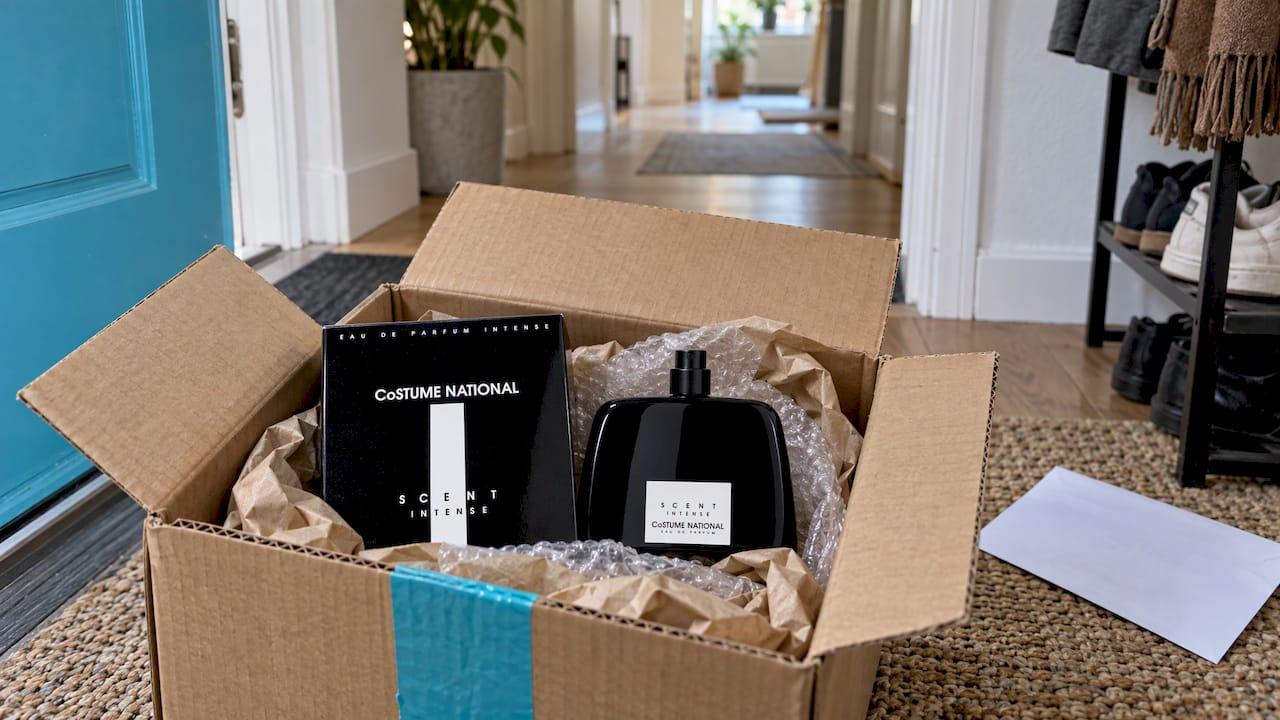
Perfume itself carries a 0% customs tariff in the EU, but that does not mean an order arrives free of charges. Since 1 July 2026, small parcels containing perfume also face a temporary €3 duty per item, and import VAT is charged on top. If you are ordering a fragrance for delivery inside the EU, the number to plan around is the total landed cost: price, duty, VAT and any handling fee. At Parfumla we ship perfume across the US and EU, so the sections below show how those charges work and how to compare a delivered price properly.
TL;DR
- The standard EU tariff on perfume (CN code 3303 00 10) is 0.000%, so duty on larger shipments is not a percentage surcharge for most origins.
- From 1 July 2026 until 1 July 2028, a temporary €3 duty per item applies to consignments up to €150, and perfumes are explicitly included. The old €150 duty exemption is gone.
- Import VAT is a national tax, so the rate depends on the EU country you live in, and it applies whether or not duty is due.
- Travelers carrying perfume in luggage use a value allowance (€430 by air or sea, €300 by land), not a quantity quota.
- Compare the delivered price, not the sticker price: that is the only comparison that holds up.
Table of Contents
- What actually changed in 2026
- Why the tariff on perfume is 0% but you can still pay duty
- How the €3 is counted: per item, not per bottle
- Import VAT: the bigger part of the bill
- A worked example: the three ways one bottle can arrive
- Carrying perfume in your luggage
- How to work out your real cost before you order
- Shipping rules that sit beside duty
- Our point of view
- Find your fragrance, then check the delivered total
- FAQ
- Sources
What actually changed in 2026
For years, parcels worth up to €150 entered the EU without customs duty, but perfumes and toilet waters were an exception. They were excluded from the €150 relief under the Commission's 2022 low-value consignment guidance, while still falling under the import VAT scheme for small parcels.
That structure has been replaced. Under Council Regulation (EU) 2026/382, the €150 relief was deleted, and a temporary €3 customs duty per item applies from 1 July 2026 until 1 July 2028. It covers imports that are VAT-exempt under the Import One-Stop Shop (IOSS, a scheme where the seller collects VAT at checkout) and goods in postal consignments.
The Commission's guidance on the €3 duty names the goods that used to be excluded from relief, including perfumes and toilet waters, as covered by the new duty. In other words, a bottle of eau de parfum is treated like any other low-value item, rather than being a special case.
The Commission also describes a wider EU customs reform: the temporary €3 duty is a bridge until normal customs duties apply once the EU's new Data Hub is fully operational. The reform also moves responsibility for customs formalities and duty payment toward platforms, sellers or carriers, and away from the individual consumer.
Why the tariff on perfume is 0% but you can still pay duty
There are two separate things here, and mixing them up causes most of the confusion.
The ordinary tariff. The Commission explains that customs duty is calculated from three factors: the tariff for the product, its customs value and its origin. Usually the duty is a percentage of the customs value. For perfume, the third-country duty in the TARIC database is 0.000%, and many preferential trade-agreement origins are also at 0.000%. TARIC is the EU's integrated tariff database, which the Commission updates daily for national customs administrations. It lists duty only, not national taxes like VAT.
The temporary low-value duty. For small consignments, a flat amount applies instead of a percentage. TARIC lists a €3.000 low-value consignment duty on perfumes and toilet waters, effective 1 July 2026 and running to 1 July 2028 for IOSS-exempt imports and postal consignments.
So the flat €3 is not a rate on your bottle's price. A €40 bottle and a €140 bottle both attract the same flat amount, provided each is a single item in a consignment up to €150.

How the €3 is counted: per item, not per bottle
The duty is charged per "item" as defined by tariff classification, not by physical pieces. The Commission's own example is that five identical T-shirts count as one item (€3), while a T-shirt plus a watch counts as two items (€6).
For a perfume buyer, this works out as follows, assuming the goods fall under the same tariff line:
| Parcel contents | Likely items | Flat duty |
|---|---|---|
| One 100 ml eau de parfum | 1 | €3 |
| Two perfumes of the same tariff classification | 1 | €3 |
| One perfume plus a candle or body lotion in a different tariff line | 2 | €6 |
The classification of a specific product is decided by customs, so treat the table as a guide to the logic, not a guarantee. The practical lesson for gift buyers is that putting a fragrance and a non-fragrance product in one box can add a second item, while two bottles of perfume in one box typically stay one.
Import VAT: the bigger part of the bill
On a typical €90 bottle, the €3 duty is small. Import VAT is the larger charge. It is a national tax, set by the EU country where the goods are released for free circulation, so a buyer in one member state pays a different rate than a buyer in another.
There are two routes for parcels up to €150, according to the Commission's low-value consignment guidance:
- IOSS. The seller charges VAT at checkout and pays it through one member state, so the import is VAT-exempt on arrival and nothing more is collected at the door.
- Special arrangements. Postal operators, express carriers and customs agents collect the VAT from you on delivery and pay it monthly to the destination member state.
Here is an illustrative example, using an assumed 20% VAT rate, which is not any specific country's rate. A €90 bottle shipped under IOSS would carry €18 VAT at checkout plus the €3 duty, so around €111 before shipping. Check your own country's standard rate when you run the numbers.
The Commission's guidance also describes a €2 Union handling fee per item, irrespective of the item's value, and says it was expected to apply from 1 November 2026. Look for it in the delivery quote alongside duty and VAT.
If you want to understand how sellers set up international orders on their side, this international ecommerce guide covers the basics of selling across borders.

A worked example: the three ways one bottle can arrive
Take one bottle with a €90 retail price, shipped to a buyer in the EU, with an assumed 20% VAT rate.
| Charge | Under IOSS at checkout | Collected by carrier on delivery |
|---|---|---|
| Product | €90 | €90 |
| Temporary duty | €3 | €3 |
| VAT (assumed 20%) | €18, paid at checkout | €18, collected at the door |
| Handling fee, if applied | €2 per item | €2 per item |
The totals are close. What changes is when and to whom you pay, and whether a surprise charge appears at the door. A delivered price shown in full at checkout is the cleanest way to buy, because the number you approve is the number you pay.
If your parcel is over €150, the €3 flat duty no longer applies, and normal duty rates do. For perfume, that tariff is 0.000%, but import VAT still applies. Splitting a large order into several parcels is not something to plan around, because rules on consignments and items are applied by customs.
Carrying perfume in your luggage
The parcel rules above do not apply to a bottle in your suitcase. Travelers have a value allowance instead. The European Commission's travel guidance says goods including perfume can be brought in duty- and tax-free up to €430 for air and sea travel and €300 for land or inland-waterway travel, with some member states applying €150 for travelers under 15.
Two practical points follow. There is no separate perfume quota: fragrance sits within the general value allowance. And the value of one item cannot be split between travelers, so a single €500 bottle exceeds the allowance even if two adults share the trip.
A separate set of limits applies before you reach customs: airline cabin rules on liquids. Our guide to the 3.4 oz limit for perfume on a plane explains what fits in hand luggage. For a price comparison between airport shops and ordering online, see duty free vs online perfume and our notes on duty-free fragrance pricing.
How to work out your real cost before you order
A short routine keeps surprises out of the checkout:
- Add up the consignment value. If the whole parcel is €150 or less, the temporary flat duty applies. If it is more, normal duty rates apply, and for perfume that is 0.000%.
- Count the items. Same-classification perfumes count together, while other products in the box may add items.
- Find your country's VAT rate. It is set nationally, so look up the standard rate for your member state.
- Check whether VAT is collected at checkout or on delivery. Checkout collection under IOSS means no bill at the door.
- Look for a handling fee in the delivery quote and add it per item.
- Compare totals, not prices. A lower sticker price can lose to a higher one that includes everything.
Our delivery information page explains how we ship across the US and EU, so you can check delivery terms for your country before you commit.
Shipping rules that sit beside duty
Alcohol-based fragrances are flammable liquids, so carriers apply their own transport rules in addition to customs. That is why a bottle bought retail from an established seller usually moves more smoothly than an ad-hoc private shipment. Our guides on perfume shipping rules and the domestic shipping limit for perfume cover what carriers expect.
Our point of view
Most customs surprises on perfume come from not knowing the full price of a bottle before checkout. The tariff on fragrance is 0%, so the headline reassurance is true, but flat duty, VAT and fees still build the landed cost.
That is why we think about fragrance buying as a whole journey. Our catalog covers more than 14,000 perfumes, from popular and celebrity names to luxury and niche houses, all sourced from trusted distributors and sold as 100% authentic. We also offer travel sprays and samples, so you can find a scent you love before committing to a full bottle, which keeps the cost of a first order low.
We ship across the US and EU, and we would rather you read the delivery terms for your country in full than guess. A bottle you can afford to the last cent is a bottle you will enjoy.
Parfumla
Find your fragrance, then check the delivered total
If you are shopping from the EU or the US, start with the category that matches who the scent is for: women's perfume, men's cologne and perfume, unisex fragrances or gift ideas. For niche lovers, a bottle like the Kilian Paris Her Majesty EDP 50ml is the kind of find our catalog is built around.

Browse the full range at Parfumla, and read the delivery details for your country before you pay.
FAQ
Is there customs duty on perfume shipped to the EU?
The standard tariff on perfume is 0.000%. However, from 1 July 2026 until 1 July 2028, a temporary flat €3 duty per item applies to consignments up to €150, and perfumes are explicitly covered. Import VAT is charged on top.
Does the €3 duty apply per bottle?
It applies per item as defined by tariff classification, not per physical piece. Several identical products count as one item, while different product types in one parcel count separately.
How much perfume can I bring into the EU in my luggage?
There is no fragrance-specific quantity limit. Perfume counts toward the general value allowance of €430 for air and sea travelers and €300 for land travelers. Check airline liquid rules separately for hand luggage.
Are fragrances cheaper duty free?
Sometimes, but the saving depends on the bottle, the airport and your allowance. Compare the full price you would pay, including any amount above your allowance. Our article on duty free vs online perfume walks through the comparison.
Sources
- Customs Guidance on the €3 customs duty (European Commission, 5 October 2026)
- Customs guidance on low-value consignments (European Commission, 2022)
- Low-value consignment guidance, special arrangements and IOSS
- EU customs duty relief system (EUR-Lex)
- EU Customs Reform (European Commission)
- Calculation of customs duties (European Commission)
- EU Customs Tariff (TARIC)
- TARIC entry: Perfumes, 3303 00 10
- TARIC entry: Perfumes and toilet waters, 3303 00 00
- Tariff page for 3303 00 10 with item-counting examples
- Consumer goods you can carry in your suitcase (European Commission, 22 July 2025)
- International ecommerce guide