
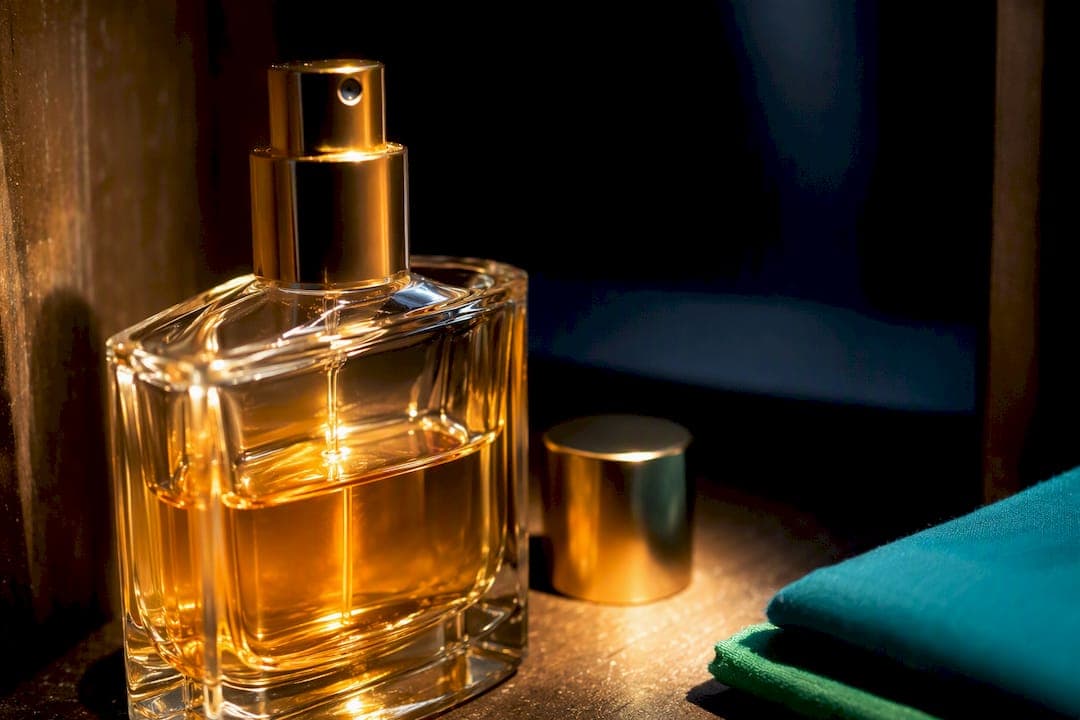
Yes, perfume expires. How fast depends on the formula and how you store it: opened bottles typically hold their quality for several years, while an unopened bottle kept away from heat and light can stay excellent for a decade or more. Light, heat, and oxygen are the three things doing the damage.
TL;DR:
- Unopened perfume can remain fresh for many years if stored away from heat, light, and oxygen, with some vintage bottles lasting decades.
- Fragrances with citrus or green notes tend to degrade faster, often losing their brightness within one to two years after opening.
- Proper storage, such as keeping bottles in a cool, dark place and tightly capped, significantly slows down the aging process and preserves scent quality.
- Signs of expired perfume include sour or metallic smells, darkened or cloudy liquid, and flat or chemical dry-down on blotter tests.
- Oxidation and evaporation are the main causes of perfume degradation, which accelerates with exposure to light, heat, and frequent air contact.
Table of Contents
- How Long Does Perfume Last, Opened vs. Unopened?
- What Causes Perfume to Degrade?
- How Can You Tell if Perfume Has Expired?
- How Should You Store Perfume to Slow Aging?
- Is It Dangerous to Wear Expired Perfume?
- Parfumla's Take on Managing a Fragrance Collection
- The Real Lesson Here Isn't About Expiration Dates
- Sources
- FAQ
How Long Does Perfume Last, Opened vs. Unopened?
An opened bottle of perfume isn't on a countdown clock the moment you break the seal, but it is on borrowed time. Most opened perfumes hold their quality for roughly one to five years, with the exact number depending on what's in the formula and where you keep the bottle. An unopened bottle ages far slower. Sealed and stored properly, away from sunlight and temperature swings, it can remain essentially unchanged for many years, and some vintage collectors report bottles staying wearable for decades.
Concentration and note family both matter, but in different ways.
- Concentration affects wear time, not shelf life. Parfum extract typically lasts 8 to 12 hours on skin, eau de parfum 6 to 9 hours, and eau de toilette 3 to 5 hours, according to longevity comparisons across fragrance concentrations. That's about performance, not how long the juice itself stays chemically stable in the bottle.
- Higher concentration usually means better stability. Parfum and EDP carry a higher ratio of aromatic compounds to alcohol, which tends to slow oxidation compared to lighter EDT and eau de cologne formulas.
- Note families age at wildly different speeds. Citrus, green, and aldehyde-heavy fragrances tend to fade and turn first, while resins, vanilla, musk, and heavy woods hold their character much longer, sometimes for years past when a citrus scent would already smell off.
If your collection leans citrus-forward, treat those bottles as the ones to use up first, not the ones to save for a special occasion five years from now.
What Causes Perfume to Degrade?
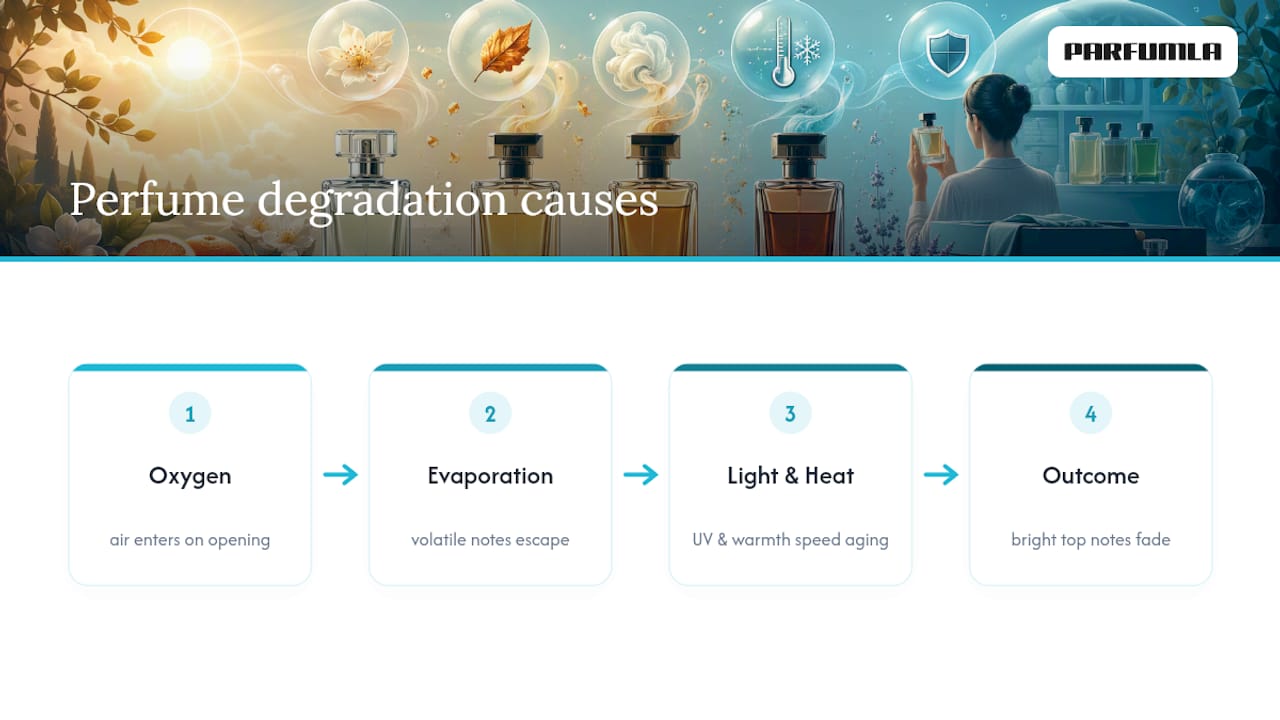
Three forces do almost all the damage: oxygen, evaporation, and light or heat. Oxidation is the biggest one. Oxygen reacts with the aromatic molecules in perfume over time, and that reaction is what turns a bright, clean scent sour, metallic, or vinegary. Every time you open the cap, a little more air gets in, which is why a bottle you spray daily ages differently than one you open twice a year.
Evaporation compounds the problem. Alcohol and the more volatile aromatic compounds escape gradually, especially through imperfect seals or worn atomizer threads, which shifts the balance of the formula. A perfume that once smelled bright and citrus forward can start smelling flat and syrupy once the lighter molecules have gassed off and only the heavier base notes remain.
Light and heat accelerate both processes. UV exposure breaks down molecular bonds and can visibly darken the liquid, while heat speeds up every chemical reaction happening inside the bottle. At the molecular level, certain top-note compounds like limonene oxidize far faster than heavier base materials, which is exactly why citrus fragrances lose their sparkle first. It's also why perfumers keep some natural raw materials refrigerated during formulation, long before the finished bottle ever reaches a shelf.
How Can You Tell if Perfume Has Expired?
You don't need a lab to figure out whether a bottle has turned. Your nose and eyes will tell you almost everything you need to know.
- Smell it straight from the bottle. Sour, metallic, vinegary, or overly harsh alcohol notes are the clearest sign something's off. A scent that's gone flat or dull, with none of its original brightness, has likely lost its lighter top notes.
- Check the liquid's appearance. Unexpected darkening, cloudiness, or visible sediment floating in the bottle points to oxidation. Color change combined with an off smell is a much stronger signal than color change alone, since some perfumes darken slightly with age even while still smelling fine.
- Do a blotter test. Spray a strip of paper and let it dry for a few minutes. If the dry-down smells sour or chemical rather than settling into its usual base notes, the formula has shifted.
- Try a patch test before wearing it on skin. Spray a small amount on your inner wrist. If you notice redness, itching, or irritation, don't wear that bottle on skin again.
Pro Tip: If a bottle smells questionable but not outright rotten, spray it on a scarf or use it as a room spray instead of skin. You lose nothing and avoid any irritation risk.
Any sign of skin irritation is a hard stop for wearing that bottle directly, even if you still want to use it around the house.
How Should You Store Perfume to Slow Aging?
Storage is the single biggest variable you actually control. Get it right and a bottle you buy this year could still smell true in 2036.
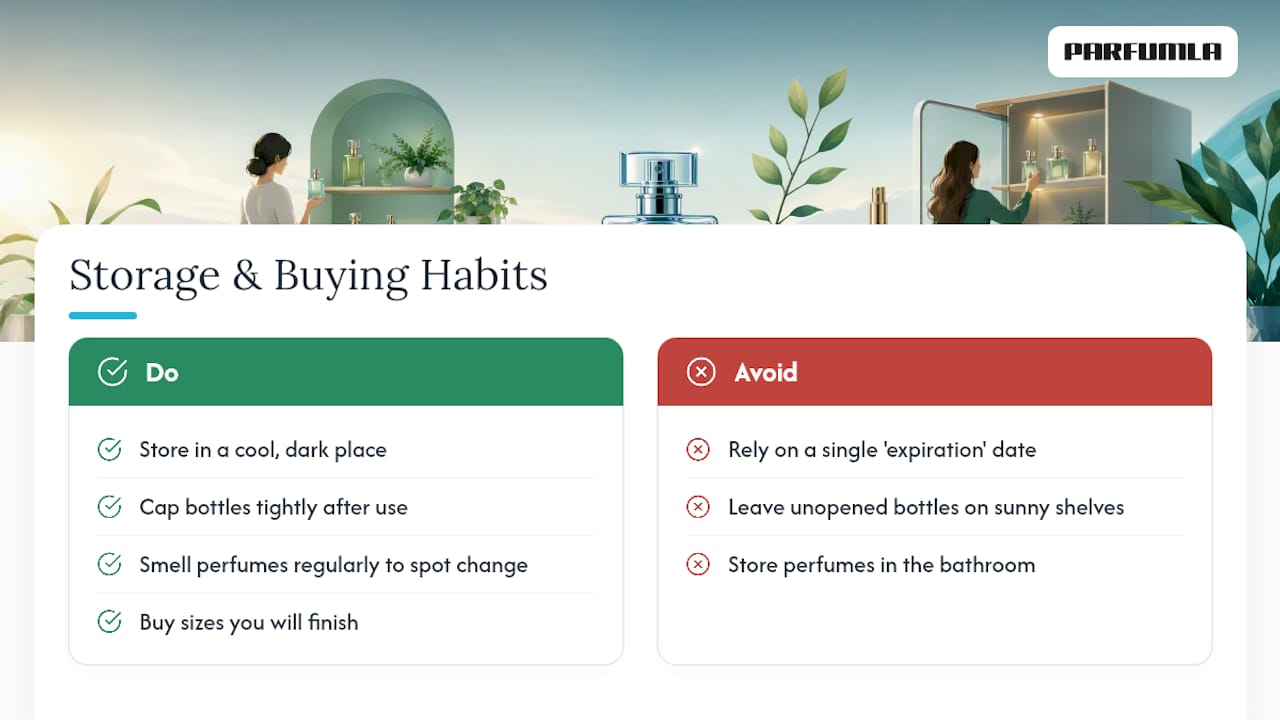
- Keep bottles in a cool, dark spot with stable temperature. A closet drawer or a dedicated box beats an open shelf every time.
- Store perfume in its original box when you can. The box blocks light and adds a buffer against temperature swings.
- Never store perfume in the bathroom or on a sunlit dresser or windowsill. Humidity, heat, and daily UV exposure are a fast track to a degraded bottle.
- Keep the cap on tight between uses to limit the oxygen getting in.
- If you're traveling, decant a small amount into a travel atomizer rather than exposing the whole bottle repeatedly. Just know that decanting itself introduces extra air into both containers, so don't do it more than necessary.
For rare or vintage bottles, some fragrance experts recommend refrigerator storage to keep temperature steady and slow oxidation further. Perfume's high alcohol content means it won't freeze under normal refrigerator conditions, so this is safe for bottles you're not opening often.
Pro Tip: If you own several bottles you rarely reach for, rotate through them instead of hoarding. A bottle that gets opened and used every few weeks often ages better than one sealed away and forgotten, since long stretches of near-zero airflow can create their own slow oxidation dynamics.
Is It Dangerous to Wear Expired Perfume?
Sometimes, yes. Oxidized fragrance compounds can become more irritating to sensitive skin than the original formula, even in a perfume that never bothered you before. If a bottle smells sour, metallic, or otherwise off, don't apply it directly to skin. A patch test on your inner wrist is a quick way to check before committing to a full spray, and it's worth doing anytime a familiar bottle starts smelling unfamiliar. For a deeper look at how oxidized ingredients affect sensitive skin generally, Lord's Love Butter's guide to identifying problematic ingredients is a useful companion read. When a bottle shows both visible degradation and an off odor, it's time to retire it from skin use entirely, even if you keep it around for fabric or room spray.
Parfumla's Take on Managing a Fragrance Collection
Buying smart is the best defense against ever facing this problem. Parfumla stocks over 14,000 fragrances, from mainstream names to niche and celebrity releases, which means you can find a bottle size that actually matches how often you'll wear it instead of guessing. A few habits from the retail side of this business:
- Sample before you commit to a full bottle, especially for a scent you've never worn. Our step-by-step guide to testing perfume properly walks through how to do it right.
- If you only reach for a scent occasionally, buy a smaller bottle size rather than a large one that will sit half full for years.
- The moment a new bottle arrives, move it straight to a cool, dark storage spot instead of leaving it on a bathroom shelf or windowsill.
- Read Parfumla's shopping checklist before buying online so you know what to look for in seller reviews and product listings.
If you're ready to buy Parfumla perfume online, our detailed product reviews and reliable US and EU shipping make it easy to find the best price for a Parfumla fragrance without gambling on a bottle that's already past its prime. If a scent in your collection has finally turned, replacing it with something like the NARCISO RODRIGUEZ Eau de Toilette is a straightforward way to buy original perfume at a fraction of retail cost.
The Real Lesson Here Isn't About Expiration Dates
Most advice on this topic treats perfume like milk, looking for a hard date when it "goes bad." That's the wrong model. Perfume degrades on a curve, not a cliff, and the curve bends differently for every bottle depending on its notes and how you treat it. The conventional wisdom that "perfume lasts forever if unopened" isn't wrong, but it skips the more useful point: an unopened bottle left on a sunny shelf for three years can degrade faster than an opened one kept in a cool drawer.
The habit worth building isn't checking a batch code once a year. It's storage discipline from day one, capping bottles tightly, keeping them out of the bathroom, and using your nose regularly enough to catch a shift before it becomes obvious. Citrus and green fragrances deserve the most attention since they turn first. Heavy orientals and woods will forgive you far longer. Buy sizes you'll actually finish, and you'll rarely have this problem at all.
— Parfumla
Sources
- PubMed article on chemical stability / oxidation (research source)
- Does Perfume Expire? Expert Guide to Shelf Life & Storage - Mist Deluxe
- How to tell if perfume has expired - Marie Claire
- Skin allergy guidance - American College of Allergy, Asthma & Immunology (general skin allergy risk info)
FAQ
Is Perfume Still Good After 20 Years?
It depends entirely on storage. An unopened bottle kept cool and dark for many years can still smell excellent, while an opened bottle exposed to heat or light for a long time has almost certainly oxidized and changed character.
Can I Still Use Expired Perfume?
You can often still use it on fabric or as a room spray if it smells off but isn't damaged, but avoid applying a sour, metallic, or irritating scent directly to skin.
Can I Use 3 Year Old Perfume?
In most cases, yes. Three years falls within the typical one to five year window for opened perfumes, especially if it's been stored away from heat and light. Check the smell and appearance first, since note family and storage conditions can push that timeline in either direction.