
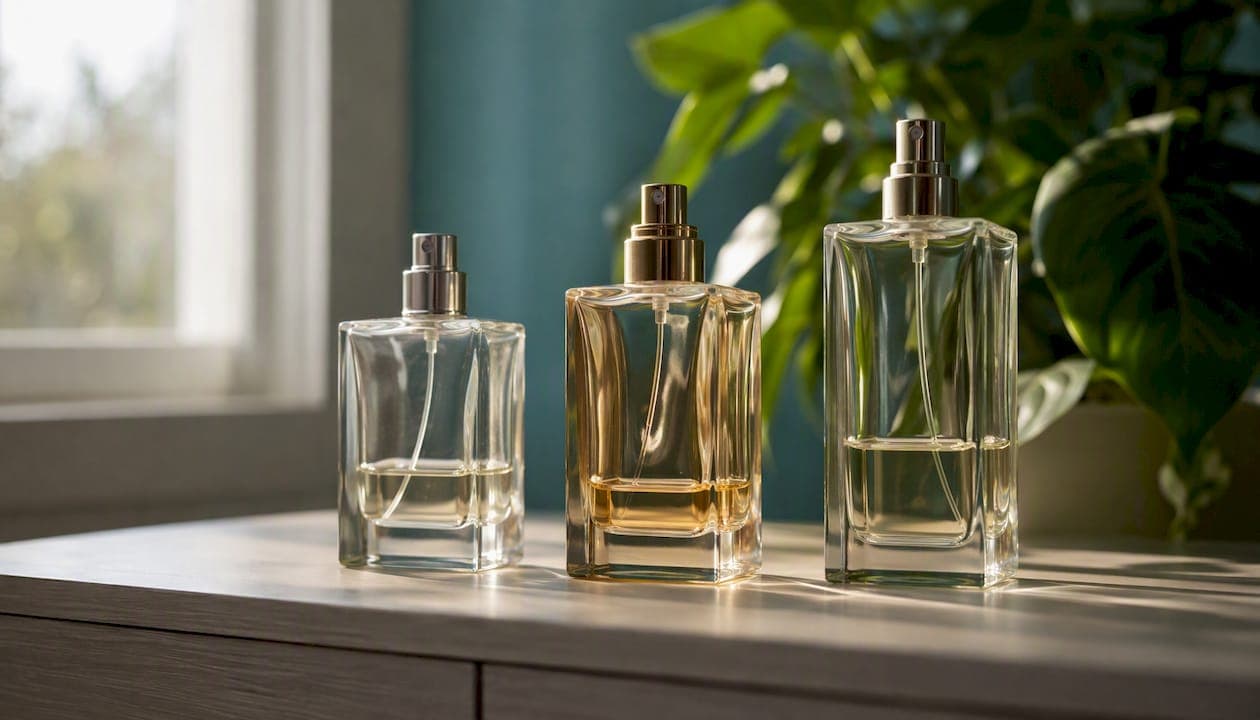
These commonly cited percentage ranges are approximate, not industry law, and that imprecision is exactly what makes concentration knowledge so valuable for collectors.
The single most important takeaway: concentration does not just change how long a fragrance lasts. It can change the formula itself, shifting which notes dominate, how the drydown behaves, and whether the bottle you're holding contains ingredients that no longer exist in modern reformulations.
Typical longevity by tier: Parfum/Extrait lasts roughly 6–12 hours on skin; EdP runs 4–8 hours; EdT holds 3–5 hours; EdC fades in 2–4 hours; Eau Fraîche and body sprays typically last under 2 hours.
Here is a quick inventory of the tiers:
- Parfum / Extrait de Parfum: ~20–40% aromatic oil; longest wear, densest character, highest price
- Eau de Parfum (EdP): ~15–20% oil; strong projection in early hours, excellent longevity
- Eau de Toilette (EdT): ~5–15% oil; the historic workhorse of men's and women's fragrance
- Eau de Cologne (EdC): ~2–5% oil; lighter, often citrus-forward, refreshing rather than persistent
- Eau Fraîche: ~1–3% oil; very light, water-based, short-lived
- Splashes / Aftershaves / Body Sprays: under 3% oil; designed for liberal application, not longevity
Key Takeaways
Understanding concentration types is the foundation of smart fragrance collecting: each tier represents a distinct formula behavior, not just a strength setting, and vintage concentrations often preserve ingredients that modern versions cannot replicate.
| Point | Details |
|---|---|
| Percentage ranges are approximate | Parfum runs ~20–40%, EdP ~15–20%, EdT ~5–15%, EdC ~2–5%, Eau Fraîche ~1–3%; ranges overlap between houses. |
| Concentration changes formula, not just strength | Different concentrations of the same fragrance may use different oil blends, note emphasis, and raw materials. |
| Vintage concentrations carry collector value | Pre-IFRA Extraits and discontinued EdTs often preserve restricted ingredients unavailable in modern reformulations. |
| Sample before buying a full bottle | Wearing a decant across several hours reveals longevity and drydown differences that a brief in-store test cannot. |
| Parfumla for comparison buying | Parfumla's extensive catalog lets collectors find and compare multiple concentrations of the same fragrance, often at significant discounts off retail. |
Table of Contents
- What do fragrance concentration types mean for collectors?
- How does concentration actually change a fragrance's character?
- Why concentration labels are imprecise across different houses
- How should collectors prioritize concentrations when building a collection?
- Practical sampling and decanting strategies for collectors
- How to store different concentrations to preserve quality and value
- Common collector misconceptions about concentration, debunked
- A collector's perspective on choosing concentrations
- Where collectors can find wide selections and affordable sampling options
- Sources
- FAQ
What do fragrance concentration types mean for collectors?
Think of each concentration tier as a coordinate on a map, not a rung on a ladder. Concentration equals the ratio of aromatic compounds to solvent, typically ethanol or a water-ethanol blend. More oil means slower evaporation, longer skin presence, and a different perceptual experience as the alcohol burns off faster and leaves the accord behind.
The reference table below gives collectors a working benchmark. Treat the percentage ranges as typical, not guaranteed, since houses assign oil loads based on marketing decisions as much as technical standards.
| Concentration | Typical Oil % | Longevity (hours) | Collector Notes |
|---|---|---|---|
| Parfum / Extrait | 20–40% | 6–12 | Highest price; often pre-IFRA formulas in vintage bottles; dense, intimate wear |
| Eau de Parfum | 15–20% | 4–8 | Strong projection early; modern niche launches favor this tier |
| Eau de Toilette | 5–15% | 3–5 | Historic standard; vintage EdTs may contain restricted ingredients |
| Eau de Cologne | 2–5% | 2–4 | Lighter; classic citrus-forward style; discontinued EdCs can be collectible |
| Eau Fraîche | 1–3% | 1–2 | Rarely collected; water-based; short-lived |
| Splash / Aftershave / Body Spray | Under 3% | Under 2 | Novelty value only; not typically collected for scent preservation |
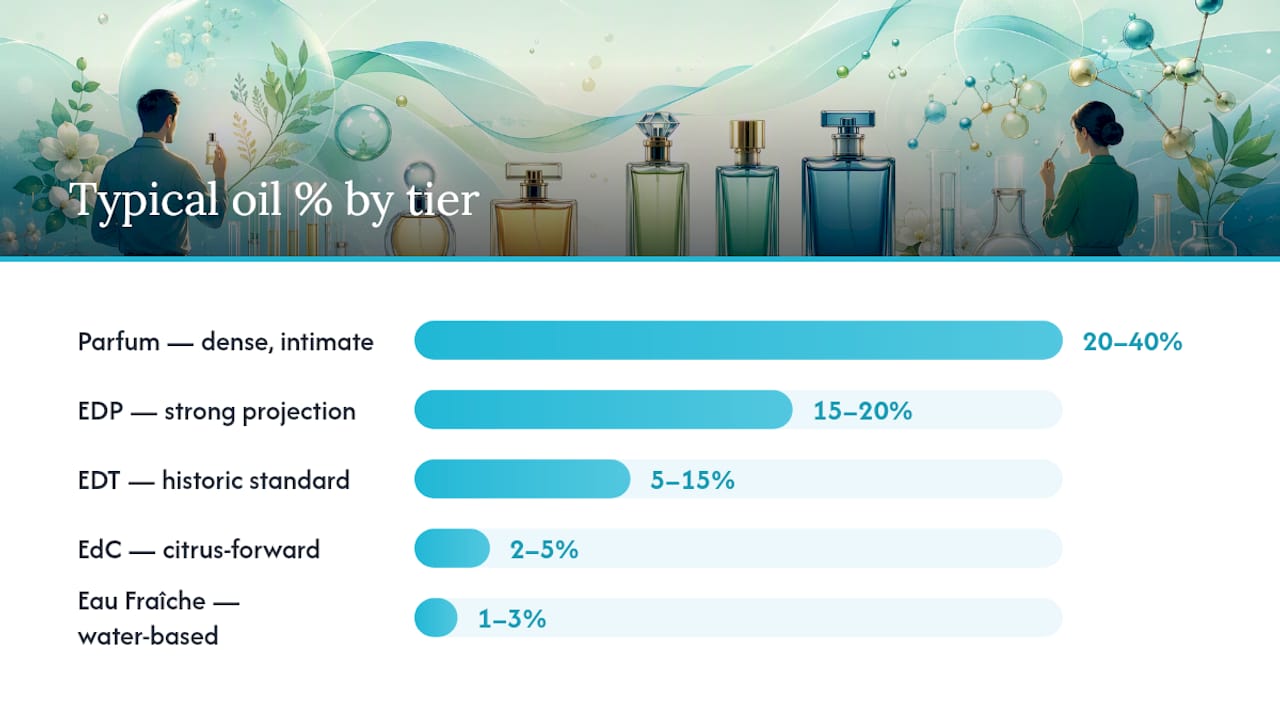
Ranges overlap between tiers. These tiers act more like a wear map than strict technical grades, which is why reading the label alone is never enough.
Pro Tip: When authenticating concentration claims on a bottle, cross-reference the label text with the batch code. Sites like Checkfresh.com and Parfumo decode batch codes to reveal production year and sometimes the specific formula run, which matters when you suspect a reformulation.
How does concentration actually change a fragrance's character?
The short answer: it changes everything except the name on the box. Higher oil ratios slow alcohol evaporation, which means the opening accord arrives differently and the drydown unfolds over a longer arc. But projection, which is how far a scent radiates from your skin, does not scale linearly with oil percentage.
Parfum/Extrait often feels closer and denser after the first hour, even while lasting longer. An EdP or even an EdT can project more aggressively in the first two hours because the higher alcohol content carries aromatic molecules further into the air before evaporating. Once that alcohol burns off, the Extrait settles into a rich skin scent while the EdT has largely faded.
Three terms collectors should keep distinct:
- Longevity: how long the scent remains detectable on skin. Higher concentration generally extends this.
- Projection: how far the scent radiates outward. Peaks early, often stronger in EdP than Extrait during the first hour.
- Sillage: the trail a fragrance leaves as you move. Closely tied to projection but measured over time and distance rather than at a fixed point.
For a deeper look at how projection works in practice, fragrance projection explained covers the mechanics in detail.
Concentration also shifts note emphasis. A higher oil load tends to mute sharp top notes, which are volatile by nature, and amplify the base. The same fragrance in EdT might open with a bright citrus burst that fades in 30 minutes; in Extrait, that citrus is quieter from the start but the woody or musky base lingers for hours. Collectors who own both concentrations of the same fragrance often describe them as related but distinct experiences.
Practical experience suggests Eau de Parfum often provides a balanced combination of projection and longevity desirable for everyday wear. Parfum or Extrait tend to stay closer to the skin and last through a full day or evening without needing reapplication.
Why concentration labels are imprecise across different houses
A label reading "Eau de Parfum" is a marketing designation, not a regulated technical specification. No international body enforces what oil percentage qualifies as EdP versus EdT.
The imprecision runs deeper than percentages. Vintage Extraits and discontinued concentrations often command higher collector value because they preserve pre-IFRA formulas and ingredients unavailable in modern reformulations. The International Fragrance Association (IFRA) has restricted or banned dozens of aromatic compounds since the 1970s, including certain musks, oakmoss derivatives, and natural isolates. A vintage EdT from the 1980s may contain oakmoss at concentrations that modern versions, even in Extrait form, cannot legally replicate.
This means two bottles with the same name and different concentration labels might not be dilutions of each other at all. They can be genuinely different formulas with different note emphasis, different raw materials, and different olfactory identities. Collectors who treat EdT and EdP as "same fragrance, different strength" often miss this entirely.
Key reasons concentration labels vary across houses:
- Marketing positioning: A house may launch at EdP to justify a higher price point regardless of actual oil load.
- IFRA reformulations: Restrictions force formula changes that sometimes coincide with concentration relaunches.
- Regional variations: Some fragrances ship at different concentrations in different markets.
- Era differences: Pre-2000 formulas often used different oil blends than current versions under the same name.
Pro Tip: For vintage bottles, check the label language itself. Older French bottles often read "Extrait" or "Parfum" without the "Eau de" prefix. The presence of a country of origin statement, a specific distributor name, or a pre-barcode label can help date the bottle to a specific production era.
How should collectors prioritize concentrations when building a collection?
A well-built collection is not a complete set of every concentration of every fragrance. It is a curated selection that serves different purposes: daily wear, special occasions, historical interest, and potential value appreciation.
For most collectors, the practical foundation looks like this:
- EdT for everyday rotation: Lighter, more affordable, and less precious to wear freely. Vintage EdTs are also historically significant.
- EdP for versatility: Strong enough for evenings, wearable enough for daytime. Modern niche launches heavily favor EdP and Extrait levels. Consequently, this tier dominates current releases.
- Extrait/Parfum for special occasions and preservation: These are the bottles you wear on significant evenings or keep sealed as collectibles. Higher oil percentages can preserve older accords that IFRA-compliant formulas cannot replicate, which is the core argument for seeking out vintage Extraits.
- Discontinued EdC or Eau Fraîche: Rarely the focus, but a discontinued EdC of a beloved fragrance can be genuinely scarce and historically interesting.
Value drivers for collectors center on three factors: rarity, formula integrity, and condition. A sealed vintage Extrait in original packaging with a documented batch code is worth considerably more than an opened bottle of the same fragrance. Limited-run concentrations, regional exclusives, and pre-reformulation bottles all carry premiums that standard retail releases do not.
For storage and rotation, keep your most valuable sealed bottles in a cool, dark location and rotate your opened bottles regularly. A fragrance that sits untouched for years can oxidize even in a sealed bottle if there is significant air space above the juice.
Pro Tip: When evaluating a fragrance for collection value, check whether the concentration you are considering was ever discontinued and relaunched. A gap in production often signals a formula change. Parfumo's vintage database and community threads are useful for tracking these histories.
For collectors watching their budget across concentrations, perfume shopping on a budget offers practical guidance on where to find value across tiers.
Practical sampling and decanting strategies for collectors
Sampling before committing to a full bottle is not optional for serious collectors. It is the only reliable way to understand how a concentration behaves on your skin, in your environment, and across a full day.
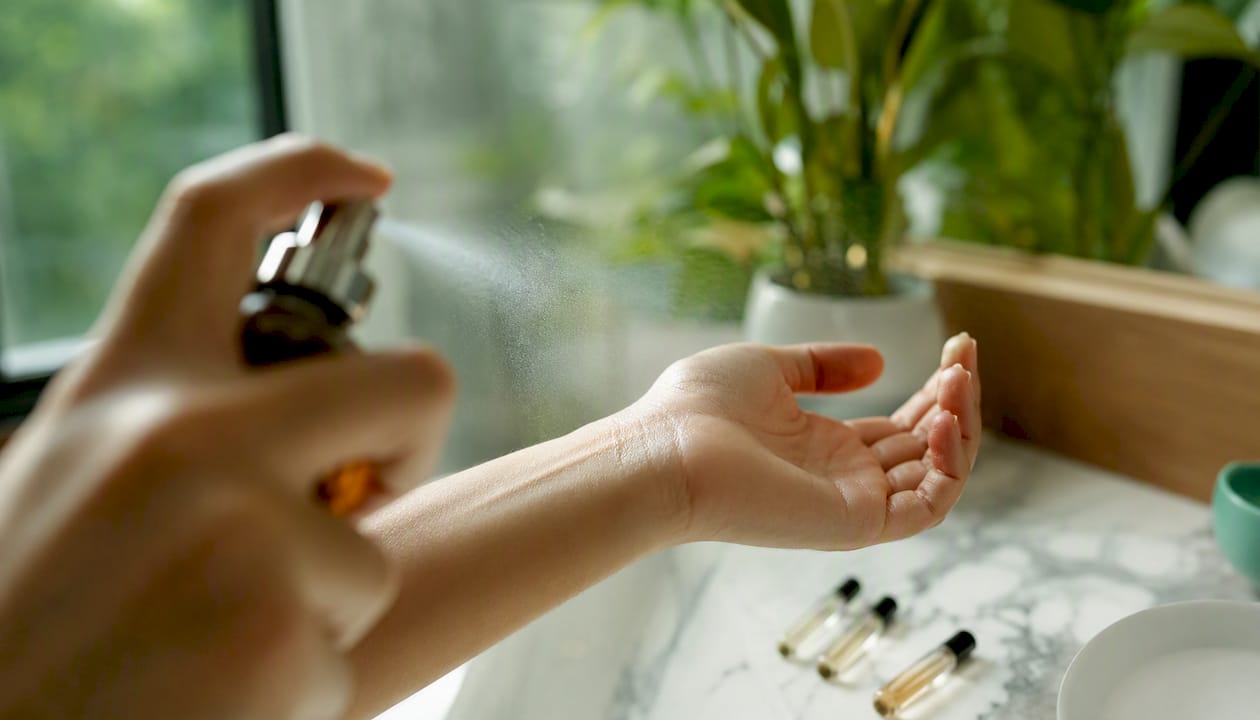
Wearing a decant in normal life for several hours reveals differences in note emphasis and longevity that a single in-store spray never shows. A 2ml decant of an EdT and a 2ml decant of the same fragrance's EdP, worn on different days, will tell you more than any review. Pay attention to the drydown specifically, since that is where formula differences between concentrations show up most clearly.
Sourcing strategies that work for collectors:
- Decants from reputable sellers: Look for sellers who disclose the batch code of the source bottle. This lets you verify the production era before you buy.
- Tester bottles: These are authentic retail stock, often without caps or in plain boxes, sold at reduced prices. For a detailed breakdown of what tester packaging means for authenticity, tester vs. retail perfume covers the key differences.
- Authorized retailers: For full bottles, buying from authorized retailers eliminates the risk of counterfeits and mislabeled concentrations.
Red flags for counterfeits and mislabeled concentrations:
- Pricing significantly below market for a sought-after vintage or limited release
- Batch codes that do not decode on standard tools like Checkfresh.com
- Label typography or font inconsistencies compared to authenticated examples
- Juice color that differs from documented production batches (oxidation or substitution)
- Caps or bottles that feel lighter or flimsier than authentic examples
The fragrance market has seen a meaningful increase in reformulations and reissues in recent years, particularly as IFRA restrictions have tightened. Many bottles sold as "vintage" are actually later production runs with updated formulas, which is why batch code verification matters so much.
Pro Tip: Test concentration differences across environments, not just skin types. An EdT that disappears in two hours in dry winter air may last four hours in summer humidity. Wear your decants in the conditions you actually plan to use the fragrance before deciding which concentration to collect.
For a step-by-step guide to testing methodology, how to test perfume properly walks through the full process.
How to store different concentrations to preserve quality and value
Storage is where many collectors lose value without realizing it. Aromatic compounds degrade through three main pathways: heat, light, and oxidation. Higher-concentration bottles are not necessarily more stable; in some ways they are more sensitive because the oil load is greater and any degradation affects more of the formula.
Core storage rules by concentration:
- Parfum/Extrait: Most sensitive to light and temperature fluctuation. Store in original box, upright, in a drawer or cabinet away from windows. Ideal temperature is 55–65°F (13–18°C).
- EdP and EdT: Similar rules apply. Avoid bathroom storage where temperature and humidity fluctuate daily.
- EdC and Eau Fraîche: Less precious but still degrade with heat and light. Refrigerator storage is acceptable for EdC if you use it regularly.
- Opened bottles: Use within 3–5 years for best scent integrity. The more air space above the juice, the faster oxidation proceeds.
For travel, decant into small atomizers rather than traveling with full bottles. A 10ml travel atomizer protects your collection from breakage and keeps the main bottle sealed, which slows oxidation.
Sealed bottles intended for value preservation should remain unopened. Once you break the seal, the collectible premium drops significantly. If you want to experience a vintage bottle, source a separate decant from a trusted seller rather than opening your sealed example.
Pro Tip: Label every opened bottle with the date you first used it and the batch code. A simple piece of archival tape on the base of the bottle takes 30 seconds and gives you provenance data that matters if you ever sell or trade the piece. Include the fill level at opening if you want a complete record.
Common collector misconceptions about concentration, debunked
Myth 1: Higher concentration always means louder projection. This is the most persistent misconception in fragrance collecting. Parfum/Extrait often projects less after the first hour than an EdP or EdT because the lower alcohol content means fewer molecules are carried into the surrounding air. Extrait is intimate; EdP is often the loudest tier in a room.
Myth 2: Percentage ranges are fixed industry standards. They are not. The terminology is imprecise and ranges overlap between houses. There is no regulatory body enforcing these labels in the United States or internationally.
Myth 3: The 3:1:1 rule and the 30/50/20 rule are industry formulas. Neither is a standardized industry specification. These are informal heuristics used in some collector and hobbyist communities for layering or mixing ratios, not formulas that perfumers or houses follow. Treat them as conversation starters, not technical guides.
Myth 4: An EdP is always a stronger version of the same EdT. Often, they are different formulas entirely. Different oil blends, different note emphasis, sometimes different raw materials. Buying both concentrations of a fragrance you love is not redundant; it is collecting two related but distinct olfactory experiences.
The stated percentage refers to the aromatic compound ratio in the formula, not the volume of the bottle.
Key correction: Concentration percentage describes the oil-to-solvent ratio in the formula, not a volume fraction of the bottle. The practical effect on wear time and character depends on which specific aromatic compounds are used, not just the percentage.
A collector's perspective on choosing concentrations
The most useful shift I made as a collector was stopping the search for the "best" concentration and starting to treat each tier as a separate purchase decision. An EdT and an EdP of the same fragrance are not substitutes. They are siblings with different personalities, and sometimes the EdT is the more interesting one, especially if it predates a reformulation that softened the EdP.
My own approach now: sample both concentrations of any fragrance I am seriously considering before buying either. The EdP vs. EdT comparison often surprises people who assume the EdP is simply "more." Sometimes it is less, in the best possible way. A lighter concentration can let a fragrance breathe in ways that a dense Extrait cannot.
The collectors I respect most do not chase the highest concentration by default. They chase the formula that best represents the fragrance's original intent, which sometimes means a vintage EdT over a modern Extrait.
Where collectors can find wide selections and affordable sampling options
For collectors who want to compare concentrations before committing to a full bottle, that catalog depth matters: you can often find both the EdT and EdP of the same fragrance in one place, at prices that make buying both for comparison genuinely practical.
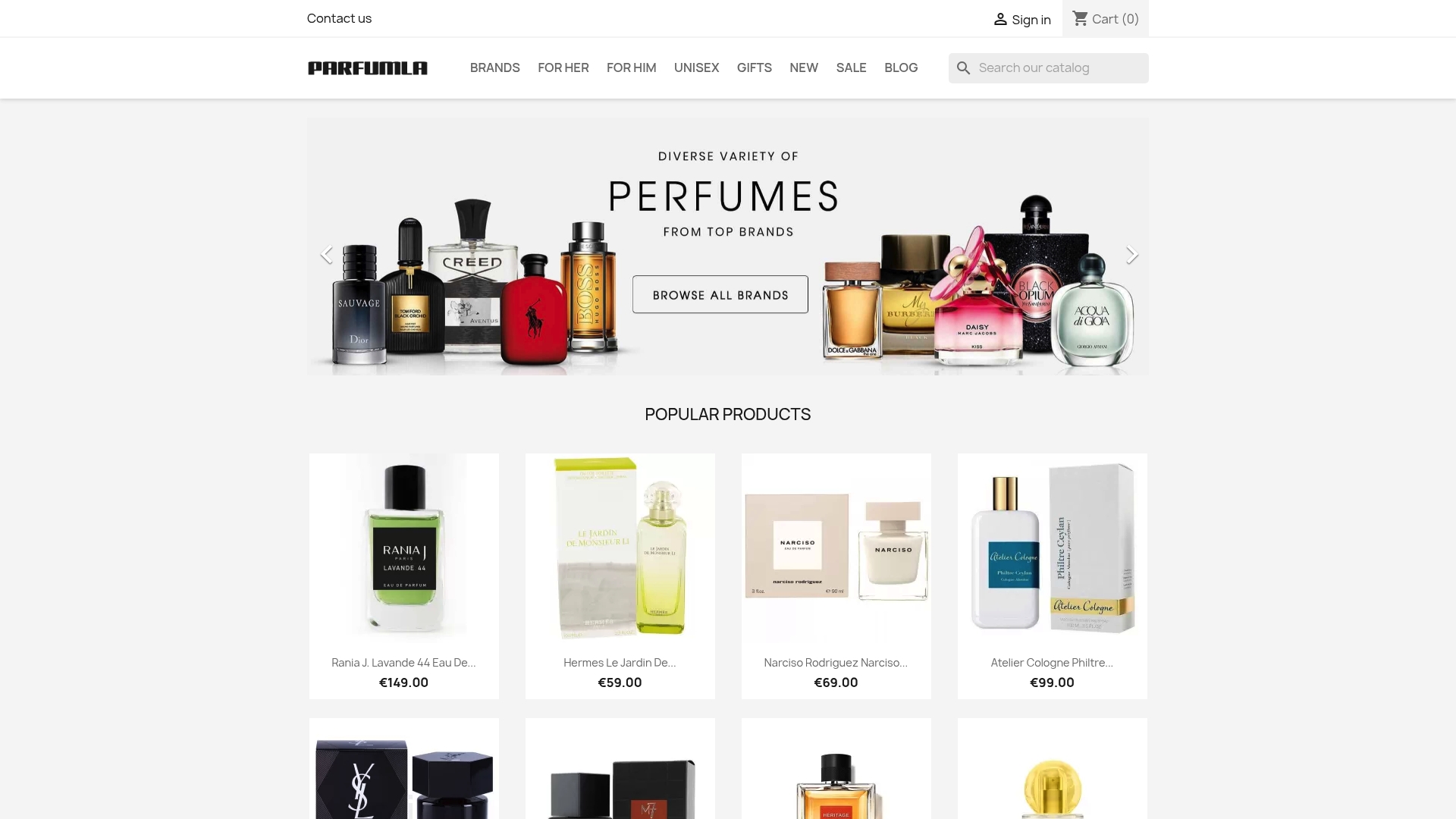
Whether you are looking for a modern niche EdP like Ex Nihilo Venenum Kiss Eau de Parfum, a classic like Christian Dior J'adore Le Jasmin EdP, or a lighter EdT to round out your rotation, Parfumla's catalog covers the full range of fragrance strength categories. All products ship reliably across the US and EU. Browse the full collection at Parfumla and use the detailed product reviews to verify concentration details before you buy.
Sources
For collectors who want to go deeper on any of the topics covered here:
- Perfume
- Fragrance Concentration Guide from EDT to Parfum – Decant Sample
- Fragrance Concentration Cheat Sheet: Parfum vs. EDP vs. EDT vs. Cologne -
- Perfume 101: Your Beginner's Guide to Perfume Concentrations
FAQ
What are the different concentrations of fragrance?
These ranges are approximate and vary by house.
What is the 3:1:1 rule for perfume?
The 3:1:1 rule is an informal hobbyist heuristic sometimes used for layering or mixing fragrance ratios, not a standardized industry formula. Perfumers and fragrance houses do not follow it as a technical standard.
What is the 30/50/20 rule for perfume?
Like the 3:1:1 rule, the 30/50/20 rule is an informal guideline used in some collector communities, not an official industry specification. It is best treated as a rough heuristic for personal blending rather than a reliable technical guide.
What does a stated concentration percentage actually mean?
The percentage describes the ratio of aromatic compounds to solvent in the formula, not the volume of oil in the bottle.
Why do vintage concentrations matter for collectors?
Vintage Extraits and discontinued concentrations often contain ingredients restricted or banned by IFRA since their production, making them chemically and olfactorily distinct from modern versions of the same fragrance. This formula difference, not just rarity, drives their collector value.