

There are four main fragrance families every beginner should know: Fresh (clean, bright), Floral (bloomy, soft), Woody (earthy, warm), and Amber (sweet, spicy). Knowing these four is enough to walk into any store, point at a bottle, and understand what you're smelling.
Start here:
- Pick one family that matches your gut instinct (love vanilla? Go Amber. Love clean air? Go Fresh.)
- Test it on your wrist, not a paper strip, and wait at least 30 minutes before deciding.
Pro Tip: Don't try more than two scents in one session. Your nose stops distinguishing after the third, and every fragrance starts smelling the same.
Table of Contents
- What is the Fragrance Wheel and why does it matter?
- How do you tell the fragrance families apart on a first sniff?
- What does the Floral family smell like?
- What does the Amber (Oriental) family smell like?
- What does the Woody family smell like?
- What does the Fresh family smell like?
- How should a beginner sample and choose a fragrance?
- Fragrance families as mood and personality tools
- How did fragrance families develop historically?
- Common mistakes beginners make with fragrance families
- Key Takeaways
- The wheel made choosing feel manageable
- Where beginners can try curated starter picks
- Further reading and references
- FAQ
What is the Fragrance Wheel and why does it matter?
The Fragrance Wheel is a circular diagram that maps all four families and shows how they connect. Michael Edwards formalized it in 1983 as a visual taxonomy, and it remains the most widely used classification tool in perfumery today. Think of it like a color wheel: families sitting next to each other share qualities, so if you love one, you'll likely enjoy its neighbor.
Here's how to use it as a beginner:
- Find your anchor family. Start with the one that sounds most appealing to you (Fresh, Floral, Woody, or Amber).
- Look at the neighbors. If you love Fresh, the Floral-Fresh and Woody-Fresh zones nearby are your safest next experiments.
- Check the subfamilies. Between the four main groups sit subfamilies like citrus, gourmand, chypre, fougère, and aquatic — these are blended styles that borrow from two adjacent families at once.
The wheel turns what feels like an overwhelming wall of bottles into a navigable map.
How do you tell the fragrance families apart on a first sniff?
You don't need a trained nose. You need a system. Follow these three steps every time you pick up a new scent:
- Smell the top note first (0–15 minutes). This is the opening burst. Citrus or green? Probably Fresh. Bright flowers? Likely Floral. Spice or resin? Amber territory. Dry wood? Woody.
- Wait for the heart note (15–45 minutes). The personality reveals itself here. Rose and jasmine confirm Floral. Vanilla and incense deepen into Amber. Cedar and vetiver settle into Woody.
- Check the base note (1+ hour on skin). The base is what lingers. Sandalwood and patchouli anchor Woody scents. Musk and benzoin anchor Amber. Fresh scents often fade faster here, which is a useful clue on its own.
Signature notes to memorize by family:
- Fresh: bergamot, lemon, sea salt, mint, galbanum
- Floral: rose, jasmine, peony, tuberose, lily of the valley
- Woody: sandalwood, cedar, vetiver, patchouli
- Amber: vanilla, benzoin, labdanum, cinnamon, tonka bean
One practical note on concentration: an Eau de Toilette (EDT) delivers a lighter version of a scent than an Eau de Parfum (EDP). The same fragrance DNA reads differently at each concentration, so a woody EDT might feel almost Fresh on first contact.
Pro Tip: If your nose gets overwhelmed, smell the crook of your elbow or a wool sleeve. It resets your olfactory palate faster than coffee beans.
What does the Floral family smell like?
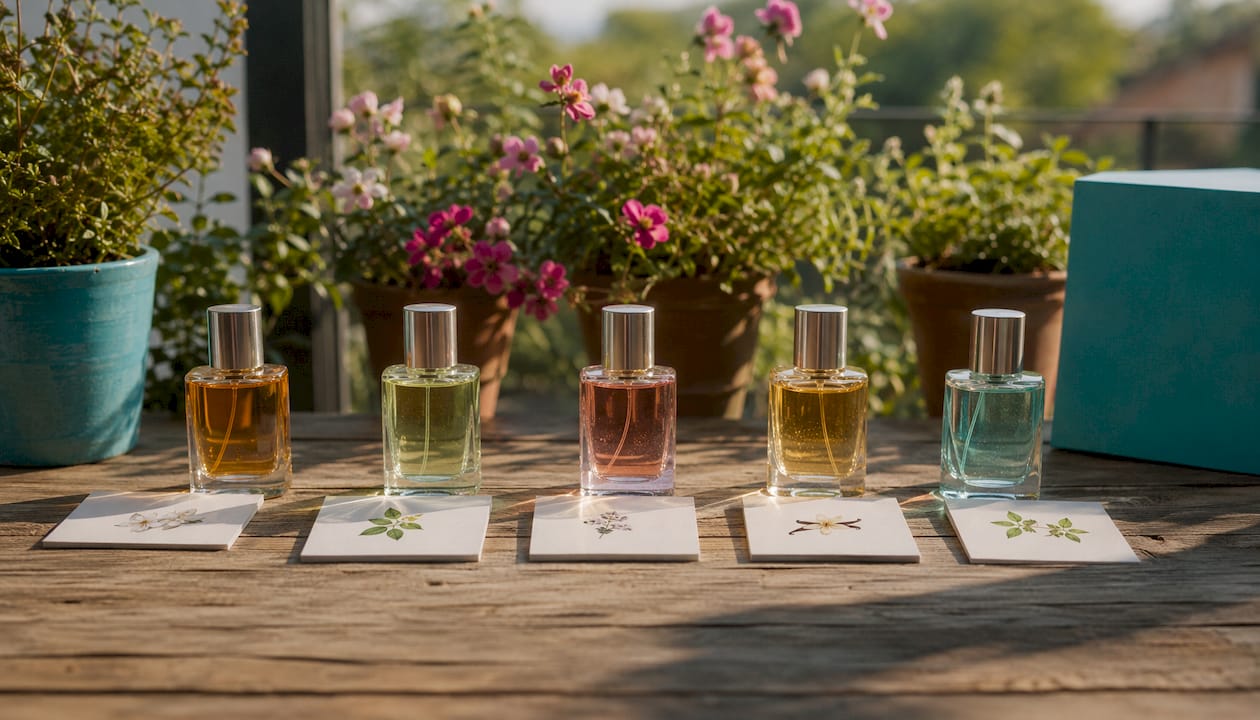
Floral is the most popular fragrance family, and it's easy to see why: it covers everything from a single dewy rose to a heady, complex bouquet. If you've ever smelled a perfume and thought "that smells like flowers," you were in Floral territory.
Key subfamilies:
- Single-flower (soliflore): One bloom dominates, like pure rose or jasmine. Clean, recognizable, easy to love.
- Soft/powdery floral: Iris and violet give these a talc-like, nostalgic quality.
- White floral: Tuberose, gardenia, and jasmine sambac. Heady, rich, sometimes almost narcotic.
- Fruity-floral: Peach, berry, or pear layered over flowers. Playful and youthful.
Signature triggers to sniff for: rose, jasmine, peony, tuberose. If one of those jumps out at you in the first 10 minutes, you're in a Floral.
Usage tip: Light florals (single-flower, fruity-floral) work beautifully in spring and daytime. White florals and powdery styles lean more evening and fall. Explore floral picks by subfamily if you want a shortcut to narrowing it down.
What does the Amber (Oriental) family smell like?
Amber scents are warm, rich, and deeply sensual. They're built on resins, spices, and sweet vanillic notes that create what perfumers call an "amber glow." Notes like vanilla, benzoin, incense, and spice define the family's signature warmth, and they tend to project strongly and last for hours.
Key subfamilies:
- Spicy: Pink pepper, cinnamon, clove, saffron. Sharp and sophisticated at the top, warm at the base.
- Gourmand: Think dessert in a bottle. Popularized by Mugler Angel in the early 1990s, gourmands lean on vanilla, caramel, chocolate, honey, and tonka bean. Comforting and crowd-pleasing.
- Resinous/amber: Labdanum, myrrh, benzoin. Deeper and more mysterious than gourmand, with an almost smoky sweetness.
Identifying gourmand vs. spicy: If your first thought is "this smells edible," it's gourmand. If it makes you think of a spice market or mulled wine, it's spicy amber.
Amber scents perform best in cool weather and evening settings. Their longevity is a genuine advantage, but they can feel heavy in summer heat.
What does the Woody family smell like?
Woody fragrances are grounding. Sandalwood, cedar, vetiver, and patchouli are the pillars, and they show up in the base of countless perfumes across all families. A scent that feels anchored and earthy, even if it opens with flowers or citrus, usually has a strong Woody backbone.
Key subfamilies:
- Dry woods: Cedar and birch. Crisp, almost pencil-shaving quality. Clean and unisex.
- Mossy/chypre: Oakmoss, patchouli, bergamot. Developed by François Coty in 1917, chypre is earthy, elegant, and complex.
- Leather: Smoky, sharp, slightly animalic. Drier than Woody proper and unmistakably bold.
- Vetiver/earthy: Vetiver reads as smoky, rooty, and slightly green. It's an acquired taste that becomes addictive.
Woody scents suit evening wear, professional settings, and cooler months. They also layer exceptionally well. If you want to understand fragrance layering basics, Woody is the best family to start experimenting with because its base notes anchor almost anything.
What does the Fresh family smell like?
Fresh fragrances are bright, clean, and energizing, built around citrus, green, or aquatic notes. They're the easiest family for beginners to identify because they smell like things you already know: lemon, cut grass, ocean air, clean laundry.
Key subfamilies:
- Citrus: Bergamot, lemon, mandarin, grapefruit. Zesty and uplifting, but they fade faster than other families.
- Aquatic: Sea salt, marine accords, sometimes mint. Cool and breezy, popular in summer.
- Green: Galbanum, violet leaf, green tea. Grassy and herbal, with a crisp outdoor quality.
Signature notes: bergamot, lemon, sea salt, galbanum, mint. If you smell one of these clearly in the first five minutes, you're in Fresh territory.
Fresh scents are the most workplace-friendly and heat-appropriate of the four families. They're a natural starting point for anyone who finds heavier scents overwhelming.
How should a beginner sample and choose a fragrance?
Sampling is a skill, and doing it wrong wastes time and money. Here's a practical routine:
- Limit yourself to two scents per session. Olfactory fatigue is real. After three fragrances, your nose stops distinguishing clearly.
- Spray on skin, not paper. Testing on skin reveals how top, heart, and base notes develop with your body chemistry. Paper strips only show the top note.
- Wait at least 30 minutes before judging. The opening burst is not the fragrance. The heart note is.
- Wear it for 4–6 hours. Base notes and longevity only reveal themselves over time. A scent you love at 10 AM might feel different by 3 PM.
- Note your emotional reaction. Does it feel like you? Comfort, confidence, and mood alignment matter more than whether a scent is "objectively good."
Dos and don'ts:
- Do test on pulse points (wrist, inner elbow).
- Don't rub your wrists together after spraying. It crushes the top notes.
- Don't sample in a perfume-heavy environment. Department store air can skew your perception.
Sample evaluation checklist:
- Top note impression (first 15 minutes): which family does it suggest?
- Heart note personality (15–45 minutes): does it confirm or surprise?
- Base note longevity (1+ hour): does it still feel like you?
On concentration: EDTs are lighter and cheaper; EDPs are richer and longer-lasting. For a beginner, starting with an EDT is lower risk. When you're ready to buy a full bottle at the best price, an online perfume shopping checklist can help you avoid overpaying.
Pro Tip: Order samples before committing to a full bottle. Parfumla carries over 14,000 fragrances, so you can find starter picks across every family without paying full retail.
Fragrance families as mood and personality tools
That framing is genuinely useful. Instead of hunting for one perfect scent, think about building a small collection across families and seasons. A fragrance wardrobe of three to five versatile bottles covers most occasions without overlap.
A simple wardrobe by family:
- Fresh for daytime and warm months
- Floral for everyday wear and spring
- Woody for evenings and professional settings
- Amber for cool weather and special occasions
One more thing: the Fragrance Wheel's neighbor principle applies to your wardrobe too. If you already love a Floral, the Floral-Fresh and Floral-Woody zones are your most likely next discoveries.
How did fragrance families develop historically?
The concept of grouping scents by family is older than most people realize. Early perfumery in ancient Egypt and Mesopotamia centered on resins and incense, which maps closely to what we now call the Amber family. Floral perfumery expanded significantly in 17th-century France, when Grasse became the center of European flower cultivation for fragrance.

The chypre structure, one of the most influential woody-mossy frameworks, was codified by François Coty in 1917 with his landmark Chypre fragrance. Fougère, another foundational accord blending lavender, coumarin, and oakmoss, traces back to Houbigant's Fougère Royale in 1882. These two accords shaped an enormous proportion of 20th-century perfumery.
The gourmand subfamily arrived much later. Mugler's Angel (1992) introduced edible, dessert-like notes to mainstream perfumery and created an entirely new commercial category. Michael Edwards' Fragrance Wheel, formalized in 1983, gave the industry a shared language to organize all of this history into a coherent map beginners can actually use today.
Common mistakes beginners make with fragrance families
Judging a scent only on the paper strip. Paper shows you the top note and nothing else. The heart and base, which define a fragrance's real character, only appear on skin over time.
Over-sampling in one session. Testing five or six fragrances back to back guarantees olfactory fatigue. Two is the practical limit.
Assuming a family label tells the whole story. Most fragrances blend elements from two or more families. A "Woody Floral" sits between those two zones on the wheel and won't smell like either family in its pure form. Read the note pyramid, not just the family label.
Buying based on someone else's skin. Fragrance reacts with individual body chemistry. A vanilla-heavy Amber that smells incredible on a friend might read as cloying on you. Always test on your own skin.
Dismissing a family too quickly. Many beginners write off Amber as "too heavy" after one department store test in summer heat. Try it in cooler conditions first. Context changes everything.
Key Takeaways
Understanding fragrance families gives beginners a reliable map for choosing scents with confidence, using the Fragrance Wheel to navigate Fresh, Floral, Woody, and Amber.
| Point | Details |
|---|---|
| Four core families | Fresh, Floral, Woody, and Amber cover the full spectrum of scent styles. |
| Test on skin, not paper | Skin reveals how heart and base notes develop with your body chemistry. |
| Limit to two per session | Testing more than two scents causes olfactory fatigue and blurs your judgment. |
| Use the wheel for discovery | Neighboring families on the Fragrance Wheel are your safest next experiments. |
| Parfumla for starter picks | Parfumla's catalog of over 14,000 fragrances lets you explore every family at up to 60% off retail. |
The wheel made choosing feel manageable
When I first started paying attention to fragrance, the sheer number of options felt paralyzing. What changed things was treating the Fragrance Wheel as a filter, not a rulebook. I started in Fresh because it felt safe and familiar, then moved one step clockwise toward Floral-Fresh. That single shift introduced me to a whole register of scents I'd been ignoring.
The other thing worth saying: liking scents across multiple families is completely normal. You're not supposed to pick one and stay there. A Fresh cologne for Monday morning and an Amber for Saturday night aren't contradictions. They're just different moods. The families give you a vocabulary for what you already feel.
Where beginners can try curated starter picks
Knowing the four families is step one. Getting your hands on actual samples is step two, and that's where cost becomes a real factor. Full bottles at retail prices are a significant commitment for a scent you've never worn past the first hour.
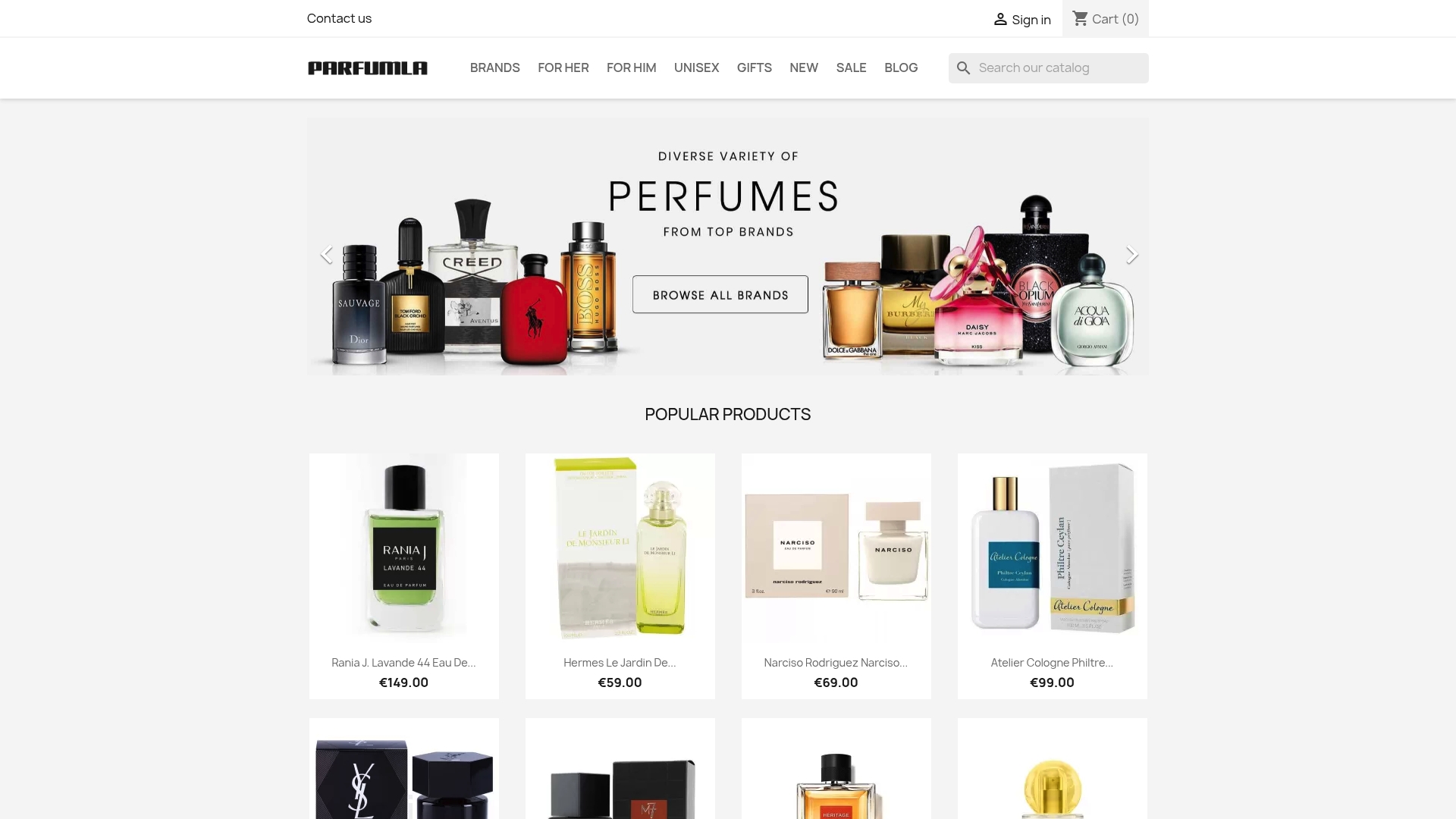
Parfumla carries over 14,000 fragrances, including popular, niche, and celebrity scents, at up to 60% off retail prices. Whether you want to try a classic floral EDP or a modern unisex pick, the catalog covers every family with detailed reviews so you know what you're buying before it arrives. Shipping runs across the US and EU.
Browse Parfumla's full fragrance catalog and find your first starter pick at a price that makes experimenting feel low-risk.
Further reading and references
- Perfume Society: Fragrance Families — Authoritative overview of family definitions and the Fragrance Wheel from a dedicated fragrance authority.
- Wikipedia: Michael Edwards (fragrance expert)) — Background on the creator of the Fragrance Wheel and its 1983 origins.
- wikiHow: Types of Scents — Practical, beginner-friendly breakdown of scent families with expert input from working perfumers.
- Harper's Bazaar: 9 Types of Perfume Explained — Expert quotes from Master Perfumer Ruth Mastenbroek and perfume creator Beckielou Brown on family characteristics.
- Parfumla: How to Sample Perfumes Affordably — Practical guide to low-cost sampling strategies for beginners.
- Parfumla: What Is a Fragrance Family? — Deep-dive companion piece covering family definitions and in-store tips.
FAQ
What are the 4 main scent families?
The four main fragrance families are Fresh, Floral, Woody, and Amber (formerly called Oriental). Every perfume you encounter fits primarily into one of these groups, often with elements borrowed from a neighboring family.
What is the most popular fragrance family?
Floral is the most widely loved fragrance family, serving as an umbrella for styles ranging from light single-flower scents to rich white-floral bouquets.
How many fragrance families are there in total?
The four main families are the standard framework, but some systems expand to seven or more by treating subfamilies like citrus, chypre, leather, and aromatic as standalone groups. The four-family model is the most practical starting point for beginners.
What is the difference between EDT and EDP?
An Eau de Toilette (EDT) has a lower fragrance concentration than an Eau de Parfum (EDP), making it lighter, less expensive, and shorter-lasting. EDTs are a lower-risk entry point when you're still exploring which family suits you.
Where can I buy original fragrance at the best price?
Parfumla offers over 14,000 authentic fragrances at up to 60% off retail, with detailed reviews and reliable shipping across the US and EU, making it a practical place to buy original perfume online without overpaying.