

Concentration labels are the most reliable predictor of how long a fragrance lasts and how far it projects. Descriptive terms like "floral" or "leather" are mostly marketing shorthand, not literal ingredient lists, as raw materials and scent descriptions can differ greatly from the actual composition; see what gives beeswax its natural scent for an example of ingredient versus scent language. When you're deciding what to buy, check the concentration percentage first, then use family and note descriptions to guess the character of the scent, not its staying power.
TL;DR:
- Fragrance longevity and projection are mainly determined by concentration, with parfum lasting the longest and eau de cologne the shortest.
- Notes unfold in stages, with top notes lasting minutes, heart notes lasting hours, and base notes lingering over six hours or more.
- Synthetics are common and often more stable, affordable, and sustainable than natural ingredients, and most fragrances blend both.
- Testing on hydrated skin and waiting for full dry-down is essential for accurately assessing a scent's performance before purchasing.
- Storing fragrances in a cool, dark place and avoiding heat or light exposure extends their shelf life significantly.
Table of Contents
- What Do Fragrance Concentration Terms Actually Mean?
- How Does a Perfume Change From Top to Base Notes?
- What's the Difference Between an Accord and a Note?
- What Do the Different Fragrance Family Terms Mean?
- What Do Longevity, Projection, and Sillage Actually Measure?
- How Do You Test and Layer Fragrances Correctly?
- Are Fragrance Ingredients Natural or Synthetic?
- Which Fragrance Ingredients Commonly Cause Reactions?
- Where Did Common Fragrance Terms Come From?
- Perfume Pyramid or Fragrance Wheel: What's the Difference?
- How Should You Store Fragrances to Keep Them Fresh?
- Parfumla's Take on Shopping With Confidence
- Sources
- FAQ
What Do Fragrance Concentration Terms Actually Mean?
Concentration tells you how much aromatic oil is dissolved in the alcohol and water base, and that ratio drives everything else: how long the scent lasts, how far it travels, and often the price. Once you understand this scale, you can predict performance before you even open the box.
- Parfum/Extrait de Parfum: a high concentration. Expect long-lasting wear and noticeable skin contact.
- Eau de Parfum (EDP): a concentration commonly described as moderately high. Provides several hours of wear on most skin types.
- Eau de Toilette (EDT): a lighter concentration. Typically lasts a few hours before it fades to skin scent.
- Eau de Cologne: a low concentration, refreshing but short-lasting.
- Eau fraîche: the lightest fragrance option, sometimes with little or no alcohol, closer to a splash than a scent statement.
These percent ranges are widely documented across fragrance glossaries, though individual brands sometimes blend their own formulas within these bands. Concentration terms carry technical meaning, but shoppers regularly use "cologne" and "parfum" as generic catch-alls regardless of what's actually in the bottle, and checking the labeled concentration remains the fastest way to predict longevity and projection. Gendered naming is a marketing convention, not a chemistry rule. An Eau de Cologne marketed to men and an Eau fraîche marketed to women can sit at nearly identical concentration levels. If you want a side-by-side breakdown of how EDT and EDP behave on skin, Parfumla's guide on choosing between Eau de Parfum and Eau de Toilette walks through real comparisons.
How Does a Perfume Change From Top to Base Notes?
Every fragrance unfolds in stages, and that unfolding is what perfumers call the pyramid. Ignore this structure and a scent that smells amazing in the store might disappoint you three hours later.
- Top notes hit first and disappear fastest, usually within 5 to 30 minutes. These are your citrus peels, light herbs, and sharp aldehydes. They're the sales pitch, not the substance.
- Heart notes (also called middle notes) take over once the top fades, lasting anywhere from 30 minutes to a few hours. Florals, spices, and fruit typically live here. This is the true "body" of the fragrance, the part most reviews are actually describing.
- Base notes emerge last and stick around longest, sometimes 6 hours or more after application. Woods, resins, musks, and amber materials dominate this stage.
The dry-down is the final phase, when the base notes settle into their quietest, most skin-close version. A perfume's dry-down often smells nothing like its opening spray, which is why testing a fragrance for only a few minutes in a store tells you almost nothing about how it will actually wear.
What's the Difference Between an Accord and a Note?
A note is a single scent impression. An accord is a blend of multiple notes designed to create one unified effect, often mimicking something that would be difficult or impossible to extract naturally. "Leather" on a note list rarely means actual leather was distilled into the bottle. It usually means a blend of smoky, tarry, and animalic materials was engineered to evoke leather.
Perfumers and marketers frequently list accords as if they were single notes, and note lists on packaging and product pages skew toward descriptive, evocative language rather than literal ingredient breakdowns. Understanding that distinction changes how you read a label. When you see "gourmand" or "amber" on a note list, you're being told what the fragrance is supposed to remind you of, not handed a chemistry printout.
What Do the Different Fragrance Family Terms Mean?
Fragrance families group scents by shared character, and once you know a handful of these terms, you can shop by feeling instead of guessing from a bottle photo. Industry glossaries and magazine explainers consistently organize consumer fragrances into these standard categories:
- Floral: built around flower notes like rose, jasmine, or peony. The most common family and the easiest to picture.
- Woody: sandalwood, cedar, vetiver. Warm, grounding, often used as a base for other families.
- Gourmand: edible-smelling sweetness. Vanilla, caramel, chocolate, and praline show up constantly here.
- Amber (also called ambery, formerly "oriental"): warm, resinous, slightly sweet, built on labdanum, benzoin, and vanilla. The term "oriental" is fading from use across the industry in favor of "amber."
- Fougère: French for "fern," a structural family built on lavender, coumarin, and oakmoss. Most classic men's fragrances live here.
- Chypre: bergamot up top, mossy and woody underneath. Sophisticated, a little austere, less common in mainstream releases today.
- Aquatic: ozonic, watery, calone-driven. Think "clean" beach air rather than an actual scent memory of the ocean.
- Powdery: soft, cosmetic, iris or violet-driven. Reminiscent of makeup rather than skin.
- Animalic: musky, skin-like, sometimes deliberately a little dirty. Small amounts create warmth; large amounts polarize people fast.
Labels shift over time for marketing reasons more than chemistry reasons. Once you know a family, you can layer within it (two woody scents rarely clash) or across it deliberately, pairing a gourmand base with a lighter floral top for contrast.
What Do Longevity, Projection, and Sillage Actually Measure?
Longevity is straightforward: how many hours you can still smell the fragrance on your own skin. Projection measures how far the scent radiates outward from your body, whether someone three feet away can smell you. Sillage, from the French word for "wake," describes the trail a fragrance leaves behind as you move through a room, like the wake behind a boat.
Reviewers throw these terms around constantly, and they matter because a fragrance can have excellent longevity with almost no projection. It stays on your skin all day but nobody else notices unless they lean in. Fixatives are the ingredients that anchor a scent and slow its evaporation. Materials like ambroxan, various resins, and heavy woods act as fixatives, which is why base-heavy fragrances tend to outlast citrus-forward ones regardless of concentration.
Pro Tip: Concentration is a useful shortcut, but skin chemistry, weather, and even hydration levels change how a fragrance performs on you specifically. Two people wearing the same Eau de Parfum can report completely different longevity. For a deeper breakdown of how far a scent should travel, Parfumla's guide to fragrance projection covers the mechanics in more detail.
How Do You Test and Layer Fragrances Correctly?
Reading a note list is only half the job. Testing it on your own skin is what actually tells you whether it works.
- Spray a blotter first, then spray a small amount on your wrist or inner elbow. Cold sniffing off paper only tells you about the top notes.
- Wait through the full dry-down, at least an hour, ideally longer, before deciding. The scent you smell at minute two is not the scent you'll be wearing at hour four.
- Test on hydrated skin. Dry skin doesn't hold fragrance oils well, which shortens longevity and mutes projection.
- Order samples before committing to a full bottle, especially for anything described with unfamiliar accords.
- Layer with restraint. Start with one grounding base (an unscented lotion or a matching oil) and add a single fragrance on top rather than stacking multiple scented products.
- Avoid combining two heavy, complex fragrances. Fewer, well-defined notes layer more successfully than dense, competing ones, and clarity beats complexity almost every time.
For a full walkthrough of building a testing routine before you buy, Parfumla's step-by-step guide to testing perfume covers sample strategy in more depth, and the beginner's guide to fragrance layering expands on pairing techniques.
Are Fragrance Ingredients Natural or Synthetic?
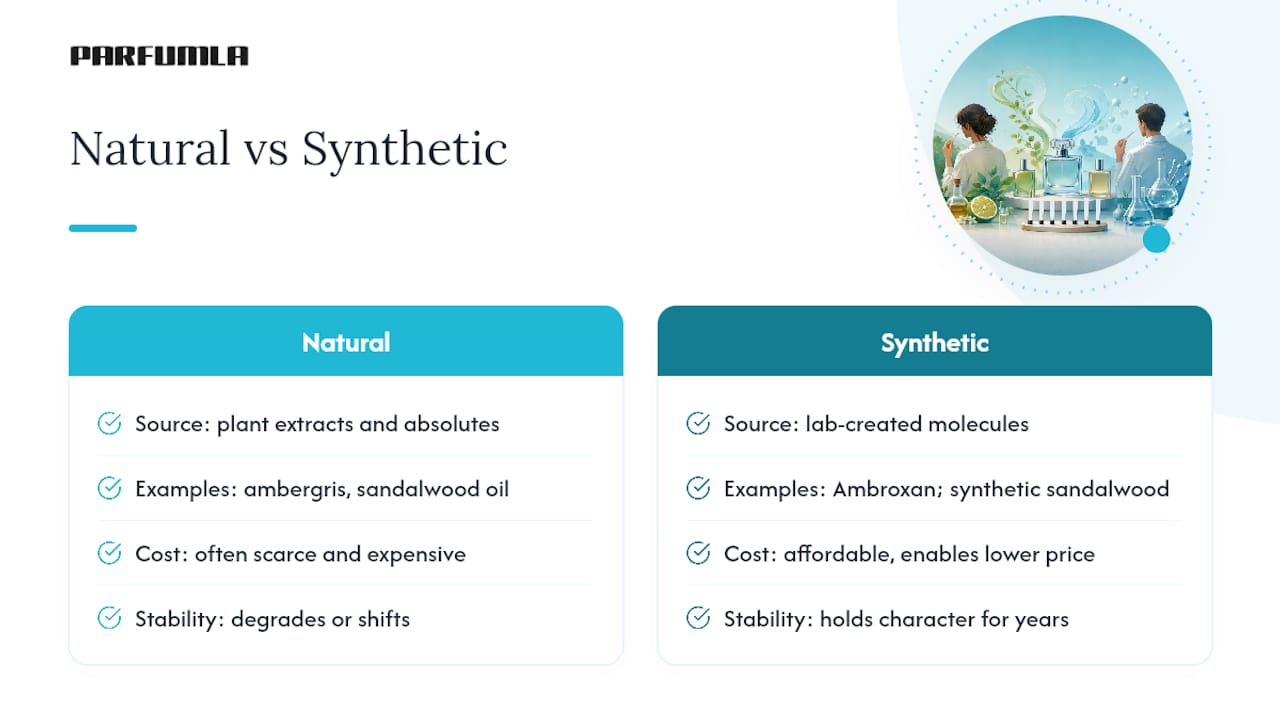
Most modern fragrances blend both. Natural ingredients come from plant extracts, essential oils, and absolutes (concentrated extracts pulled from flowers or resins using solvents). Synthetic ingredients are lab-created molecules, some of which mimic natural scents and some of which create effects that don't exist in nature at all.
Synthetics aren't a downgrade. They're often what makes a fragrance affordable, consistent, and sustainable. Ambroxan, a synthetic material, largely replaced ambergris, a natural substance historically sourced from whale digestive systems, and did so for both cost and ethical reasons. Sandalwood oil has become so scarce and expensive that most fragrances now rely on synthetic sandalwood substitutes instead.
There's also a durability argument for synthetics: many natural extracts degrade or shift in scent over time, while stable synthetic molecules hold their character for years in the bottle. A fragrance built entirely from naturals would also be wildly expensive and might not smell noticeably better, just different, and sometimes less consistent from batch to batch.
When a note list says "amber" or "musk," you're almost never smelling a literal natural extract. You're smelling an engineered accord designed to evoke that idea, built from a mix of both natural and synthetic materials chosen for stability, cost, and how well they perform on skin over the full wear time.
Which Fragrance Ingredients Commonly Cause Reactions?
Fragrance is one of the most common triggers for contact dermatitis and skin sensitivity, and a handful of ingredients show up repeatedly in reaction reports. Essential oils high in limonene (from citrus) and linalool (from lavender and many florals) are common culprits, particularly once they oxidize after exposure to air.
Other frequent offenders include oakmoss, certain synthetic musks, and cinnamal, a compound found in cinnamon-scented and some floral compositions. Sensitivity doesn't always show up as an obvious rash. Sometimes it's mild redness, itching, or a headache that shows up hours after application and gets blamed on something else entirely.
If you have sensitive skin, a few habits help: patch-test a new fragrance on your inner arm before spraying it broadly, avoid applying directly to broken or irritated skin, and consider testing lighter concentrations (Eau de Toilette or Eau fraîche) before committing to a Parfum-strength version of the same scent. Fragrance-free doesn't mean ingredient-free either. Some "unscented" products still contain masking fragrances, so read labels carefully if you're managing a known sensitivity.
Where Did Common Fragrance Terms Come From?
Most fragrance vocabulary in English borrows directly from French, which has dominated the perfume industry's language for centuries. "Eau de toilette" translates roughly to "grooming water," a holdover from when scented water was part of a morning washing ritual rather than a finishing spritz. "Sillage" simply means "wake," borrowed straight from nautical language to describe the trail a scent leaves in a room.
"Chypre" is named after Cyprus, the island associated with the mossy, citrus-forward style that defined the category. "Fougère" means "fern" in French, even though ferns themselves have almost no scent. The name refers to the green, herbal impression the family creates rather than a literal ingredient.
"Accord," borrowed from music terminology, reflects how perfumers think about blending, layering distinct notes the way a composer layers notes into a chord. Even "note" itself comes from that same musical metaphor, treating a fragrance's structure like a piece of music with a beginning, middle, and lingering final passage. The vocabulary is old, but it still does real descriptive work today.
Perfume Pyramid or Fragrance Wheel: What's the Difference?
The perfume pyramid describes how a single fragrance changes over time on your skin: top, heart, and base notes unfolding in sequence. It's a timeline, useful for predicting how one specific bottle will evolve over the hours you wear it.
The fragrance wheel is a different tool entirely. It's a classification map that groups entire fragrances into families and sub-families (floral, woody, amber, fresh, and so on) based on their overall character, regardless of how they evolve over time. Where the pyramid tells you what happens to one perfume across a day, the wheel tells you how that perfume relates to every other perfume in its category.
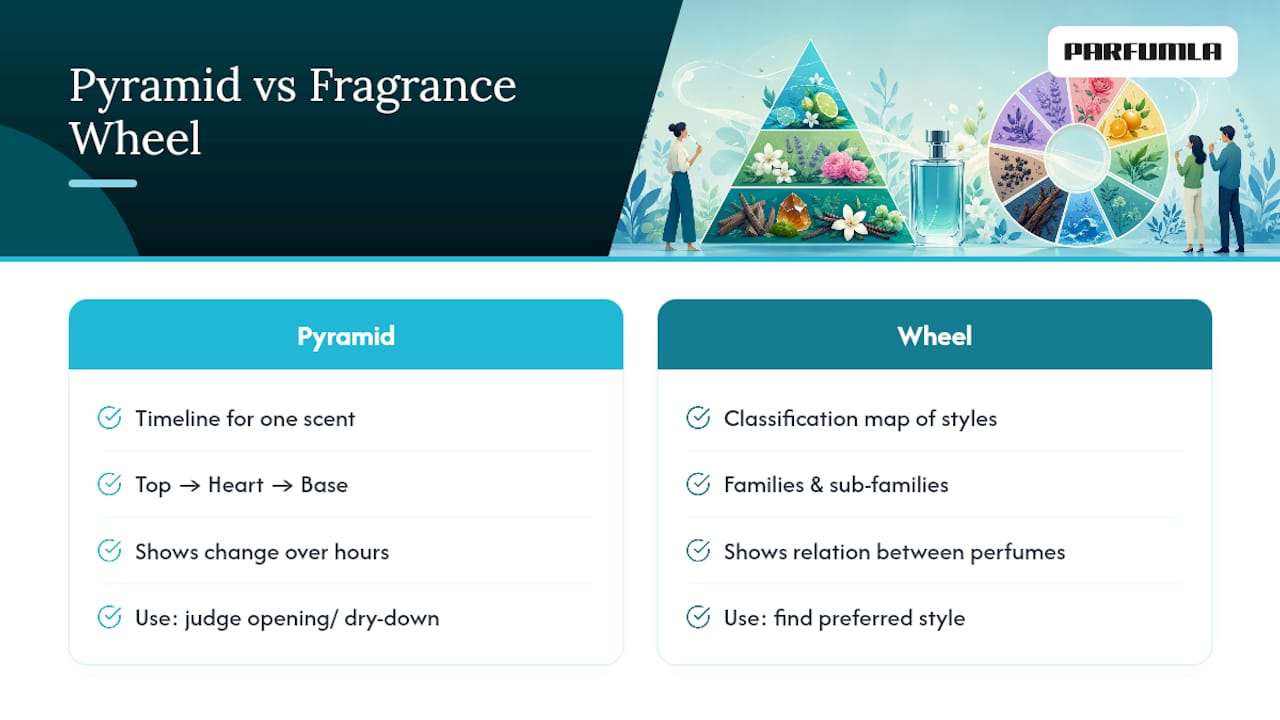
Shoppers benefit from both. Use the wheel to figure out which general style you gravitate toward, then use the pyramid to judge whether a specific bottle's opening, heart, and dry-down actually deliver on that style. A fragrance can sit in the "floral" wedge of the wheel and still have a base note structure that behaves nothing like another floral three shelves over.
How Should You Store Fragrances to Keep Them Fresh?
Heat, light, and air are the three things that degrade fragrance fastest. Bathroom cabinets, despite being the most common storage spot in most homes, are actually one of the worst locations because of humidity and temperature swings from showers.
Store bottles in a cool, dark place, ideally in their original box, away from direct sunlight and away from radiators or windowsills. Keep caps tightly closed between uses to limit oxygen exposure, since oxidation is what causes citrus and floral top notes to turn slightly sour or flat over time. A fragrance kept properly sealed and stored away from light can remain stable for several years, while one left open on a sunny windowsill can noticeably shift within months.
If you're traveling, avoid leaving fragrance bottles in a hot car, even briefly. Heat can accelerate degradation faster than almost any other storage mistake, and it can also affect the pressure inside spray bottles. For long-term collectors, treat fragrance the way you'd treat wine: consistent temperature matters more than any single storage gadget you could buy.
Parfumla's Take on Shopping With Confidence
Fragrance vocabulary shouldn't be a barrier between you and a bottle you'll actually enjoy wearing. Parfumla carries more than 14,000 fragrances, spanning popular department-store names, niche houses, and celebrity releases, with savings of up to 60% off retail pricing across the catalog. Every listing includes detailed customer reviews so you can cross-check how a scent performs in the real world against what the note list promises.
Our educational blog posts on concentration, layering, and projection exist specifically so you can buy Parfumla perfume online with the same confidence you'd have standing at a counter with a knowledgeable salesperson. If you're weighing formats, an EDT and an EDP of the same fragrance can feel like two different scents, and product pages like the Christian Dior Sauvage Eau de Parfum show exactly how concentration and note structure are presented side by side.
Before committing to a full bottle, sample when you can and read the reviews on the product page. That habit alone will save you more disappointment than memorizing every term in this glossary.
— Parfumla
Sources
For readers who want to go deeper on specific terms, these sources cover the ground reliably. The Fragnatique glossary compiles 50+ standard industry definitions from accord to ambroxan. ELLE's guide to perfume terminology breaks down how marketing language diverges from literal ingredients. British Vogue's layering guide offers expert technique for combining scents without clashing, and The Independent's scent layering explainer adds practical testing tips.
- Perfume glossary — Whatscent magazine
- How to layer fragrances — British Vogue
- A definitive guide to perfume terminology — ELLE
- Fragnatique glossary
FAQ
Is Parfum Better Than Eau de Parfum?
Neither is objectively better. Parfum carries a higher concentration (15% to 40%+) and typically lasts longer, while Eau de Parfum (15% to 20%) offers strong longevity at a lower price point. Choose based on how long you need the scent to last and how much you want to spend.
What Are the Five Stages of a Fragrance?
Most explanations describe three core stages: top notes, heart (middle) notes, and base notes, with the dry-down as the final settling phase of the base. Some glossaries split this further into opening, development, and drydown, but three to four stages is the standard framework.
What Are Some Common Fragrance Industry Terms?
Beyond concentration levels, shoppers frequently encounter accord, sillage, projection, dry-down, and fixative. Each describes a different aspect of how a fragrance is built or how it performs once applied.
What Are the Four Main Types of Fragrance Concentration?
The four most commonly referenced types are Parfum/Extrait, Eau de Parfum, Eau de Toilette, and Eau de Cologne, with Eau fraîche sometimes added as a fifth, lighter category. Each represents a different percentage of aromatic oil, which directly affects longevity and intensity.
Where Can I Find the Best Price for a Specific Fragrance Brand?
Parfumla lists over 14,000 fragrances with savings of up to 60% off retail, making it a practical place to compare pricing across popular and niche brands before buying original perfume online.