
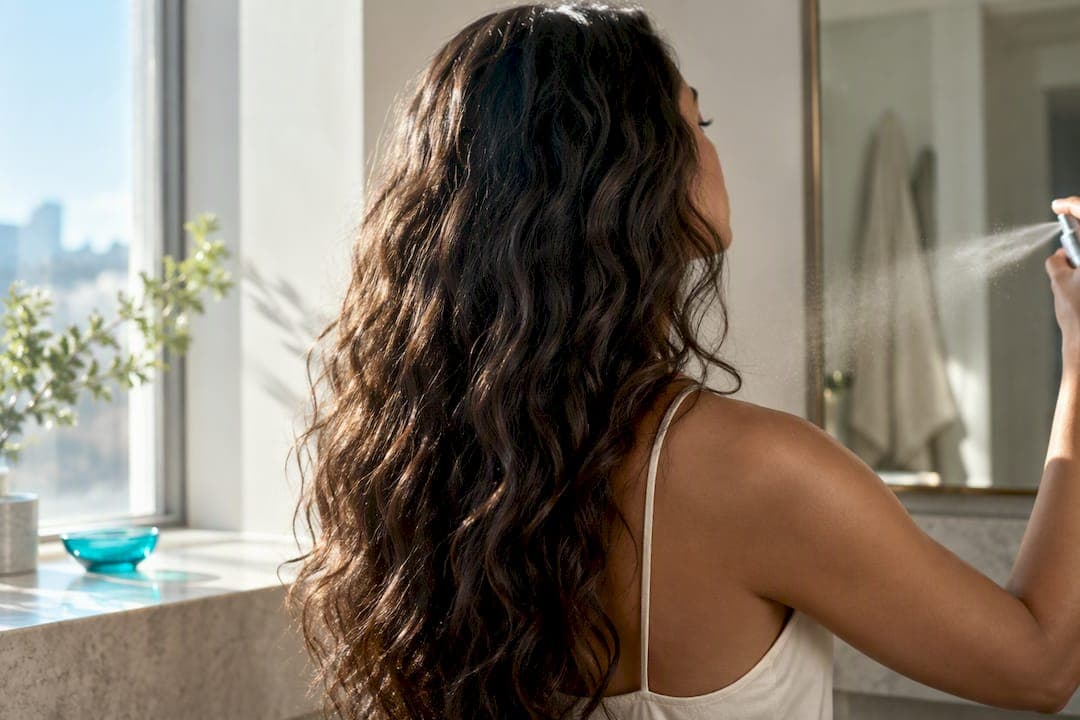
Hair perfume works best in your hair, and eau de parfum works best on your skin. Hair perfume is a lighter, often alcohol-reduced formula built to condition strands and scent them gently, while eau de parfum carries a much higher concentration meant for pulse points and lasting projection. Skip spraying straight EDP directly onto dry or chemically treated hair. The high ethanol content that helps it evaporate beautifully on skin can pull moisture out of your strands over time.
TL;DR:
- Hair perfume contains a fragrance concentration of about 3% to 5%, significantly lower than the 15% to 25% of eau de parfum, affecting longevity and scent projection.
- Hair-specific formulas often use water or fatty alcohols instead of ethanol to prevent moisture loss and incorporate conditioning ingredients like glycerin and plant oils.
- Application should be done on dry, styled hair, targeting mid-lengths and ends with the halo technique, and reapplication midday is recommended due to lower concentration.
- Repeated use of high-alcohol EDP on hair can strip moisture and weaken strands, especially in color-treated or dry hair types, unlike gentle hair mists.
- Sampling in travel sizes or decants before committing helps determine how scents perform on hair versus skin and prevent waste.
Table of Contents
- Hair Perfume vs Eau De Parfum: What Each One Actually Is
- Why the Ingredients Matter More Than the Marketing
- How to Apply Each One Without Wrecking Your Hair
- Weighing the Real Benefits Against the Real Trade-Offs
- Why Hair Holds Scent Longer Than You'd Expect
- Parfumla's Take on Testing Before You Commit
- Try Before You Commit: Sampling Hair Mists and EDP the Smart Way
- Sources
- FAQ
Hair Perfume vs Eau De Parfum: What Each One Actually Is
Hair perfume and eau de parfum are not the same product wearing different labels. They're built on different concentration scales and, increasingly, different chemistry altogether.
Eau de parfum sits in the 15% to 25% fragrance oil range, which is why a couple of sprays on your wrists can last most of a workday. Hair mists and hair perfumes typically dilute fragrance oil down to about 3% to 5%, a fraction of that strength. That gap in concentration is the whole reason these products behave so differently once they hit your hair or your skin.
You'll find hair fragrance sold under a few names, and it helps to know them so you're not fooled by marketing language on a shelf:
- Hair mist or brume cheveux — the most common format, usually in a fine-mist spray bottle
- Hair perfume oil — a few drops worked through ends, often marketed for very dry or curly hair
- Perfumed hair serum — combines a leave-in treatment with a light scent
- Travel or sample sizes of EDP — useful for testing a scent on skin before committing to a full bottle
If you're still fuzzy on how EDP concentration compares to eau de toilette or parfum, this breakdown of eau de parfum covers the fragrance pyramid in more detail.
Why the Ingredients Matter More Than the Marketing
The real difference between these two products isn't the bottle shape. It's what's dissolving the fragrance oil.
Most eau de parfum relies on denatured ethyl alcohol as its carrier. That's what makes it dry down fast and project well, but ethanol is also what pulls moisture out of hair fibers when it's applied directly and repeatedly. Hair-specific formulas swap that structure out. Many use water as the primary vehicle, cut ethanol dramatically, or skip it entirely in favor of fatty alcohols that don't have the same drying effect.

Statistic snapshot: Where a standard EDP might run 15% to 25% fragrance concentration, most hair mists land closer to 3% to 5%. That fourfold difference is why hair perfume smells like a "veil" instead of a cloud.
Beyond dropping the alcohol content, brands are leaning into skincare-style additives:
- Glycerin and hyaluronic acid for lightweight hydration
- Featherweight plant oils like argan or jojoba, used in trace amounts so hair doesn't look greasy
- UV filters in some premium formulas, aimed at protecting color-treated strands from fading
Formulators lean on these skincare-minded ingredients specifically so a product can condition and scent hair at the same time, something a traditional EDP was never designed to do. That lighter oil load also changes the scent itself: heavy base notes like patchouli or amber tend to get dialed back, while citrus, florals, and airy musks move to the front.
How to Apply Each One Without Wrecking Your Hair
Application technique matters almost as much as the formula you choose. Get this wrong and even a gentle hair mist can leave buildup; get it right and even a stronger EDP won't do damage.
- Hold the bottle 8 to 12 inches from your head. Spraying too close concentrates alcohol and oil in one spot instead of letting it disperse.
- Target mid-lengths and ends, not your scalp. Scalp skin is more reactive, and roots get oily fast enough without added product.
- Apply to dry, styled hair. Wet hair is more porous and more likely to absorb ethanol deeply into the shaft; save the mist for after you've finished styling.
- Try the halo technique for EDP. Spray a light cloud into the air above your head and walk into it, rather than spraying strands directly. This is the move hairstylists and perfumers favor when someone wants a hint of their skin fragrance to carry into their hair without direct contact.
- Reapply hair mist midday if needed. Because concentration is low, a second pass around lunchtime won't oversaturate hair the way reapplying EDP would.
Pro Tip: Carry a travel-size hair mist in your bag instead of your full EDP bottle for touch-ups. It's lighter, cheaper to replace, and far less likely to leave you smelling like you just walked through a department store.
Weighing the Real Benefits Against the Real Trade-Offs
Neither format wins across the board, and pretending otherwise does you no favors when you're standing in front of a shelf trying to decide.
Hair perfume's case is straightforward. It's gentler on strands, often carries conditioning extras you'd otherwise pay for separately, projects a soft aura instead of an overwhelming cloud, and costs less to reapply throughout the day since bottles are typically smaller and cheaper. The New York Magazine's Strategist column notes that hair perfumes create a lighter, airier scent experience precisely because they're not trying to compete with skin-applied fragrance.
But there are real trade-offs:
- Lighter concentration means shorter staying power if used alone, without an EDP layered on skin
- Oil-based formulas can leave a faint sheen on fine or already-oily hair
- Fragrance and preservative ingredients can still trigger sensitivity in some people, even in alcohol-reduced formulas
- Chemically treated, bleached, or scalp-sensitive hair is more reactive to any added product, hair-safe or not
A light spritz of regular perfume once in a while probably won't wreck your hair. It's the daily, repeated habit of spraying strands with a high-alcohol EDP that gradually strips moisture and leaves hair more fragile over time.
If your hair is color-treated, keratin-straightened, or already dry from heat styling, that's exactly the profile dermatologists point to when recommending hair-specific formulas over repeated EDP application.
Why Hair Holds Scent Longer Than You'd Expect
Ask a perfumer why your hair smells like your perfume hours after your wrists have gone quiet, and the answer comes down to structure, not magic.

Hair is more porous than skin, and that porosity lets fragrance molecules cling to individual strands rather than evaporating off a smooth surface the way they do from skin. Movement helps too. Every time hair swings, it releases a fresh trace of scent, which is part of why people notice hair fragrance as a presence that "follows" someone across a room.
Skin and hair project differently because they're chasing different goals:
- EDP on skin relies on heavier base notes (musk, amber, woods) that anchor and slowly evolve over hours
- Hair perfume skips most of that base-note weight, favoring top and mid notes that read as fresh rather than deep
- Layering the two lets you get both: apply EDP to pulse points for the anchor, then mist hair with a lighter, complementary scent for movement
A simple layering ratio that works for most people: one full spray of EDP per pulse point, then two to three light passes of hair mist using the halo technique. If you're new to combining scents this way, this guide to fragrance layering walks through how to avoid clashing notes.
Parfumla's Take on Testing Before You Commit
Most people pick one format and never test the other, which is a waste given how differently they perform. Our advice, having watched customers navigate this exact decision across thousands of fragrance profiles: sample before you commit to a full bottle, especially if you're layering.
Start small. A decant or travel size lets you check whether a scent's opening notes work on your skin before it fades into something else entirely over the next hour, and it lets you test how the same fragrance family behaves in a hair mist format versus full-strength EDP. If your hair runs dry, color-treated, or textured, prioritize labels that list water or fatty alcohols ahead of ethanol; the ingredient order on the bottle tells you more than the marketing copy does. And if your hair type changes how product sits on strands, guides on styling by texture are worth a look before you decide how much product your routine can handle.
Try a decant before you commit to a full bottle, particularly if you're building a layered signature scent from scratch.
— Parfumla
Try Before You Commit: Sampling Hair Mists and EDP the Smart Way
Guessing which fragrance will work on both your skin and your hair is expensive when you're buying full bottles blind. Sampling options from retailers can make that guesswork unnecessary.
Browse Decants & Samples if you want to try a scent in both a hair mist and a full-strength format before buying either at full size. Looking to buy Parfumla perfume online for the skin side of your routine? The women's fragrance collection and men's fragrance collection both carry EDPs suited to pulse-point wear, while the unisex category is worth checking if you're hunting for a scent versatile enough to layer with a lighter hair mist. Shopping for someone else? The gifts section bundles fragrance sets that make experimenting with layering simple.
If you're searching for the best price for original perfume from names like Dior, Narciso Rodriguez, or Carolina Herrera, start with a sample size, confirm the scent works for you on both skin and hair, then size up when you know it's right.
Sources
- Everything You Need to Know About Hair Perfume — Vogue
- Your hair deserves its own perfume — Allure
- Perfume on hair: Is it bad? — Healthline
- Hair perfumes explained — NYMag The Strategist
- How to get great-smelling hair — The Telegraph
FAQ
Does Hair Perfume Work the Same as Regular Perfume?
Not quite. Hair perfume is diluted much further, typically 3% to 5% fragrance oil versus 15% to 25% in a standard eau de parfum, so it smells lighter and fades faster on its own. It's designed to complement, not replace, a stronger fragrance worn on skin.
Are Hair Perfumes Good for Your Hair?
Many are, since they're often formulated with lower alcohol content and conditioning additives like glycerin or hyaluronic acid. That said, ingredient sensitivity varies by person, so anyone with a very reactive scalp should patch-test first.
What Are the Downsides of Using Hair Perfume?
The biggest trade-off is staying power. Because concentration is low, hair mists fade faster than EDP and may need reapplication midday. Oil-based versions can also leave a slight sheen on fine or already-oily hair.
Do You Put Hair Perfume on Wet or Dry Hair?
Dry, styled hair is the better target. Wet hair is more porous and absorbs alcohol and oils more deeply into the shaft, so apply after your styling routine is finished, not before.