
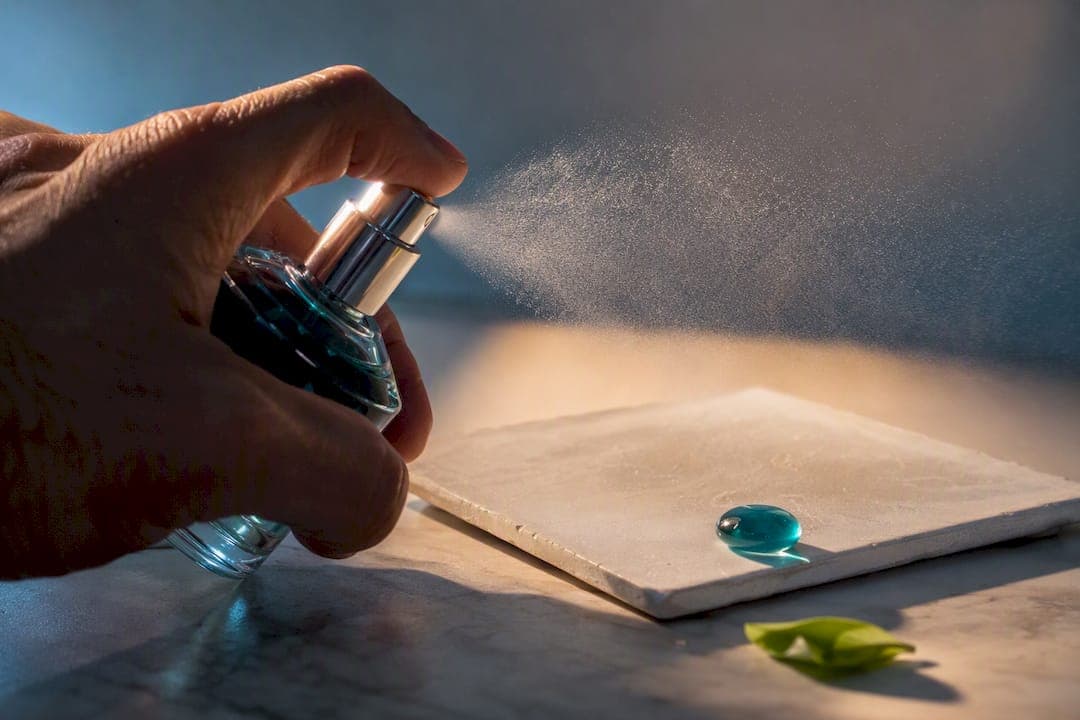
Start with 2 to 4 sprays for most Eau de Parfum, 1 to 2 for Extrait, and 3 to 5 for Eau de Toilette or cologne, then test at conversational distance and adjust. One milliliter typically equals 8 to 12 sprays, so a little math tells you fast whether your habit matches your bottle. When in doubt, spray less than you think you need. You can always add one more.
TL;DR:
- Most fragrances require fewer sprays than common assumptions, with Extrait needing 1 to 2, EDP 2 to 4, and EDT 3 to 5 for optimal daily use.
- Spray counts vary based on concentration, body temperature, climate, and environment, so adjust accordingly, especially in warmer or outdoor settings.
- A bottle of 100 milliliters can typically deliver between 800 and 1,200 sprays, but actual output depends on nozzle design and spray volume.
- Testing your spray's actual output by weighing and counting provides a more accurate estimate tailored to your atomizer, saving money.
- Applying fragrance to pulse points like the chest and wrists, avoiding rubbing, helps create a refined scent trail and prolongs fragrance life.
Table of Contents
- How Many Sprays Do You Actually Need?
- Where Should You Spray for the Best Scent Trail?
- How Many Sprays Are in a Bottle?
- How to Test Your Bottle's Real Spray Output
- When Should You Cut Back on Sprays?
- Your Quick Spray Reference
- Parfumla's Take on Matching Bottle Size to Spray Habits
- Buy the Right Concentration for Your Spray Habit
- Sources
- FAQ
How Many Sprays Do You Actually Need?
The right number depends almost entirely on concentration, because concentration determines how much fragrance oil hits your skin per spray. Extrait de Parfum runs 20% to 40% fragrance oil, so 1 to 2 sprays deliver more scent molecules than most people expect. Eau de Parfum sits around 15% to 20% concentration, which is why 2 to 4 sprays is a practical starting point for daily wear. Eau de Toilette and cologne dilute the oil further, often to 5% or 10%, so they need more sprays to reach the same presence.
Here's how that breaks down by category and setting:
- Extrait/Parfum: 1 to 2 sprays, skin only, works for evenings and close contact.
- Eau de Parfum (EDP): 2 to 4 sprays for daytime, 3 to 4 for evening or date settings.
- Eau de Toilette (EDT): 3 to 5 sprays, since lighter concentrations fade faster and need reinforcement.
- Cologne/Body Mist: 4 to 6 sprays, given how quickly these formats lose intensity.
Outdoor settings and colder climates let you go toward the higher end of each range, since wind and cold air disperse molecules faster. Warm rooms, small offices, and humid weather amplify scent, so drop toward the lower end.
Pro Tip: Gourmand and oud-heavy fragrances punch far above their spray count. A single spray of a dense amber or oud composition can rival 4 sprays of a citrus EDT, so treat those bottles with extra restraint until you know their true strength on your skin.
Most guidance converges on the same idea: 2 to 4 sprays works as a baseline, but skin chemistry, humidity, and personal projection preference all shift that number in either direction.
Where Should You Spray for the Best Scent Trail?
Placement changes how a fragrance behaves almost as much as the spray count does. Pulse points, the spots where blood vessels sit close to skin, run warmer and help fragrance diffuse. Chest, neck, and inner wrists count as primary points; behind the ears and inner elbows work as secondary options for a subtler trail.
A reliable pattern for most people:
- One spray to the chest, one to the base of the neck, one to an inner wrist.
- Skip rubbing wrists together. Friction breaks down the fragrance's top notes and shortens its life.
- Clothing holds scent longer than skin but can distort the fragrance's true character, especially with wool or synthetic fibers.
- Skin releases scent in phases as your body heat interacts with the oils, giving you the intended arc from top to base notes.
For readers who want to understand how spray placement affects how far a scent carries, fragrance projection depends on body heat, skin type, and airflow as much as on spray count itself.
How Many Sprays Are in a Bottle?
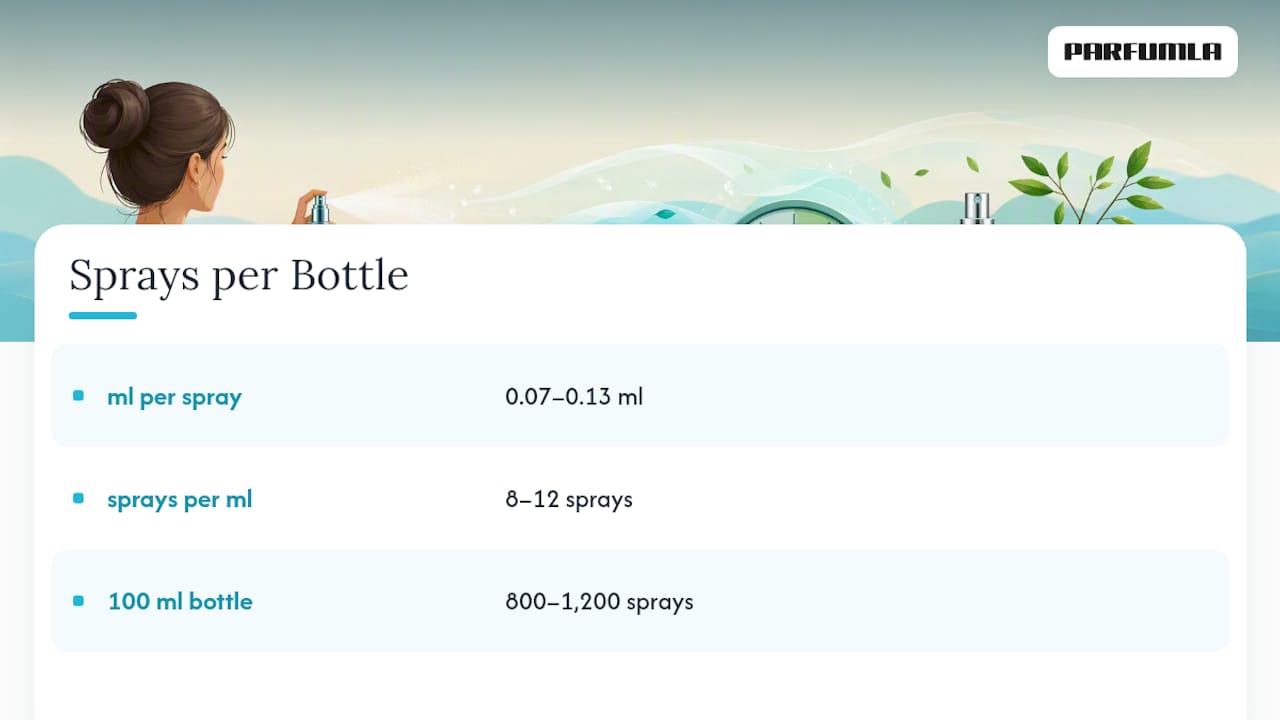
Industry estimates put ml-per-spray roughly between 0.07 ml and 0.13 ml, depending on nozzle design and pump pressure. The math is simple: total sprays equal bottle volume in milliliters divided by ml per spray.
A 100 ml bottle commonly yields between 800 and 1,200 sprays in practice, which lines up with the 1 ml equals roughly 8 to 12 sprays rule of thumb. That range exists because atomizer nozzles vary. Some pumps push larger droplets per actuation, others produce a finer, lower-volume mist, so two bottles of identical size can last noticeably different lengths of time. If cost-per-wear matters to you, testing your own bottle beats trusting any published average.
How to Test Your Bottle's Real Spray Output
Guessing wastes money. Testing takes five minutes and gives you a number you can actually budget around.
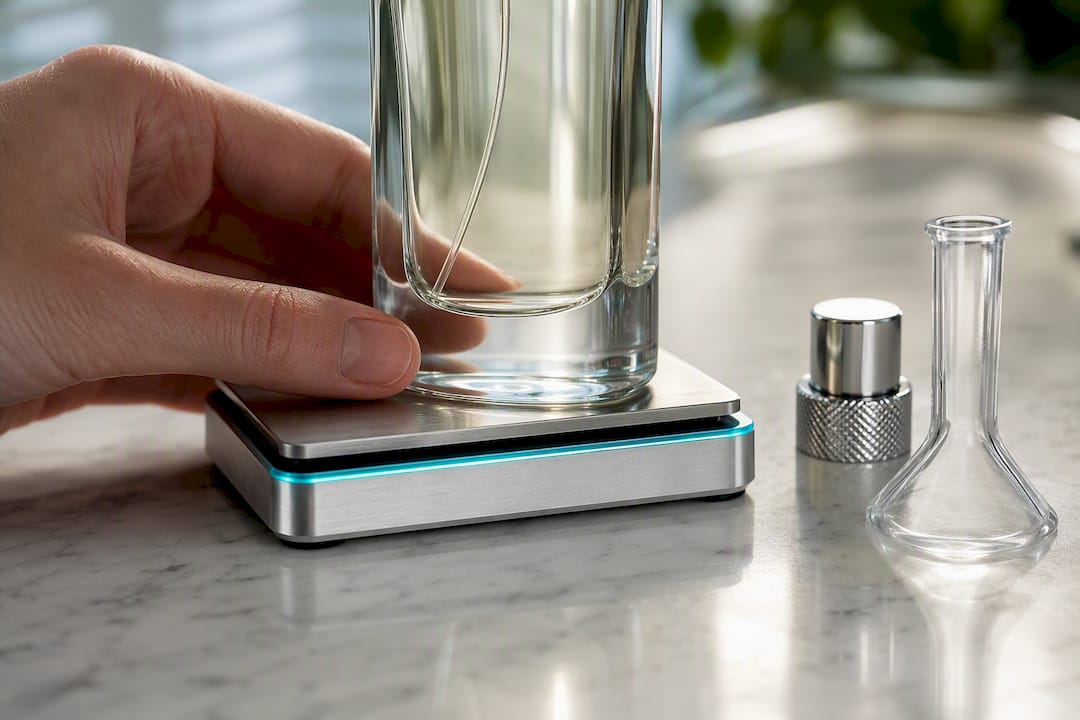
- Weigh the full bottle on a kitchen or postage scale, recording the number in grams.
- Spray it 20 to 50 times into the air or onto a tissue, counting each actuation.
- Weigh the bottle again and subtract to find the total weight lost.
- Divide that weight loss by your spray count to get grams per spray, then treat that as roughly equal to milliliters per spray, since most fragrance concentrates sit close to water's density.
- Multiply your bottle's total volume by your result to estimate how many sprays remain.
If you don't have a scale, a quick alternative works too: count how many sprays it takes to empty a small travel-size vial, then scale that ratio up to your full bottle's volume.
Pro Tip: This method gives you a personal, testable estimate rather than a guess. Alcohol-based fragrances are slightly less dense than water, so your actual spray count may run a touch higher than the weight math suggests, which works in your favor.
The step-by-step testing guide covers this process in more depth if you want to fine-tune further.
When Should You Cut Back on Sprays?
Scent-sensitive environments call for restraint that has nothing to do with how good your fragrance is. Offices, medical settings, and shared vehicles all reward a lighter hand.
- In offices or medical settings, stick to 1 to 2 sprays on skin, and lean toward EDT or lighter EDP formats instead of dense Extrait.
- Outdoors and in open-air venues, you can push toward the higher end of your fragrance's range since airflow disperses concentration quickly.
- In closed rooms, elevators, or crowded transit, drop a spray or two below your usual count.
- Cold, dry climates mute scent, warm, humid climates amplify it, so adjust seasonally, not just situationally.
If you've overdone it, blot exposed skin with a damp cloth, air out in a well-ventilated space for a few minutes, or change into a layer that hasn't been sprayed. None of these fully erase strong fragrance, but they cut intensity fast.
Pro Tip: Before leaving the house, have someone stand at a normal conversational distance, about 2 to 3 feet, and tell you honestly whether they can smell you. If they can from across the room, you've oversprayed.
Your Quick Spray Reference
Keep these numbers in your head and you'll rarely misjudge a fragrance application again:
- Extrait: 1 to 2 sprays. EDP: 2 to 4. EDT: 3 to 5. Cologne or body mist: 4 to 6.
- One milliliter delivers roughly 8 to 12 sprays, so a 100 ml bottle typically holds 800 to 1,200 sprays.
- Test your own atomizer once with the weigh-and-count method to get a personal, reliable number instead of a guess.
- When uncertain, start with 2 sprays and add one at a time. Respect scent-sensitive spaces by defaulting low.
Parfumla's Take on Matching Bottle Size to Spray Habits
Your spray count should decide your bottle size, not the other way around. A light sprayer who uses 1 to 2 daily applications of Extrait can stretch a 30 ml bottle for well over a year, while a heavy EDT or cologne user going through 5 sprays a day burns through the same volume in a few months.
Before committing to a 100 ml bottle, test a travel size or sample vial first, especially with concentrated formats where a little goes a long way. Comparing Eau de Parfum against Eau de Toilette side by side helps clarify which concentration actually fits your spray habit before you spend on a larger bottle. Catalogs of fragrances spanning multiple formats can help match your habit to the right size and strength without guesswork once you know your numbers.
— Parfumla
Buy the Right Concentration for Your Spray Habit
Once you know your spray count, the concentration choice gets easier. Heavy sprayers who go through 4 to 6 applications a day often get better value from an Eau de Toilette, while restrained 1 to 2 spray wearers usually get more from an Eau de Parfum or Extrait, since those formats deliver more scent per actuation.
If you're comparing bottle sizes before you commit to a full 100 ml purchase, the NARCISO RODRIGUEZ Eau De Toilette for Women 100ml makes a solid reference point for testing your own spray math against a well-known EDT profile. Shopping around for the best price for a specific fragrance, or looking to buy original Parfumla-listed perfume online, starts with browsing the full catalog and checking current markdowns before you check out.
Sources
- Aromawarehouse
- How Many Sprays of Perfume Is Enough? | Perfume On Skin
- Perfume ml to oz Converter: How Many Sprays Per Bottle | ThotsLifed
- How Many Sprays Are in a 100ml Perfume Bottle? - Smilebottles
FAQ
Is 2 Squirts of Cologne Too Much?
No, 2 sprays is a reasonable starting point for most colognes, especially in warm rooms or scent-sensitive settings, though many people find 3 to 5 sprays more appropriate for cologne's lighter concentration.
What Is the 5 Spray Rule?
There's no single agreed-upon "5 spray rule." Some guides use 5 sprays as a rough ceiling for Eau de Toilette or cologne, but the smarter approach is starting at 2 sprays and testing at conversational distance before adding more.
How Can You Smell Good Without Overspending?
Focus on layering fewer, higher-quality sprays on pulse points rather than dousing yourself, and shop discounted Eau de Parfum or Extrait, where a smaller spray count still delivers strong presence. Parfumla's budget shopping guide covers how to stretch a bottle further without sacrificing scent strength.
What Is the 3:1:1 Rule for Cologne?
Definitions of this rule vary across fragrance communities, and no standardized version appears in fragrance industry guidance, so treat any specific ratio you see online with caution and rely on concentration-based spray ranges instead.
How Many Sprays Should You Use for a First Date?
For an evening date, 3 to 4 sprays of Eau de Parfum or 2 sprays of Extrait typically hits the right balance, close enough to notice, not so strong it lingers in someone else's car.