

Proper perfume testing is defined as a methodical, timed evaluation of a fragrance on your skin, designed to reveal how it evolves through its top, heart, and base note phases. Most people spray a scent on their wrist, sniff once, and decide. That approach misses the full picture. Your skin chemistry, body temperature, and the environment all shape how a fragrance smells and lasts. Learning how to test perfume properly takes about 30 minutes of active attention and several hours of passive wear. The payoff is a purchase you will not regret.
How to test perfume properly: setting up your environment
The testing environment controls the quality of your results. Test perfume in a neutral, well-ventilated room with consistent temperature and no competing odors from candles, food, or cleaning products. A bathroom full of air freshener will skew every impression you form.
Before you start, gather the right tools:
- Blotter strips: Paper strips for quick, neutral screening before you commit to skin tests
- A timer or phone: To mark your 15-minute, 1-hour, and 4-hour checkpoints
- A small notebook: To record observations at each stage
- Unscented soap: To wash your wrists clean before applying anything
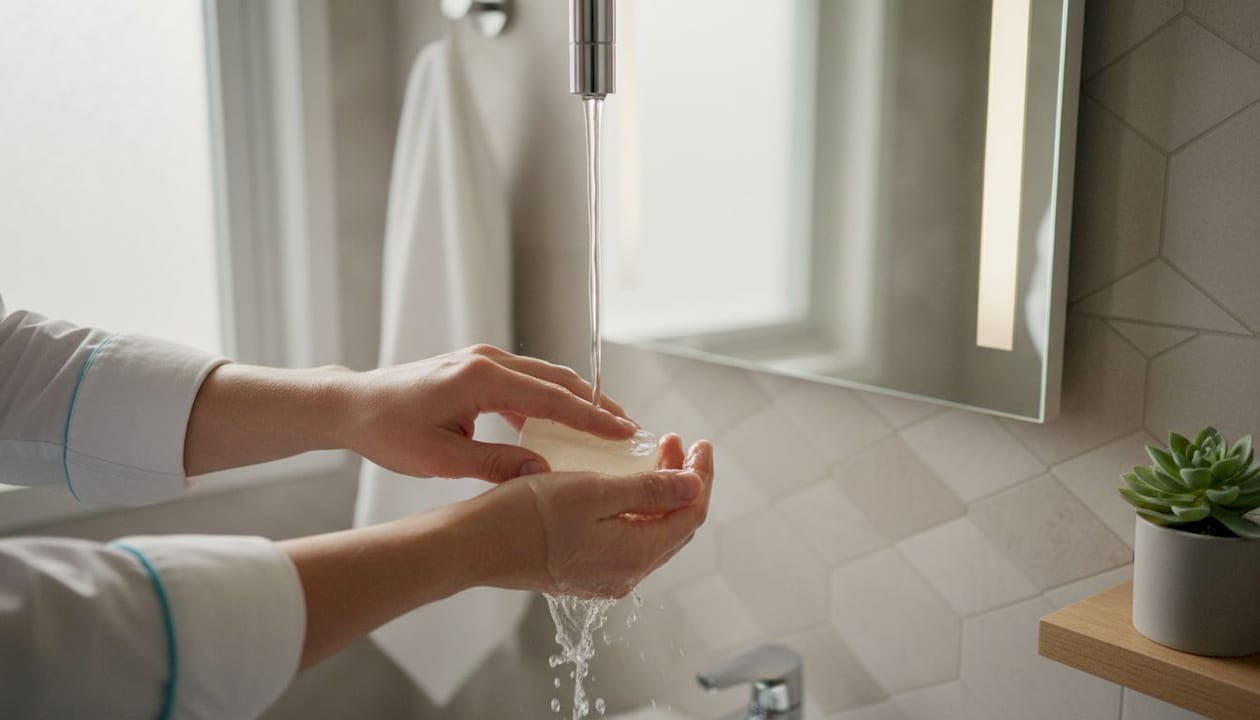
Skin preparation matters as much as the tools. Wash your wrists with unscented soap, rinse thoroughly, and let your skin dry completely. Avoid scented lotions, body oils, or hand creams on the day you plan to test. Residual scent from moisturizer will blend with the fragrance and give you a false reading.
Pro Tip: Hold the bottle 3–4 inches from your skin and apply exactly one or two sprays per test site. Keeping the distance and quantity consistent across every fragrance you try makes comparisons far more reliable.
What is the step-by-step process for testing perfume on skin?
Start every session with blotter strips. Use 1–2 sprays per scent on separate blotters, spaced at least an arm's length apart. Blotters give you a fast, neutral overview and help you eliminate obvious mismatches before you commit skin space to them. If a fragrance smells wrong on paper, it rarely improves on skin.
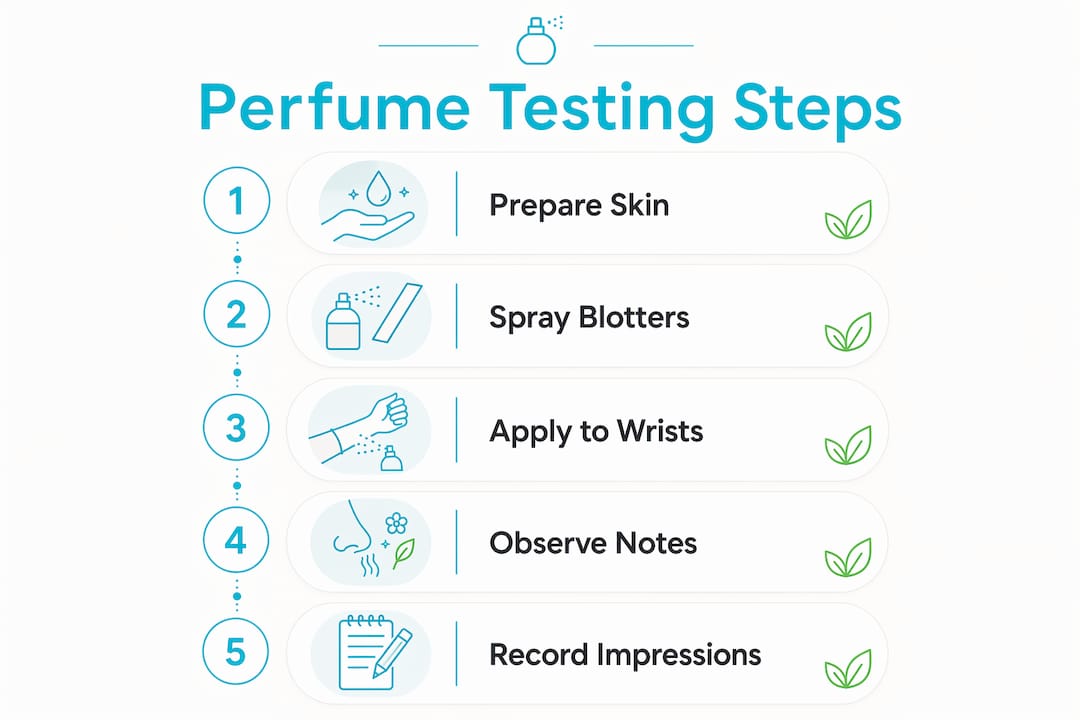
Once you have narrowed your choices to two or three, move to skin testing. Apply each fragrance to a separate pulse point, either the inner wrist or the inner elbow. These spots generate gentle warmth that activates the scent without overheating it.
Follow this timed checkpoint schedule:
- 0–5 minutes: Smell the top notes. These are the first impression, typically citrus, light florals, or green accords. They evaporate fast.
- 15–30 minutes: The heart notes emerge. This is the core of the fragrance, often florals, spices, or woody accords.
- 1 hour: The heart is fully developed. Assess whether you still enjoy the direction the scent is taking.
- 2–4 hours: The base notes begin to dominate. Musks, woods, and resins define the dry-down.
- 6–8+ hours: Evaluate longevity and how close the scent sits to your skin at this stage.
Perfume evolves through distinct phases: top notes last 0–5 minutes, heart notes develop from 15–60 minutes, and base notes carry through 2–8 or more hours. Each phase reveals different characteristics that matter for a purchase decision.
One rule applies at every stage: do not rub your wrists together. Rubbing breaks down top notes by generating heat that accelerates evaporation and distorts the scent progression. Let the fragrance air dry naturally.
| Checkpoint | Phase | What to assess |
|---|---|---|
| 0–5 min | Top notes | First impression, brightness, freshness |
| 15–30 min | Heart notes | Core character, complexity |
| 1–2 hrs | Heart to base transition | Depth, warmth, direction |
| 4–8+ hrs | Base notes | Longevity, skin scent, dry-down |
Document your observations at each checkpoint. Write down specific words: "sharp citrus," "soft rose," "dry cedar." Vague notes like "nice" or "okay" will not help you compare fragrances later.
Pro Tip: Number your test sites in your notebook before you start. If you are testing three fragrances at once, label them A, B, and C on your skin with a pen. This prevents mix-ups during later checkpoints.
How do you avoid common perfume testing mistakes?
The most common mistake is testing too many fragrances in one session. Limit testing to a maximum of 3 fragrances per session to avoid olfactory fatigue. Your nose stops distinguishing scents accurately after the third or fourth fragrance. The result is misjudgments that lead to regrettable purchases.
Other mistakes that undermine accurate evaluation:
- Judging on top notes only: Top notes last under five minutes. A fragrance that smells sharp or medicinal at first can become warm and beautiful within 30 minutes.
- Testing over scented skin: Wearing perfume from the day before, or using scented lotion that morning, contaminates the test.
- Skipping repeat sessions: A single wear rarely tells the full story. Mood, stress, and even diet can affect how your skin interacts with a fragrance on a given day.
- Relying only on blotters: Paper strips show you the raw formula. They do not show you how your skin chemistry transforms the scent.
"Olfactory fatigue sets in quickly after 3–4 fragrances. Best practice is to limit testing and reset your sense of smell with fresh air rather than coffee beans, which can skew perception."
Step outside for 5–10 minutes between samples, or smell the inside of your elbow on unscented skin. Professional testers use fresh air as their primary reset tool. Coffee beans became a popular myth, but they introduce their own strong aroma and can interfere with your next impression.
Testing over multiple days gives you the most reliable results. Wear a fragrance on a Tuesday, then again on a Friday. If you still love it both times, you have a genuine match.
How do you interpret longevity, sillage, and personal fit?
Longevity measures how many hours a fragrance remains detectable on your skin. Sillage, pronounced "see-yahj," refers to the scent trail a fragrance leaves in the air around you. Both are worth evaluating separately because a fragrance can have strong sillage early and fade quickly, or sit close to the skin for 10 hours with almost no projection.
When assessing personal fit, consider these factors:
- Occasion: A heavy oriental fragrance that works beautifully on a winter evening may feel oppressive in a summer office.
- Season: Citrus and aquatic fragrances project well in heat. Musks and woods deepen in cold air.
- Personal style: A fragrance should feel like an extension of how you present yourself, not a costume.
Documenting perfume tests with notes on scent stages, sillage, longevity, and personal feelings improves selection accuracy over time. A fragrance journal helps you identify patterns, such as a preference for dry woody bases or a dislike of synthetic musks, that you might not recognize without written records.
Use a simple 1–10 score for each attribute at each checkpoint. After several sessions, the numbers make comparisons straightforward. A fragrance that scores 8 on longevity and 7 on personal fit beats one that scored 9 on first impression but faded within two hours.
For shoppers building a collection on a budget, a smart fragrance buying guide can help you prioritize which fragrances are worth the full testing process and which are safe blind buys based on your established preferences.
How does blind testing remove bias from fragrance comparisons?
Brand recognition and packaging influence perception more than most people admit. A fragrance in a plain bottle smells different to most people than the same formula in a luxury flacon. Blind A/B/C testing with consistent sprays and labeling removes that bias and forces you to evaluate the scent itself.
Set up a blind test using these steps:
- Ask someone else to label your test strips or wrists as A, B, and C without telling you which fragrance is which.
- Apply the same number of sprays from the same distance to each site.
- Evaluate and score each fragrance before revealing the labels.
- Record scores for top notes, heart, base, longevity, sillage, and uniqueness.
A repeatable testing protocol removes bias and highlights your true fragrance preferences. Repeat the blind test on a different day under different conditions. If fragrance B wins both times, that result is reliable.
| Scoring criterion | What to evaluate |
|---|---|
| Top notes | Freshness, brightness, appeal at first spray |
| Heart notes | Complexity, warmth, character |
| Base notes | Depth, longevity, dry-down quality |
| Sillage | Projection and scent trail during wear |
| Uniqueness | Distinctiveness from fragrances you already own |
Pro Tip: Use the same atomizer for all samples in a blind test. Different spray mechanisms deliver different quantities, which changes the intensity and skews your comparison.
If you plan to test fragrances while traveling, a perfume travel guide covers how to carry samples safely and apply them consistently away from home.
Key Takeaways
Testing perfume properly requires timed skin evaluation across multiple sessions, not a single sniff on a blotter strip.
| Point | Details |
|---|---|
| Test on skin, not just paper | Blotters screen options; skin chemistry reveals the true scent. |
| Follow timed checkpoints | Evaluate at 5 min, 30 min, 1 hr, and 4+ hrs to capture all note phases. |
| Limit sessions to 3 fragrances | Olfactory fatigue after the third scent causes inaccurate judgments. |
| Never rub your wrists | Rubbing accelerates evaporation and distorts the scent progression. |
| Document every test | Written scores and notes improve accuracy and prevent impulse decisions. |
What I have learned from years of testing fragrances
The biggest mistake I see is impatience. People smell a fragrance for 30 seconds and decide. That is like judging a film by its opening credits. The base notes of a great fragrance, the part that stays with you for hours, often take two or more hours to fully develop. I have passed on fragrances that became favorites only after I gave them a second chance.
The fragrance journal changed how I shop. Writing down specific words at each checkpoint, not just "good" or "bad," forced me to articulate what I actually respond to. After a few months, I realized I consistently score dry woody bases highest and dislike synthetic white musks. That knowledge cut my testing time in half.
Balancing sensory data with emotional response is the real skill. Numbers and scores give you structure. But a fragrance that makes you feel confident, calm, or joyful the moment you put it on carries weight that a scoring sheet cannot fully capture. The best approach uses both. Score the technical qualities, then ask yourself how wearing it makes you feel. When both answers are positive, you have found your fragrance.
For readers building a fragrance wardrobe from scratch, the online perfume shopping checklist at Parfumla's blog is a practical starting point.
— Parfumla
Parfumla makes it easy to test before you commit
Choosing a fragrance with confidence starts with having access to the right options at the right price. Parfumla carries over 14,000 perfumes, including popular, niche, and celebrity scents, with savings of up to 60% off retail prices. Detailed product descriptions and customer reviews give you the context you need to shortlist candidates before you ever open a bottle.
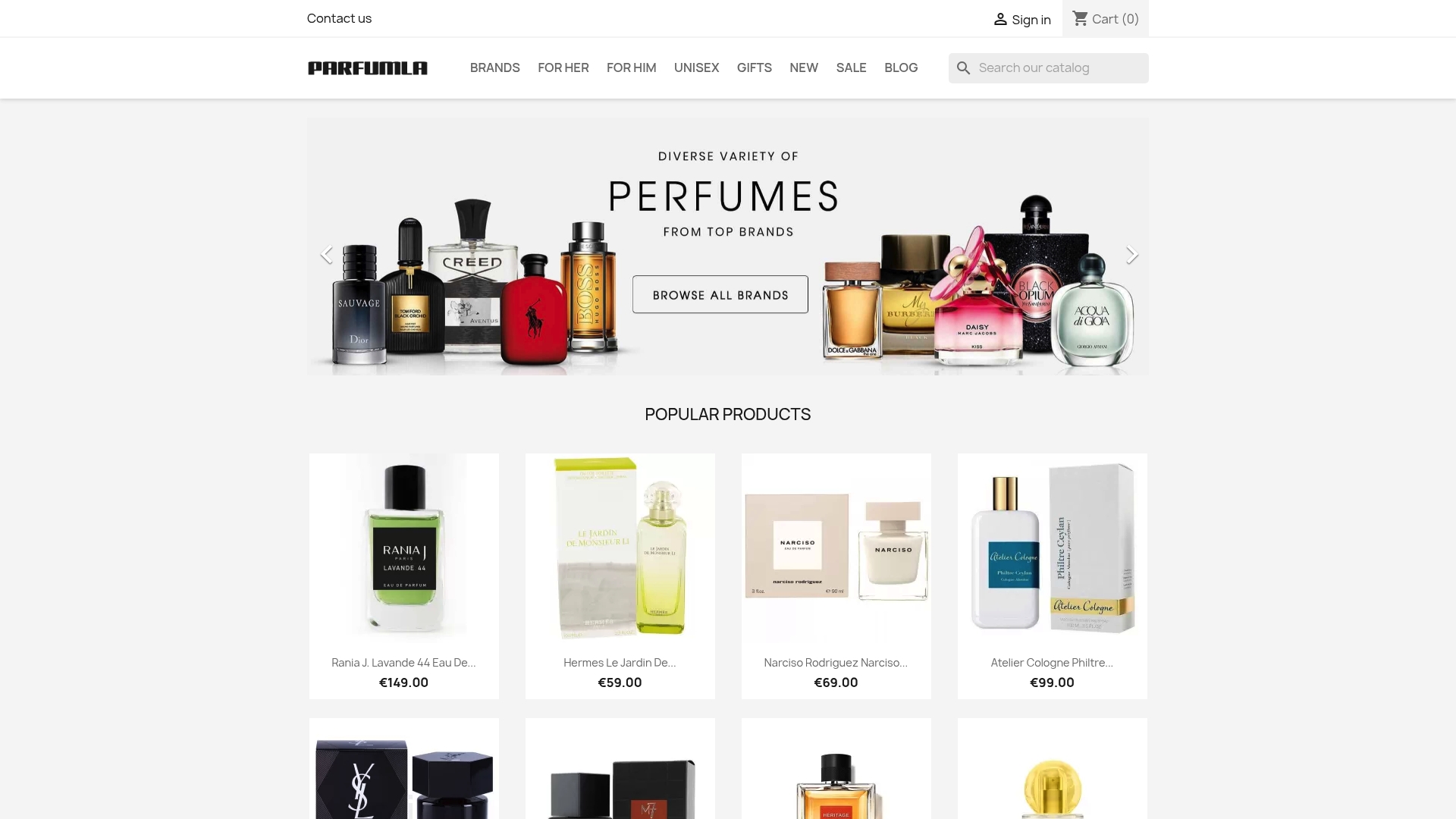
If you are ready to put your testing skills to work, the Narciso Rodriguez Eau de Toilette for Women is a strong starting point. It is a clean, musky floral with excellent longevity, and it rewards the full timed testing process. Parfumla ships reliably across the US and EU, so your next favorite fragrance is never far away.
FAQ
How many perfumes should you test in one session?
Limit each session to 3 fragrances. Olfactory ability drops sharply after the third scent, causing inaccurate evaluations.
Should you test perfume on your wrist or on paper?
Test on both. Use blotter strips to screen options quickly, then apply your top choices to pulse points on your inner wrist or inner elbow for a full skin evaluation.
Why should you not rub your wrists after applying perfume?
Rubbing generates heat that breaks down top notes and accelerates evaporation, which distorts the fragrance's intended scent progression.
How long should you wait before judging a perfume?
Wait at least 1–2 hours before making a judgment. Perfume evolves through top, heart, and base note phases that unfold over several hours, and the base notes define how the fragrance actually wears on your skin.
What is the best way to reset your sense of smell between tests?
Step outside for 5–10 minutes or smell unscented skin on your inner arm. Fresh air is more effective than coffee beans, which can introduce their own scent and interfere with the next sample.