
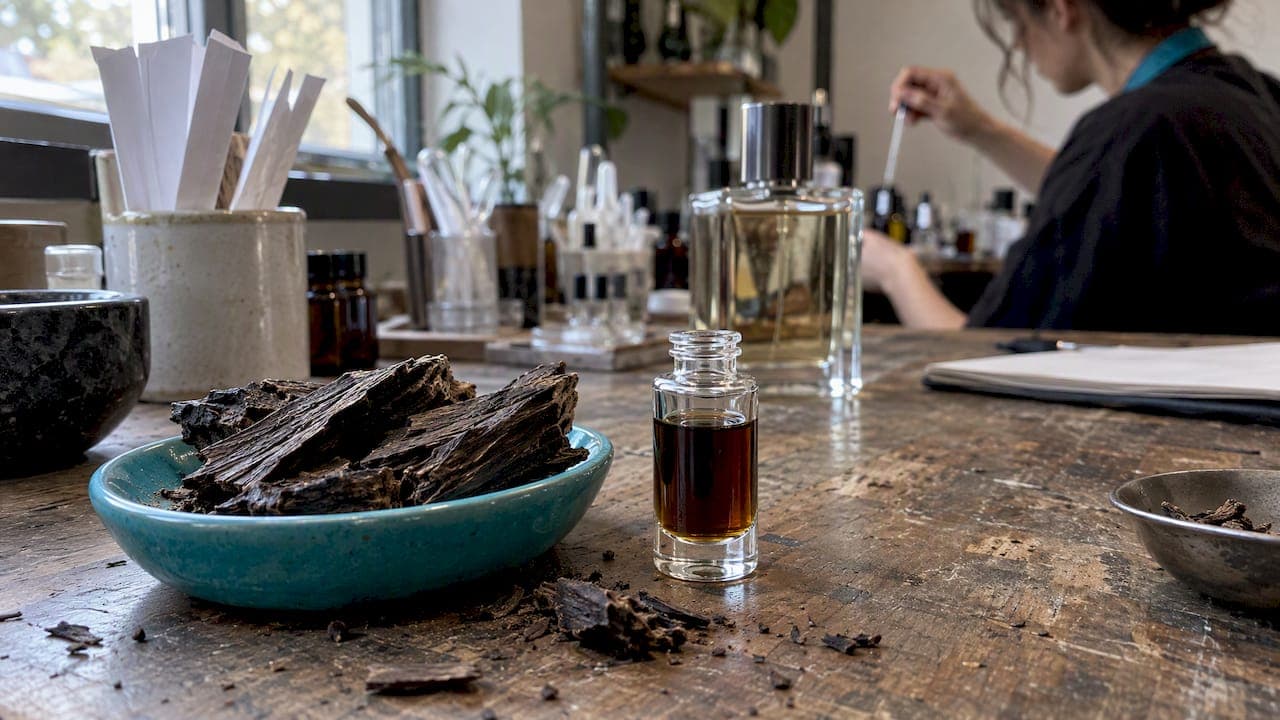
Oud is a dark, resinous, smoky-sweet wood note that comes from the infected heartwood of Aquilaria trees. In a bottle it smells warm, woody, a little leathery and sometimes faintly animalic. Most oud perfumes you can buy today are built on a synthetic reconstruction, not on the real oil. That is not a flaw. It is why oud fragrances can be wearable and affordable, and why you need to know what you are paying for.
This guide explains what oud is, how it smells, what separates real from synthetic, which styles to try first, and how to buy an original oud perfume online without overpaying.
TL;DR
- Oud (agarwood) is a resin the Aquilaria tree makes when infected by a fungus. Genuine oil is among the rarest materials in perfumery.
- Most oud perfumes, especially at mainstream prices, use a synthetic oud accord. Modern accords are designed to be clean and wearable, not inferior.
- Start with soft ouds blended with rose, saffron, vanilla or amber, then move toward smokier, leatherier styles.
- Apply less than you think: one or two sprays is plenty, since oud is strong and lingers.
- When you buy, check authenticity of the seller first, then compare prices on the exact size and concentration.
Table of Contents
- What oud actually is
- What does oud smell like?
- Real oud vs. synthetic oud accords
- Oud styles: a map for beginners
- Why oud perfumes cost what they cost
- How to wear oud without overdoing it
- Our perspective at Parfumla
- Where to buy original oud perfume online
- Buying checklist at a glance
- FAQ
- Sources
What oud actually is
Oud, also called agarwood, is not the wood of a healthy tree. Healthy Aquilaria trees do not produce it: the resin forms only when the tree's heartwood is infected by a particular fungus and defends itself. In the wild only about 2% of trees develop this infection, and distilling 70 kg of wood may yield only 20 ml of oil. That scarcity is why oud earned the nickname "black gold".
A useful distinction: agarwood is the resinous wood, while oud is the essential oil distilled from it. On a perfume label, "oud" can mean the real oil, a small amount of it, or a fully synthetic impression of it. The word alone tells you nothing about what is inside.
What does oud smell like?
There is no single oud smell, but most of them share a few threads:
- Woody and earthy: a deep, forest-floor quality, like damp bark or aged timber.
- Smoky: incense, burnt wood, a campfire that has died down.
- Sweet and balsamic: honeyed, resinous, sometimes close to amber.
- Leathery or medicinal: a dry, slightly bitter edge.
- Animalic: in raw oil, a barnyard or aged-cheese funk that divides people sharply.
The last point is why many people say they dislike oud after one bad experience. They may have met a raw, animalic version. The oud in most department-store perfume is a modern reconstruction designed to be wearable, clean and office-friendly, leaving out the pungent facets of raw oil. If you dislike one oud, try another style before giving up.
Real oud vs. synthetic oud accords
This is the question that shapes every purchase.
Real oud oil is complex and evolves over hours. It is also very costly. Perfumes with meaningful amounts of it tend to sit at the luxury or artisanal end of the market.
Oud accords are blends of aroma chemicals built to evoke the direction of oud. Modern oud is mostly a skilful reconstruction of agarwood, not the raw oil itself. Perfumers use them because they give long-lasting woody depth without the extreme cost or unstable supply of the natural material.
| Real oud oil | Synthetic oud accord | |
|---|---|---|
| Smell | Layered, changes over hours, can be animalic | Cleaner, more linear, easier to wear |
| Cost | Very high | Low to moderate |
| Supply | Rare, regulated | Unlimited |
| Best for | Collectors, connoisseurs | Everyday wear, first-time buyers |
| Consistency | Varies by batch | Very consistent |
A practical rule: a low price tells you the oud is almost certainly an accord, and that is fine as long as the perfume is honest about being what it is and you like how it smells. What you should avoid is paying a real-oud price for an accord, or buying a counterfeit.
How to verify genuine oud oil
If you are chasing the real material, marketing language is not proof. The definitive lab check is a gas chromatography-mass spectrometry (GCMS) report, which looks for chromones that synthetic accords lack. Serious buyers ask sellers for batch-specific reports. For everyday perfume bottles, nobody will hand you a GCMS report, so judge by the seller's reliability and the way the fragrance performs on your skin.

There is also a legal and ethical layer. All Aquilaria species are listed under CITES Appendix II, so international trade in genuine agarwood needs documentation. Buyers who care about sourcing should look for brands that explain where their material comes from instead of leaning on a story.
Oud styles: a map for beginners
Oud is rarely worn alone in popular perfumery. The supporting notes decide how it feels.
- Floral oud (rose, saffron, violet): the gentlest door in. Rose softens the smoke and makes it elegant.
- Sweet oud (vanilla, amber, tonka, caramel): warm, cozy, cold-weather friendly. Good for gifts.
- Spicy oud (cardamom, pepper, cinnamon): bolder, evening-leaning, often marketed to men but wearable by anyone.
- Leather and smoke oud: darker, drier, closer to the traditional character.
- Fresh or citrus oud: oud with bergamot or aquatic notes for warm weather and the office.
If you have never worn oud, begin with the first two. If you are still working out which scent families you enjoy, our fragrance families guide for beginners shows where woody and amber scents sit.
Why oud perfumes cost what they cost

Three things move the price: the amount of real oil, the brand and marketing, and the concentration (eau de toilette vs. eau de parfum vs. extract). A designer bottle with an oud accord is priced like any designer bottle. A niche perfume with real oil is priced for the raw material. Experts note that a price in the hundreds of dollars is often the only reliable sign of genuine high-grade oud in a formula, though a high price alone never guarantees quality.
If you want to understand the rest of the markup, we break it down in why perfume prices vary so widely and what makes designer fragrance expensive.
How to wear oud without overdoing it
Oud is projective and clings to fabric. A few habits help:
- Start with one or two sprays. Chest or neck is enough. You can always add more.
- Moisturize first. Unscented lotion gives scent something to hold on to.
- Match the season. Dense, sweet ouds shine in fall and winter. Fresher blends work in spring.
- Match the setting. Keep it light for the office, close spaces and dinners. Save heavier ouds for evenings.
- Test on skin. Oud changes from the first spray to the dry-down several hours later. Wear it a full day before deciding.
If you have sensitive or reactive skin, think about the ingredients in everything you put on it. This overview of how fragrance behaves in skincare and who should avoid it is a helpful read, and a dermatologist is the right person to see if a perfume repeatedly irritates you. Spraying fragrance on clothes instead of skin is a common workaround.
Our perspective at Parfumla
We sell fragrances for people, not for collectors of rare raw materials, and that shapes how we think about oud. Most shoppers asking for an oud perfume want that warm, smoky, luxurious mood in a bottle they can wear on a Tuesday. A well-made oud accord delivers exactly that, and it should not cost a fortune.
Where we get strict is authenticity. A discounted perfume is only a good deal if it is the genuine product, which is why we stand behind a 100% authenticity guarantee and publish a guide on how to spot authentic discount fragrances. We also know oud is a polarizing note, so we encourage trying before committing: decants and samples let you live with a scent for a few days before you buy a full bottle. Our customer reviews help too, because other people's honest descriptions of projection and dry-down tell you more than a note list does.
— Parfumla
Where to buy original oud perfume online
Oud is a magnet for fakes and for misleading labels. Before you buy oud perfume online, run through this list:
- Check the seller, not just the product. Look for a clear authenticity guarantee, real customer reviews, and transparent shipping and return terms.
- Compare the same item. Match brand, name, concentration (EDT, EDP, parfum) and size in ml. A 50 ml bottle and a 100 ml bottle are not comparable by sticker price.
- Be suspicious of extremes. A price far below every other seller usually means a problem. A price far above for a plain designer bottle may just be markup. Our guide to outlet perfume shopping covers how to tell discounts from traps.
- Inspect on arrival. Check the box, batch code, sprayer quality and the liquid's color against the brand's normal look.
- Sample first. A decant costs far less than a bottle you end up disliking.
At Parfumla you can browse over 14,000 fragrances at up to 60% off retail, with detailed reviews, and we ship across the US and EU. Oud-leaning scents appear across our women's, men's and unisex collections, and our decants and samples are the lowest-risk way to test a new note. Buying for someone else? See our gift picks, or read how luxury and affordable gift scents really differ.
New to perfume overall? Our starter guide using 30 ml bottles and discovery sets shows a low-cost way to build confidence before investing in a bold note like oud.
Buying checklist at a glance
| Question | What to look for |
|---|---|
| Do I want real oil or an oud-style scent? | Real oil means a much higher price. For everyday wear, an accord is a sensible choice. |
| Is the seller trustworthy? | Authenticity guarantee, reviews, clear policies |
| Is the price comparable? | Same brand, concentration and size |
| Will I like the smell? | Try a decant or sample first |
| Do I care about sourcing? | Look for traceability and documentation if buying real agarwood products |
FAQ
What is the best-smelling oud perfume?
There is no single answer, because oud is highly personal. Beginners usually enjoy ouds softened with rose, saffron, vanilla or amber. Sample two or three styles and wear each for a full day before choosing.
Why do many people use oud in their culture and daily life?
Oud has a long history of use as a perfume and incense across the Middle East and Asia. Ethnographic work on South Yemen describes how people apply agarwood as a perfume in everyday life, not only on special occasions. Its cultural weight is one reason oud remains so prized.
Is oud perfume unisex?
Yes, in most cases. Oud is a woody, resinous note and is not tied to a gender. What changes is the supporting cast: florals and sweetness read softer, spice and leather read darker. Browse our unisex collection to compare.
Does cheap oud perfume contain real oud?
Usually not. Affordable perfumes typically use synthetic accords that imitate the scent. That can still smell excellent, but you should not expect the layered complexity or rarity of genuine oil.
How many sprays of oud should I wear?
One to two for daytime and up to three or four for an evening out. Oud lingers on skin and clothes, so start small.
Sources
- What Is Oud? An Expert Guide to the Fascinating Perfume Note, Harper's Bazaar
- What Exactly Is Oud? Allure
- Agarwood Oil vs Oud Oil: Are They the Same?
- Modern Oud Guide: Real vs Synthetic, WhatScent
- What Is Oud Made From? 8 Essential Facts About Agarwood
- Agarwood Perfume 2026: Real Oud Sourcing & Price Guide
- The Value of Agarwood: Reflections Upon Its Use and History in South Yemen