

There is no perfume that is guaranteed safe for sensitive skin. Terms like "hypoallergenic" have no federal definition in the U.S., so the safest approach is to choose lighter formulas, test before you commit, and wear scent where it touches skin least. This guide shows you how, step by step.
TL;DR
- "Hypoallergenic," "clean," "natural" and "for sensitive skin" are marketing phrases, not guarantees. Read the ingredient list and test the product yourself.
- Patch test on a quarter-sized spot for 7 to 10 days before wearing a new perfume regularly.
- Spray on clothing or hair ends instead of directly on skin, and skip freshly shaved or irritated areas.
- Try a sample or decant first. A small vial costs less than a full bottle you cannot wear.
- If a reaction is severe or keeps coming back, see a dermatologist and ask about patch testing.
Table of Contents
- Is perfume bad for your skin?
- What "hypoallergenic" and "fragrance-free" really mean
- How to choose a perfume when your skin reacts easily
- How to patch test perfume at home
- How to wear perfume if your skin is sensitive
- What to do if you react
- Our perspective at Parfumla
- Where to start shopping
- Perfume and sensitive skin: common questions
- Sources
Is perfume bad for your skin?
For most people, no. For some, yes, and the reason is usually specific ingredients rather than perfume as a category.
Fragrance can cause several kinds of skin problems: allergic contact dermatitis, irritant contact dermatitis, photosensitivity, hives and pigmented contact dermatitis, according to the European Commission's consumer guide on perfume allergies. The two you are most likely to meet are irritation and allergy, and they behave differently.
Irritation versus allergy
Irritant reactions often appear within minutes as itching, burning or stinging. They are more common in people with sensitive skin or conditions such as rosacea and dermatitis, according to Allergy UK.
Allergic reactions work through the immune system. In allergic contact dermatitis the reaction is T-cell-mediated, and on re-exposure it develops within one to two days. That delay is why people often blame the wrong product: the rash shows up the day after you wore the perfume, not while you wore it.

The practical difference: an irritant reaction may fade once you stop and your skin barrier recovers. An allergy tends to return every time you meet the same ingredient.
Why a perfume you have worn for years can suddenly bother you
Sensitivity is not fixed. Allergy UK notes that a person can develop a contact allergy to a product they have used safely for years, because the immune system can become sensitized through constant exposure.
The mechanism is well studied. Fragrance molecules often act as haptens: they combine with skin proteins and trigger an immune response. Some need air oxidation first. Linalool, a common lavender and citrus component, oxidizes to linalool hydroperoxides, which are more allergenic, as described in the EU's Scientific Committee on Consumer Safety opinion. The same opinion reports that around 16% of eczema patients in the European population are sensitized to fragrance ingredients.
Two takeaways follow. An old bottle that has sat open, warm and exposed to air may behave differently from a fresh one. And a sensitivity that appears late is not your imagination.
What "hypoallergenic" and "fragrance-free" really mean
This is where most shoppers get misled. The FDA states that terms such as hypoallergenic, fragrance-free and "for sensitive skin" lack federal definitions or regulatory standards in the U.S., so they do not guarantee you will avoid a reaction.
The American Academy of Dermatology draws a few useful lines:
| Label | What it can mean | What to watch |
|---|---|---|
| Fragrance-free | No fragrances at all, including masking ones | Not a perfume, by definition |
| Unscented | May still contain fragrance chemicals that hide other odors | Can trigger the same reactions |
| Clean / natural | Not regulated | Says nothing about allergen content |
| Hypoallergenic | No federal definition | A brand's own claim |
The AAD explains the fragrance-free versus unscented distinction and notes that "clean" and "natural" labels are not regulated.
Natural does not mean gentle
Plant-based scents are often marketed as the safe choice. Dermatology literature disagrees: fragrances, including essential oils, may cause skin sensitization and subsequent allergic contact dermatitis. Lavender, citrus peel and rose are all plant-derived and all contain molecules that can sensitize. If you want the longer version of this debate, our piece on natural versus synthetic fragrances walks through what actually differs.
Why allergen labels help, and where they stop
In 2003 the European Commission listed 26 fragrance ingredients as allergens, and the FDA's own page reproduces that list, including linalool, limonene, geraniol, citral, eugenol and coumarin. The point: in the U.S. these ingredients may not be identified on the label, which hides the very information a sensitive-skin shopper needs. In the EU, labeling of such allergens is expected above set levels, so a bottle made for the European market often tells you more.
Even the EU's safety body cautions that an exposure level of 0.01% may be tolerated by most consumers but does not guarantee protection for the most sensitive people. Labels are a tool, not a shield.
How to choose a perfume when your skin reacts easily
No format is safe for everyone, but some choices lower your odds of trouble.
1. Start from your own history
Think back to what you have worn without trouble and what triggered redness, itching or a rash. Write down names. If three irritating bottles share a note (say, a heavy citrus or a spicy cinnamon accord), that is a clue. Our guide to skin chemistry and fragrance matching explains why the same perfume can smell and feel different on different people.
2. Consider the format
Alcohol is a common solvent in sprays, and for some people it dries or stings skin. Others react to the fragrance itself, not the carrier, so switching format is a trial, not a cure.
- Alcohol-free formulas: worth testing if sprays sting. Our walkthrough, testing alcohol-free perfumes for sensitive skin in one week, lays out a simple routine.
- Perfume oils: often contain less alcohol and can feel more moisturizing, but they are usually more concentrated in fragrance material, which matters if the fragrance is your trigger. See perfume oil versus spray for longevity and application differences.
- Lighter concentrations: an eau de toilette puts less fragrance concentrate on you per spray than an extract. That is not a safety claim, only a lower dose per application.
3. Prefer simpler scent profiles
Fewer notes usually means fewer potential triggers to track. A clean musk, a soft woody scent or a single-note composition is easier to troubleshoot than a 20-note gourmand. If a reaction happens, a short ingredient list is far easier to work through with a dermatologist.
4. Read the ingredient list where it exists
Look for the allergens named in the FDA list above. If one of them is a known trigger for you, avoid products that list it, and treat a bare "fragrance" or "parfum" entry as an unknown.
5. Be careful with skin-scent styles
Soft, close-to-skin fragrances can feel gentler, but they often use the same ingredients. The label "skin scent" describes how a fragrance wears, not how it is formulated. Our explainer on what a skin scent is covers the style.
How to patch test perfume at home
The AAD recommends testing new products on a quarter-sized spot, such as the underside of the arm or the bend of the elbow, twice daily for 7 to 10 days. Here is how that works for perfume:
- Pick a spot. Inner forearm or elbow crease, about the size of a quarter.
- Apply one spray or a small dab to clean, dry skin. Do not layer other products on top.
- Repeat twice a day for 7 to 10 days. Note redness, itching, bumps or burning each time.
- Wait for the delayed reaction. Because allergic reactions can take one to two days to appear, a clean first evening proves little.
- Only then wear it on larger areas such as the neck or chest.
The AAD adds that if fragrance causes a reaction, you should use fragrance-free products and stay cautious with unscented or botanical ones.
This is slower than a quick spritz at a store counter, and that is the point. Counter testing also mixes scents on your skin and nose, which muddies what you smell. Our step-by-step guide to testing perfume properly covers the smelling side.
Try before you buy a full bottle
The sensible way to run a 7 to 10 day test is with a small vial rather than a 100 ml bottle. A sample lets you complete the patch test, then decide. If you are building a trial plan on a budget, see how to sample perfumes affordably.
How to wear perfume if your skin is sensitive
Even after a clean patch test, how you apply matters.
- Spray clothing, not skin. Hold the bottle 6 to 8 inches from a scarf, coat or sweater. Test a hidden fabric spot first, since some perfumes stain silk and light fabrics. Many people with fragrance-prone skin dab perfume on clothes for this reason.
- Try hair ends or a hairbrush, keeping it off the scalp.
- Avoid broken, freshly shaved or sunburned skin. A compromised barrier lets more through.
- Skip the wrists if they react. Wrists and the neck are thin, warm and frequently touched, which makes them common trouble spots.
- Be careful in the sun. Photosensitivity is one of the reaction types the European Commission lists, so if you notice marks only where you applied perfume and then went outside, stop and ask a doctor.
- Wash it off at the first sting. Do not wait to see if it settles.
- Store bottles cool and dark, away from heat and light, since oxidation changes fragrance molecules, as described above.
If you also use moisturizers, note that emollients form a protective film and reduce water loss, but the NHS warns that some can irritate contact dermatitis, including because of perfume. Your skincare may be adding to the load.
What to do if you react
Stop using the product first. The AAD advises that if a reaction develops you gently wash the product off and use a cool compress or petroleum jelly. See a dermatologist if the reaction is severe and does not settle, and discuss patch testing when the cause is hard to pin down.
It helps to know what that testing involves. Clinical patch testing applies a standard series of common allergens, often 50 substances including specific fragrances, to the back for 48 hours, with the skin checked again at 72 to 96 hours, according to Royal Free London. One practical detail from a UK hospital leaflet: avoid creams and ointments on the back for 24 hours before testing. Your clinic will give its own instructions.
The best treatment for allergic contact dermatitis is to avoid the allergen once it is identified. That is why a named result from a dermatologist is worth more than guesswork. You can then check perfume labels against it.

Our perspective at Parfumla
We sell perfume, so you might expect us to tell you it is all fine. It is not, and we would rather you find out on a sample than on a full bottle.
In our experience, sensitive-skin shoppers are let down by three habits: trusting a front-label claim like "hypoallergenic," committing to a 100 ml bottle on a first impression, and testing for ten minutes instead of ten days. All three are fixable. We stock decants and travel sprays so you can wear a scent for a week before deciding, and we keep reviews on product pages so you can see how others describe wear and comfort.
Our view on what to do with that: pick two or three candidates, sample each, patch test, and only then buy the bottle. Authenticity matters here too. A genuine fragrance has a consistent, known formula, and that consistency is what lets you learn which ones your skin tolerates. We source from trusted distributors and stand behind the 100% authenticity of what we ship.
— Parfumla
Where to start shopping
If you are ready to test, begin small. Our Decants & Samples let you trial a fragrance before committing to a full size, and you can browse by women's, men's or unisex collections.
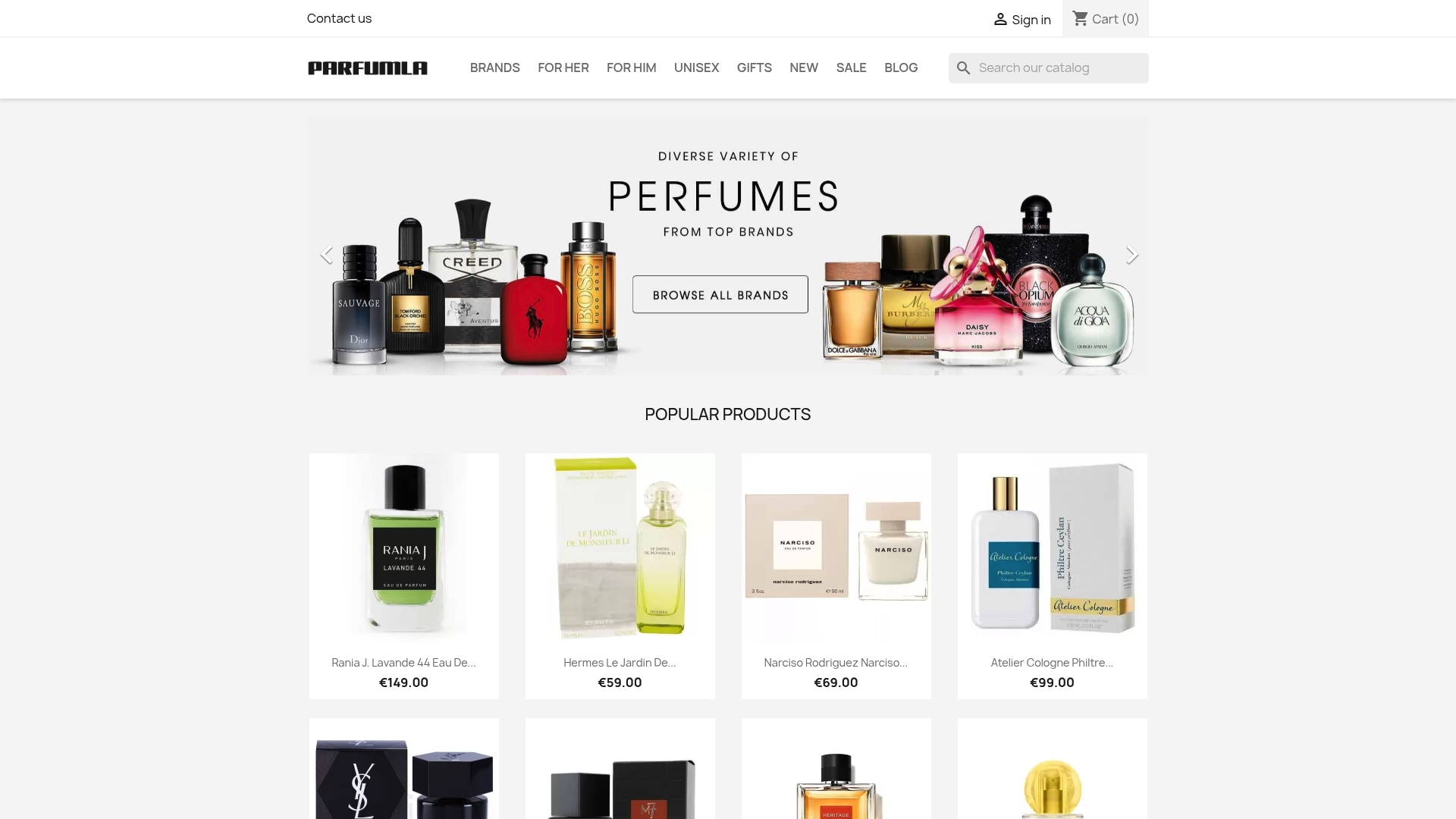
Parfumla carries over 14,000 discounted fragrances from designer houses to niche creators, with savings of up to 60% off retail and shipping across the US and EU. When you want to buy a specific brand's perfume online, start from the brands page, where you can look for options such as Dolce & Gabbana or Karl Lagerfeld and compare prices. Shopping for a gift? The gifts section is a good place to look, though for anyone with sensitive skin, a sample set is a safer present than a single large bottle. For tighter budgets, see our budget perfume shopping guide.
Perfume and sensitive skin: common questions
What perfumes are good for sensitive skin?
No perfume is universally safe, but simpler, lighter formulas with short ingredient lists are easier to tolerate and troubleshoot. Alcohol-free or oil-based formats suit some people, though they are not automatically gentler. Whatever you choose, patch test it for 7 to 10 days first.
Which perfume is best for an allergic person?
It depends on what you are allergic to. If a dermatologist has identified a specific fragrance allergen through patch testing, choose products whose ingredient lists do not include it, and avoid any that list only "fragrance." Without that information, you are guessing, so ask about patch testing.
How do I wear perfume if I have sensitive skin?
Spray it on clothing or the ends of your hair rather than directly on skin, and keep it away from broken, shaved or sunburned areas. Test a hidden fabric spot first so you do not stain a garment. Wash it off right away if you feel stinging or burning.
Is fragrance-free the same as unscented?
No. Fragrance-free products contain no fragrances, while unscented products may still contain fragrance chemicals that mask other odors. If you react to fragrance, the AAD advises caution with unscented products too.
Can you suddenly become sensitive to a perfume you have worn for years?
Yes. Allergy UK explains that the immune system can sensitize to an ingredient over time through constant exposure. If a long-loved scent starts to cause redness or itching, stop wearing it and talk to a dermatologist.
Sources
- European Commission: What kind of skin problems are caused by perfume allergies
- SCCS Opinion on fragrance allergens in cosmetic products
- Allergy UK: Allergy to cosmetics
- Allergy UK: Contact dermatitis
- FDA: Allergens in cosmetics
- American Academy of Dermatology: What's causing your child's itchy rash?
- American Academy of Dermatology: How to test skin care products
- Cutis: A Whiff of Trouble, navigating allergic contact dermatitis
- NHS: Contact dermatitis treatment
- Royal Free London: Having a patch test for skin allergies
- Hull University Teaching Hospitals: Patch testing for contact dermatitis