
From Chanel No.5 to Black Opium, the most recognizable perfume names in history share one thing: they stick. This article delivers a curated catalog of iconic, contemporary, and vintage fragrance names organized for fast discovery and smart shopping.
Here are five names to orient you immediately:
- Chanel No.5 — the world's most famous floral aldehyde, still a retail staple
- Shalimar (Guerlain) — a powdery oriental that defined luxury in the 1920s
- J'adore (Dior) — a modern floral icon found in virtually every department store
- Hungary Water — one of the oldest recorded perfume names, dating to the 14th century, per the List of perfumes
- Sauvage (Dior) — one of the best-selling men's fragrances of the past decade
Parfumla carries a very large number of fragrances, including most names on this list, at significant discounts compared to retail. Whether you're shopping for a classic or tracking down a niche release, the sections below break every major naming category down so you can find what you're looking for fast.
Key Takeaways
The most useful thing to know about perfume names is this: a name signals positioning and mood, but the note list and concentration are what actually determine what you smell and how long it lasts.
| Point | Details |
|---|---|
| Use scent family as a filter | Match a name to its family (floral, woody, gourmand) before buying to set accurate expectations. |
| Check concentration every time | The same name in EDT vs. EDP can smell and last noticeably differently; confirm before purchasing. |
| Numbers signal lineage or exclusivity | Numbered names like Chanel No.5 and Baccarat Rouge 540 carry collector and edition-tracking significance. |
| Vintage names need special searches | Historic names like Hungary Water and Farina Eau de Cologne require "re-edition" or "vintage" search terms to find modern versions. |
| Parfumla for price comparison | Over 14,000 names available at up to 60% off retail, with reviews and US/EU shipping included. |
Table of Contents
- Classic perfume names every fragrance lover should know
- Popular contemporary fragrance names trending right now
- How scent families help you decode a perfume name
- Why some perfumes use numbers or letters instead of words
- Historic and vintage perfume names worth knowing
- How perfume names are chosen today
- How to find and buy a perfume by name
- Why perfume names matter more than most people realize
- Shop over 14,000 fragrance names at up to 60% off
- Sources
- FAQ
Classic perfume names every fragrance lover should know
These are the names that shaped the industry, defined scent families, and still move units at counters worldwide. You'll encounter them in department stores, vintage markets, and gift guides alike.
- Chanel No.5 — The floral aldehyde that made numbered names famous. Launched in 1921, it remains the benchmark for feminine luxury fragrance.
- Shalimar (Guerlain) — A powdery oriental built on vanilla, iris, and bergamot. One of the first fragrances to define the "oriental" family for Western markets.
- J'adore (Dior) — A luminous floral bouquet of ylang-ylang, rose, and jasmine. Consistently one of the top-selling women's fragrances globally.
- Terre d'Hermès — An earthy, woody-citrus composition for men that redefined what a masculine fragrance could smell like in the 2000s.
- Light Blue (Dolce & Gabbana) — A fresh aquatic-citrus scent that became a summer staple for both men and women. Widely available and immediately recognizable.
- Fleur du Mâle (Jean Paul Gaultier) — A floral take on a men's fragrance, built around orange blossom. The name itself signals the genre-bending intent.
- Daisy (Marc Jacobs) — A light, playful white floral that became a bestseller among younger shoppers. The name and bottle design work together as a cohesive identity.
- Angel (Thierry Mugler) — The fragrance that launched the gourmand category. Patchouli, caramel, and vanilla in a star-shaped bottle. Nothing smelled like it in 1992.
- La Vie Est Belle (Lancôme) — French for "life is beautiful," this iris-and-gourmand composition became one of the fastest-selling women's fragrances of the 2010s.
- Flowerbomb (Viktor & Rolf) — A rich floral-oriental with jasmine, rose, and patchouli. The name is deliberately maximalist, and the scent delivers on it.
- Joy (Jean Patou) — Once marketed as "the costliest perfume in the world," built on an enormous quantity of rose and jasmine absolute.
- Mitsouko (Guerlain) — A chypre masterpiece built on peach, oakmoss, and vetiver. Beloved by collectors and considered one of the most complex classic fragrances.
- Hungary Water — Widely cited as one of the earliest recorded named perfumes, dating to the 14th century. A rosemary-and-herb-based tonic that predates modern perfumery conventions entirely.
- Farina Eau de Cologne — The original Eau de Cologne, created in Cologne, Germany in the early 18th century. The name established a concentration category that still exists today.
These names appear in mainstream retail, vintage re-editions, and collector markets. If you're hunting a specific classic, search the name alongside "re-edition" or "vintage" to find the right formulation.
Pro Tip: When gifting a classic, check whether the current formulation matches what the recipient knows. Many iconic fragrances have been reformulated over the decades, and a vintage bottle from a collector market may smell noticeably different from the current retail version.
Popular contemporary fragrance names trending right now
Modern best-sellers tend to cluster around a few naming styles: short evocative words, French phrases, and bold single-word titles. Here's what's moving in stores and online right now, with a note on why each name resonates.
- Black Opium (Yves Saint Laurent) — Coffee, vanilla, and white flowers. The name signals dark glamour, and the scent delivers. One of the most searched women's fragrances on community ranking platforms.
- Sauvage (Dior) — French for "wild," this woody-aromatic men's fragrance has held a top-seller position for years. Search "buy Sauvage perfume online" or "best price for Dior Sauvage fragrance" to find competitive pricing.
- La Vie Est Belle (Lancôme) — Already listed among the classics, but worth noting here: it continues to rank at the top of community-voted popularity lists alongside newer releases.
- Flowerbomb (Viktor & Rolf) — Still a top seller more than two decades after launch. The name's boldness is part of its staying power.
- Good Girl (Carolina Herrera) — A split personality fragrance: jasmine and tuberose on top, cocoa and tonka on the base. The name plays on the duality deliberately.
- Libre (Yves Saint Laurent) — French for "free," a lavender-orange blossom-musk composition that became a flagship women's release.
- Oud Wood (Tom Ford) — Oud is one of the most expensive raw materials in perfumery. Naming the fragrance after its hero ingredient is a transparency move that also signals luxury.
- Baccarat Rouge 540 (Maison Francis Kurkdjian) — A numbered name that signals exclusivity and has become one of the most discussed niche fragrances of the past decade.
- Molecule 04 (Escentric Molecules) — A single-molecule fragrance built around Javanol. The clinical name is the point: it tells you exactly what you're getting. You can find it on Parfumla at a fraction of boutique pricing.
- Narciso Rodriguez For Her — The brand name doubles as the fragrance name, a minimalist move that keeps the focus on the house identity. Search "buy Narciso Rodriguez perfume online" for best-price options.
- Fleur Narcotique (Ex Nihilo) — A niche floral-aquatic that has built a strong following through word-of-mouth and community ratings.
- Incanto Heaven (Salvatore Ferragamo) — A fresh, light floral that consistently appears in affordable-luxury searches.
For any of these names, the fastest way to compare prices is to search "best price for [Brand] fragrance" or "where to buy original [Brand] perfume" alongside the full name. Community ranking sites aggregate thousands of votes and give you a quick read on whether a fragrance is genuinely popular or just heavily marketed.
How scent families help you decode a perfume name
A fragrance name rarely tells you exactly what something smells like, but the scent family it belongs to does. Once you know the family, you can set realistic expectations before you ever open a bottle.
| Scent Family | Example Names | Typical Notes |
|---|---|---|
| Floral | J'adore, Daisy, Flowerbomb | Rose, jasmine, ylang-ylang, peony |
| Woody | Terre d'Hermès, Oud Wood | Cedarwood, vetiver, sandalwood, oud |
| Citrus / Fresh | Light Blue, Farina Eau de Cologne | Bergamot, lemon, grapefruit, green tea |
| Gourmand | Angel, Black Opium | Vanilla, caramel, coffee, praline |
| Oriental / Amber | Shalimar, Mitsouko | Amber, musk, patchouli, incense |
| Chypre | Mitsouko, Joy | Oakmoss, labdanum, bergamot, rose |
A few naming cues worth knowing:
- Words like Noir, Opium, or Nuit often signal dark, heavy oriental or gourmand compositions.
- Fleur, Rose, Blossom, or Garden in a name almost always points to a floral family.
- Place names (Terre d'Hermès = "earth of Hermès," Light Blue evoking Mediterranean air) tend to anchor a fragrance in a mood or geography rather than a specific note.
- Gourmand names often use food-adjacent words: Angel was the first, but names like Candy, Caramel, and Praline followed the same trail.
Knowing the family before you buy is especially useful when shopping online. If you love Shalimar's warmth, you're in the oriental family. Search that family alongside your budget and you'll find options you might never have considered.
Why some perfumes use numbers or letters instead of words
Numbers and letters in a fragrance name are not random. They are a deliberate branding choice, and collectors read them as signals.
According to the International Perfume Bottle Association, number- and letter-based names are a long-established device used to imply exclusivity, lineage, or precision. Chanel No.5 is the most famous example: the "5" was reportedly the fifth formula submitted by perfumer Ernest Beaux, and Coco Chanel chose it for its simplicity. The number stuck because it was different from every floral name on the market at the time.
Other well-known examples:
- Chanel No.19 — A greener, more austere sibling to No.5, named after Coco Chanel's birthday (August 19).
- Chanel No.22 — A more powdery, aldehydic variation from the same era.
- Baccarat Rouge 540 — The number refers to the temperature (540°C) at which Baccarat crystal is fired. It positions the fragrance as a luxury craft object, not just a scent.
- Molecule 04 (Escentric Molecules) — The number tracks the molecule in the brand's sequential series, giving collectors a clear lineage to follow.
- 4711 (Mäurer & Wirtz) — One of the oldest numbered fragrance names, originally a house address in Cologne that became the product's identity.
Collectors use these numbering systems to track production eras and authenticate vintage bottles. A bottle labeled "No.5" with a specific font or cap style can be dated to a particular decade, which matters for both provenance and value.
Historic and vintage perfume names worth knowing
The oldest recorded perfume names predate modern retail by centuries. Understanding them helps you recognize how naming conventions evolved and where to look when you want something genuinely rare.
- Hungary Water (c. 14th century) — Widely considered one of the first named perfumes in recorded history. A rosemary-based tonic associated with the Hungarian court. The original formula no longer exists in commercial form; search for "Hungary Water re-edition" or museum-catalog references to find modern interpretations.
- Farina Eau de Cologne (early 18th century) — Created in Cologne, Germany, this citrus-herb formula established the "Eau de Cologne" concentration category. The name "Farina" refers to its creator, Johann Maria Farina. Modern versions exist, but the original formulation is a collector's item.
- Jicky (Guerlain, 1889) — One of the first fragrances to use synthetic ingredients alongside naturals. The name is a nickname, not a botanical reference, which was unusual for the era.
- Mitsouko (Guerlain, 1919) — Named after a fictional Japanese character from a novel. The exotic name was a marketing choice that positioned the fragrance as mysterious and foreign to Western buyers.
- Chanel No.5 (1921) — Already covered in the classics list, but worth noting here as the fragrance that made numbered naming a viable commercial strategy.
- Shalimar (Guerlain, 1925) — Named after the Shalimar Gardens in Lahore. Place-name inspiration was common in early 20th-century luxury perfumery.
Most original vintage formulations are not available in mainstream retail. When searching for these names, add "vintage," "re-edition," or "original formula" to your search. Visual verification matters too: the Wikimedia Commons perfume image archive catalogs historical bottle and label photos that help you confirm what an authentic vintage bottle should look like before buying from a collector.
How perfume names are chosen today
Names are marketing decisions first. The scent comes second in the naming process, at least commercially.
Modern naming trends have shifted toward social-media and lifestyle-driven choices, with celebrity branding and influencer culture shaping what names reach mainstream shoppers. A name like "Good Girl" or "Libre" is designed to communicate an identity, not a note list. That shift is deliberate: short, evocative names perform better on social platforms where a bottle photo needs to communicate everything in a thumbnail.
Current naming conventions and what they signal:
- Evocative adjectives ("Libre," "Sauvage," "Intense") — signal mood or attitude, often used for flankers and limited editions.
- Place names ("Terre d'Hermès," "Madison Avenue" by Bond No.9) — anchor the fragrance in a geography or lifestyle. Bond No.9's product pages explicitly link the name to the street's character and note list, showing how houses use place names as storytelling shorthand.
- Floral terms ("Fleur du Mâle," "Fleur Narcotique") — signal the dominant note family and often appeal to buyers who want a clear olfactory promise.
- Numeric sequences (Chanel No.5, Baccarat Rouge 540) — imply precision, heritage, or exclusivity.
- Celebrity names (Ariana Grande, Rihanna's Fenty) — use the star's identity as the primary purchase driver. The reasons celebrities launch perfume lines are largely commercial, but the naming strategy is straightforward: the celebrity IS the name.
- Compound or invented words ("Flowerbomb," "Sillage") — create a proprietary identity that can't be confused with a competitor.
A useful case: ALDEBARAN by Marc-Antoine Barrois is named after a star in the Taurus constellation. The house describes it as a "perfume of optimism" and publishes the star-inspired concept alongside the note list. That combination of evocative name plus transparent notes is a model worth paying attention to: it tells you what to expect emotionally AND olfactorily.
Pro Tip: When a name is purely evocative (no botanical or geographic reference), go straight to the note list before buying. A name like "Midnight" could be a dark oriental or a fresh aquatic depending on the house. The notes are the only reliable guide.
How to find and buy a perfume by name
Knowing a name is the starting point. Getting the right bottle at the right price takes a few more steps.
- Search with buying intent. Use phrases like "buy [Brand] perfume online," "best price for [Brand] fragrance," or "where to buy original [Brand] perfume" to surface retailer listings rather than editorial content.
- Check the concentration. The same name often comes in multiple concentrations: Eau de Toilette (EDT), Eau de Parfum (EDP), and Parfum. An EDP version of the same name will smell richer and last longer than the EDT, and the price difference is usually significant. Confirm which concentration you want before adding to cart.
- Read the note list. Don't rely on the name alone. A fragrance called "Rose Garden" might be 80% musk with a trace of rose. The note list tells you what you're actually buying.
- Check community ratings. Community-voted databases aggregate tens of thousands of fragrance votes and give you a fast read on whether a name is genuinely beloved or just heavily advertised. Sort by votes, not just score.
- Verify the seller. For any named fragrance, check that the seller lists the full name, concentration, and volume. Authentic listings include bottle photos showing the label clearly. Cross-reference the bottle against the Wikimedia Commons perfume archive if you're buying vintage.
- Compare prices across formats. A 30ml bottle of an EDP is not the same value as a 100ml EDT, even if the per-bottle price looks similar. Calculate cost per ml before committing.
- Use Parfumla's catalog for price comparison. With over 14,000 fragrances listed, Parfumla covers most names on this list. Search the exact name plus concentration to find the best price for designer fragrances compared to department store retail.
Pro Tip: Avoid listings that show only a stock photo with no actual bottle image. Counterfeit fragrances almost always use manufacturer images rather than photos of the real product. A legitimate seller photographs the actual bottle.
Why perfume names matter more than most people realize
Names in perfumery do something unusual: they create expectation before the scent is ever experienced. "Angel" primes you for something otherworldly. "Sauvage" tells you to expect something raw and outdoorsy. "La Vie Est Belle" promises a certain lightness of spirit. That priming is not accidental.
What's underestimated is how much a name shapes the memory of a scent after the fact. Studies in sensory psychology consistently show that people rate the same fragrance higher when it's given an appealing name versus a neutral one. The name becomes part of the experience. That's why houses spend as much time on naming as on the formula itself, and why a name like "Mitsouko" still carries cultural weight a century after launch.
For shoppers, this means names are useful signals but imperfect ones. The best approach is to treat a name as an invitation to investigate, not a guarantee of what you'll find. Check the notes, read the community ratings, and if possible, sample before committing to a full bottle. Parfumla's catalog makes that process easier by pairing each name with detailed reviews and concentration options, so you're not buying blind.
Shop over 14,000 fragrance names at up to 60% off
Parfumla gives you direct access to a comprehensive range of fragrance names covered in this article, from department-store classics to niche releases, often at prices well below retail.
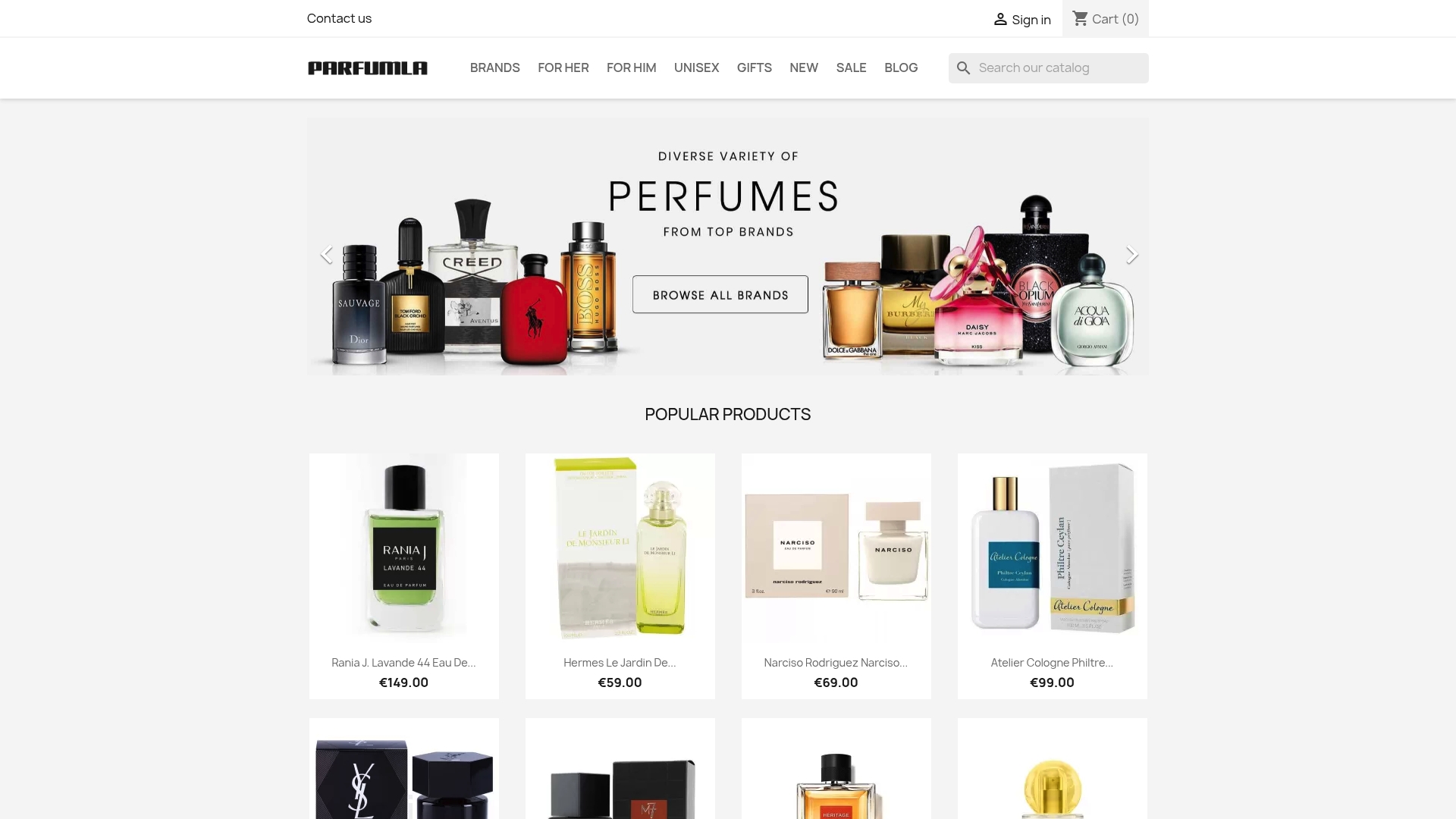
Search any name from this list on Parfumla and you'll find the exact concentration, bottle size, and current price alongside verified reviews. Whether you're tracking down a J'adore Le Jasmin for a gift or comparing prices on a niche release, the catalog covers it. Use search phrases like "buy [Brand] perfume online" or "best price for [Brand] fragrance" directly on the site to surface the right listing fast. Shipping covers both the US and EU, and every order comes with the same price-to-quality guarantee that keeps fragrance enthusiasts coming back. Browse the full catalog at Parfumla and find your next name today.
Sources
These resources back the claims in this article and give you reliable starting points for deeper research.
- List of perfumes
- 40 Scent-sational Perfume-Inspired Names
- Fragrances Named With Numbers and Letters - International Perfume Bottle Association
- Most Popular Perfumes 2026 — Most Voted Fragrances | Fraganty
FAQ
What makes a good perfume name?
A strong fragrance name creates an immediate emotional or sensory expectation and is easy to remember. The best names, like "Angel" or "Sauvage," work because they prime the buyer's imagination before the first spray.
What are some of the most popular perfume names right now?
Black Opium (YSL), Sauvage (Dior), La Vie Est Belle (Lancôme), and Flowerbomb (Viktor & Rolf) consistently rank among the most voted fragrances on community platforms like Fraganty.
What are some old or vintage perfume names?
Hungary Water (14th century) and Farina Eau de Cologne (early 18th century) are among the oldest recorded names. Jicky (Guerlain, 1889) and Mitsouko (Guerlain, 1919) are early commercial classics still referenced today.
How do I find the best price for a named fragrance online?
Search "buy Brand] perfume online" or "best price for [Brand] fragrance" to surface retailer listings. Parfumla carries over 14,000 names at up to 60% off retail with US and EU shipping, making it a practical first stop for [budget-conscious fragrance shopping.
Why do some perfumes use numbers instead of names?
Numbers signal lineage, exclusivity, or precision.