
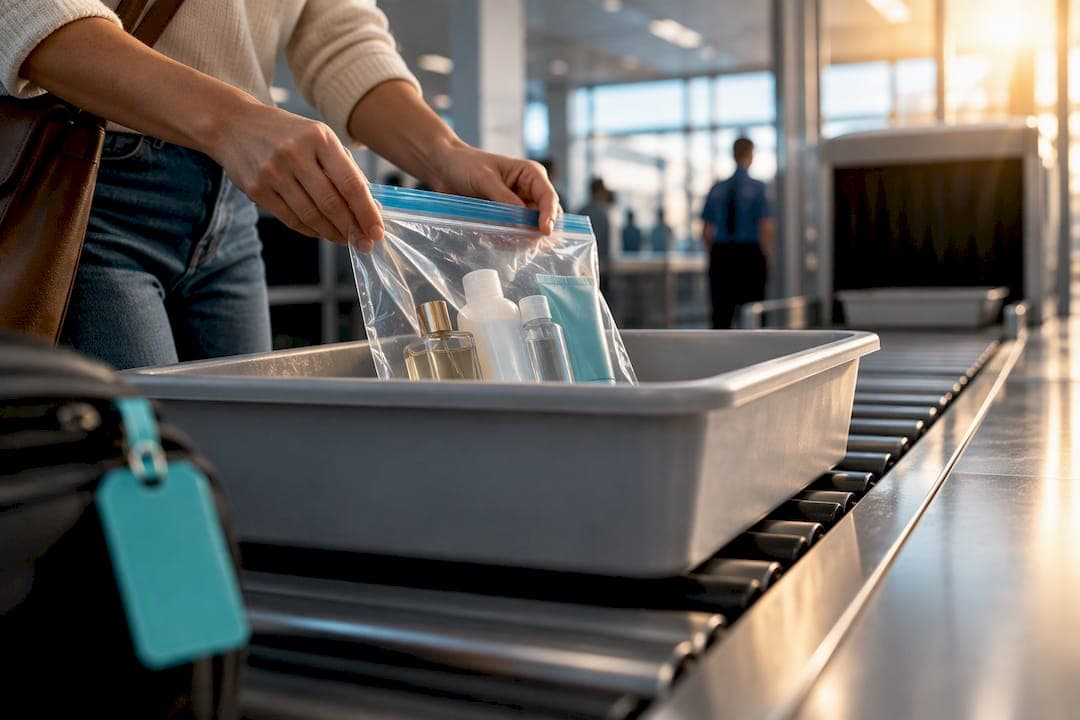
Yes, you can bring perfume on a plane. Carry-on bottles must be 3.4 ounces (100 ml) or smaller and fit inside one quart-size clear bag. Larger bottles have to go in checked luggage, wrapped and cushioned against breakage. TSA officers make the final call at the checkpoint, so anything oversized risks getting pulled and tossed.
TL;DR:
- Perfume bottles in carry-on luggage must be 3.4 ounces (100 ml) or smaller and fit inside a single quart-size clear bag; larger bottles must go in checked luggage.
- TSA measures the labeled capacity on the bottle, not the remaining perfume, so partially used containers still count as full-sized if they exceed 100 ml.
- Using decants, travel sprays, or cushioning protective packaging can help prevent leaks and breakage during airport security checks and baggage handling.
- Duty-free large bottles are allowed in sealed, tamper-evident bags with the receipt visible, but may face issues at connecting airports depending on security protocols.
- Fashioning your scent with lighter options and spraying before security helps avoid inconveniences and consideration from fellow travelers sensitive to strong fragrances.
Table of Contents
- Perfume on Plane Rules: The TSA 3-1-1 Standard Explained
- Packing Perfume in Your Carry-On Without a Mess
- Checked Luggage Rules: FAA Limits and Breakage Risk
- The Duty-Free Loophole and Why Connections Complicate It
- Should You Wear Perfume on a Plane?
- If Your Perfume Gets Confiscated or Breaks in Transit
- Where to Find Travel-Ready Perfume and Decants
- Customs Rules for Perfume When You Land
- How Perfume Rules Differ From Country to Country
- Buying Perfume at the Airport: What to Know Before You Shop
- Editorial Take: Pack Smart, Wear Light
- Travel-Ready Fragrances Without the Guessing Game
- Sources
- FAQ
Perfume on Plane Rules: The TSA 3-1-1 Standard Explained
The rule that governs perfume in your carry-on is the same one that governs shampoo, contact solution, and hand sanitizer: 3-1-1. Three ounces max per container (rounded to 3.4 oz / 100 ml), one quart-size clear resealable bag, one bag per traveler. Perfume fits into that liquids category the same as anything else that pours or sprays.
Here's the part that trips people up: TSA measures the bottle's printed capacity, not how much perfume is actually left inside. A nearly empty 3.5-ounce bottle still reads as a 3.5-ounce container, and it still gets flagged. The label size is what an officer checks, not the liquid level.
That distinction matters because a lot of travelers assume a half-used bottle is fine. It isn't, at least not by the letter of the rule. If the bottle says 100 ml on the glass, it counts as 100 ml no matter what's sloshing around inside it.
A few practical points worth locking in before you pack:
- Perfume must be included in your one-quart liquids bag together with other gels, lotions, and liquids you bring.
- Your liquids bag must seal properly; an overfilled bag that does not close may require repacking.
- TSA officers have final authority over what passes through screening, and they can confiscate any container that exceeds the limit, no appeal process at the checkpoint.
- Decorative or unusually shaped bottles sometimes require a second look, which slows you down but rarely results in confiscation if the size is compliant.
Bringing a bottle clearly within allowed size speeds up the security process.
Packing Perfume in Your Carry-On Without a Mess
Getting perfume through security cleanly comes down to a few habits, not luck. Follow these in order:
- Buy or decant into a travel-size container. Anything at or under 3.4 oz (100 ml) qualifies, and clearly labeled travel sprays move through screening faster than a bottle an officer has to squint at.
- Place it where it's visible. Put the perfume near the top of your quart bag instead of buried under lotion tubes. Officers move faster when they can see what they're looking at.
- Protect the sprayer. A loose atomizer top is the number one cause of leaks in a carry-on. Tape over the nozzle or use a small cap cover before it goes in your bag.
- Cushion the glass. Wrap the bottle in a sock or slide it into a padded pouch so it isn't rattling against your laptop charger or a water bottle.
- Consider a decant instead of the full bottle. If you're traveling with a $200 bottle of niche fragrance, decanting a small amount into a travel atomizer protects the original and keeps you well under the limit.
Pro Tip: Keep the perfume in its original box or a hard travel case if you're bringing something expensive. A hard shell does more to prevent breakage than any amount of clothing padding.
Samples and decants make the most sense for short trips. Full bottles make sense only when you're gone long enough to justify carrying the weight and the risk.
Checked Luggage Rules: FAA Limits and Breakage Risk
Checked bags play by different math than carry-ons. Under FAA PackSafe guidance, toiletries in checked luggage can go up to 500 ml (17 oz) per container, with a combined aggregate cap of roughly 2 liters (2 kg) of restricted toiletry and medicinal items per traveler. That gives you far more room than the carry-on limit, but it comes with tradeoffs.
Cargo holds swing in temperature and pressure during flight, which can be rough on delicate fragrance compositions over time. Checked bags also get tossed, stacked, and dropped by handlers who aren't thinking about your glass bottle. A full-size bottle that survives the trip intact still might come out smelling slightly different if it sat in extreme heat or cold on the tarmac.
Minimize the damage with a few habits:
- Use resealable plastic bags to double-bag perfume bottles to protect your luggage in case of leaks.
- Place perfume bottles cushioned in clothing near the center of your luggage to avoid damage.
- Avoid packing perfume near the top or sides, where impact from handling is most likely.
- Skip checked luggage entirely for anything irreplaceable or discontinued. Ship it separately or leave it home instead.
The Duty-Free Loophole and Why Connections Complicate It
Duty-free perfume is the one exception to the 3.4-ounce carry-on ceiling. A bottle larger than 100 ml can travel in the cabin if it's sold in a tamper-evident, sealed security bag with the receipt visible inside. Airport security accepts this because the bag proves the liquid was screened and sealed after your last checkpoint, not before.

Connecting flights are where this exception gets shaky. If your itinerary routes you through a second airport with its own security screening, that country's rules on sealed duty-free bags may not match the ones where you bought the bottle. Some airports honor the seal; others require you to check the bag or open it for inspection.
Protect yourself with a short checklist:
- Keep the receipt inside the sealed bag at all times.
- Don't open the bag until you've cleared your final security checkpoint before boarding.
- Check whether your connecting airport recognizes duty-free tamper-evident bags before you fly, especially on international itineraries.
When in doubt, treat a large duty-free bottle like checked luggage material and pack it accordingly rather than risk losing it at a connection.
Should You Wear Perfume on a Plane?
There's no rule against wearing perfume on a flight. That said, a cabin is a sealed metal tube with recycled air and strangers sitting inches from you, which makes strong fragrances land differently than they would in an open room. Fragrance experts and travel writers generally recommend skipping heavy, projection-heavy scents in favor of something lighter for the flight itself.
Cabin airflow circulates constantly, and strong cologne or perfume in tight quarters has sparked enough passenger complaints to become a recurring travel etiquette debate. Some fellow travelers have genuine allergies or migraines triggered by heavy fragrance, and there's nowhere to escape it in a middle seat.
A few habits keep you considerate without giving up scent entirely:
- Wear perfume before arriving at the airport rather than spraying it onboard.
- Avoid spraying perfume inside the airplane cabin.
- Opt for lighter, less intense scents during travel, reserving stronger perfumes for your destination.
- If you want scent without spray, a lightly perfumed lotion or deodorant does the job with far less spread.
Pro Tip: Scent your scarf or jacket lightly before you pack it, rather than spraying yourself right before boarding. The fragrance mellows by the time you're in your seat.
If Your Perfume Gets Confiscated or Breaks in Transit
Two things go wrong most often: a bottle gets pulled at security, or a bottle breaks in checked luggage. Here's how to handle each.
- If it's confiscated at the checkpoint: the decision is final. TSA officers won't return an oversized container, so don't argue the point. Ask if there's a mail-back kiosk nearby; some airports offer one for a fee.
- If it breaks in checked luggage: photograph the damage immediately, keep the broken bottle and any leaked packaging, and file a claim with the airline's baggage counter before you leave the airport.
- Carry backup supplies: a couple of extra zip-top bags, tissue, and a strip of tape in your carry-on solve most minor leaks on the spot, whether it's your perfume or someone else's suitcase that sprung a leak.
Where to Find Travel-Ready Perfume and Decants
Parfumla's Decants & Samples selection exists for exactly this problem: getting a real fragrance experience into a bottle small enough to clear security without a second thought. Instead of gambling on whether a full bottle survives cargo handling, a decant gives you the scent in carry-on-friendly form.
Parfumla's blog also breaks down the mechanics in more depth, including step-by-step TSA-safe packing methods and safe ways to decant perfume for travel if you're working from a full-size bottle at home. With over 14,000 fragrances in the catalog and detailed reviews on most listings, finding a travel-appropriate scent takes minutes, not a shopping trip.
Customs Rules for Perfume When You Land
Getting perfume through airport security is only half the equation. Customs allowances on arrival vary by country, and they're separate from anything TSA or the FAA enforces at departure.
Most countries set a duty-free personal allowance for perfume, often expressed as a value limit (like $800 for returning US residents) rather than a strict volume cap, though some nations do cap fragrance imports by milliliter. Exceed the declared value or volume threshold and you may owe import duty on the difference, or in stricter jurisdictions, face confiscation of the excess.
A few things shift the calculation:
- Commercial quantity suspicion. Arrive with a suitcase full of identical, unopened bottles and customs agents may assume you're reselling rather than traveling with personal items, which can trigger extra scrutiny or duty charges.
- Opened versus sealed bottles. A bottle you're clearly using personally, half empty, cap loose, faces far less scrutiny than a shrink-wrapped case of full bottles.
- Country-specific caps. Some countries in the Gulf region and parts of Asia impose tighter restrictions on cosmetics and fragrance imports than the US or EU do, sometimes requiring declaration above a modest threshold.
The safest approach is to travel with quantities that obviously match personal use, one or two bottles rather than a suitcase full, and to keep receipts if a customs officer asks about value. When you're unsure of a specific country's threshold, checking that country's customs website before departure beats guessing at the airport.
How Perfume Rules Differ From Country to Country
The 3-1-1 carry-on rule isn't universal law. It's a US framework that most countries have adopted in some form, but the details shift once you leave American airports.
The European Union, United Kingdom, Canada, and Australia all use a version of the same 100 ml carry-on cap and clear-bag requirement, largely because international aviation security cooperation pushed most major aviation authorities toward matching standards after liquid explosive threats in the mid-2000s. That's good news if you're flying between major hubs. Your carry-on perfume that passed screening in Chicago will pass the same way in London or Toronto.
Where things diverge is enforcement style and the treatment of duty-free exceptions. Some countries are stricter about connecting-flight duty-free bags than others, as covered earlier. Others allow slightly different bag sizes or don't require the liquids bag to be a specific brand or type, just a clear resealable one.
A handful of countries also impose fragrance-specific import restrictions unrelated to airport security. Certain markets restrict perfumes containing particular animal-derived ingredients or high alcohol concentrations for reasons tied to local regulation rather than aviation safety. These rules affect what you can bring into the country long-term, separate from what clears the security checkpoint on your way there.
The practical takeaway: assume the 100 ml carry-on standard applies almost everywhere, but verify duty-free connection rules and import restrictions for your specific destination if you're carrying anything larger or unusual.

Buying Perfume at the Airport: What to Know Before You Shop
Airport duty-free shops sell perfume at prices that look like a discount but aren't always one. Duty-free removes certain local taxes, which can make prices genuinely lower than retail in high-tax countries, but in many US airports the markup on brand-name bottles roughly matches what you'd pay outside the terminal.
A few things to check before buying perfume at the gate:
- Compare before you fly. If you know what you want, check the price at home first. Airport duty-free isn't automatically cheaper, especially for popular designer names.
- Ask about the tamper-evident bag if you're connecting. If your itinerary includes another security screening, confirm the shop seals the bottle in a bag that will hold up through your connection.
- Watch bottle size against your itinerary. A duty-free bottle bought on your outbound flight and carried the whole trip needs to survive being opened and resealed, which voids the tamper-evident exception on the way home.
- Consider buying before you fly instead. Travel-size luxury perfumes purchased ahead of time, already compliant with carry-on limits, remove the guesswork entirely and usually cost less than an airport kiosk markup.
If duty-free pricing matters to your trip, understanding how duty-free fragrance pricing actually works before you land at the gate saves you from assuming a discount that isn't there.
Editorial Take: Pack Smart, Wear Light
Most perfume problems at the airport come from treating a fragrance bottle like an afterthought. Carry a travel spray for anything you actually want with you, decant the valuable stuff, and don't gamble a $150 bottle on checked cargo handling. In the air, dial the scent down. Nobody in row 24 asked for your signature fragrance at full strength for five hours.
— Parfumla
Travel-Ready Fragrances Without the Guessing Game
Packing perfume for a flight shouldn't mean choosing between leaving your favorite scent home or risking it in a suitcase. Parfumla carries decants, samples, and travel-friendly bottle sizes across women's, men's, and unisex fragrances, all drawn from a catalog of more than 14,000 perfumes at up to 60% off retail. That means you can buy the original, full-size bottle for home and a compliant decant for the trip, without paying full retail twice.
If you're shopping for someone else's travel bag, the gift sets make it easy to hand over a travel-ready fragrance without the sizing guesswork. For your own kit, start with the Decants & Samples selection, pick a scent under 3.4 oz, and check out knowing it clears carry-on rules before you even pack your bag.
Sources
- Perfume | Transportation Security Administration
- PackSafe for Passengers (FAA)
- Is Wearing Perfume on a Plane Okay? (The Cut)
FAQ
Will TSA throw away my perfume?
TSA officers can confiscate any perfume bottle larger than 3.4 oz (100 ml) at the checkpoint, and that decision is final. Bottles within the limit and properly bagged pass through without issue.
Can I bring a 3.4 oz perfume on a plane?
Yes. A 3.4 oz (100 ml) bottle is exactly at the carry-on limit and is allowed as long as it fits in your quart-size clear liquids bag.
Can you take a 100 ml bottle of perfume on a plane?
Yes, 100 ml is the maximum size TSA allows in carry-on luggage under the 3-1-1 rule. Anything larger needs to go in checked luggage or qualify under the duty-free sealed-bag exception.
Why can't I bring a full-size perfume bottle in my carry-on?
Full-size bottles typically exceed the 3.4 oz (100 ml) cap that applies to all liquids, gels, and aerosols in carry-on bags. The rule applies to the bottle's labeled capacity, not how much perfume is actually inside it.
Does Parfumla sell travel-size perfume for flying?
Parfumla offers decants and samples specifically sized for carry-on compliance, alongside full-size bottles across its women's, men's, and unisex catalogs. Current prices and available sizes are listed on the Decants & Samples page.