

The most reliable rainy day perfumes are built on petrichor, green, tea, or soft-wood accords with low to moderate sillage. Humid air amplifies projection and slows evaporation, so lighter, earthier compositions read better than heavy sweets or dense animalics. What follows covers why rain changes how perfume behaves on your skin, which notes actually earn their keep in damp weather, and specific scent directions to try the next time the forecast calls for gray skies.
TL;DR:
- Lighter, earthier scents built on petrichor, green, tea, or soft woods perform best in humid conditions, while heavy gourmands and dense ambers risk becoming overwhelming.
- Rain increases fragrance projection and causes woody notes to swell, making scents richer and more three-dimensional in wet weather.
- Applying one or two fewer sprays and testing indoors for ten minutes helps prevent over-application, as humidity amplifies scent intensity.
- Scents with vetiver, oakmoss, ozone, or mineral accords mimic rain’s fresh, damp-earth smell, while gourmand notes tend to turn syrupy in high humidity.
- Testing existing fragrances at home in humid conditions reveals how they change, guiding adjustments before purchasing or wearing new rainy-day perfumes.
Table of Contents
- How Rain and Humidity Change Perfume Performance
- Notes and Accords That Work Best for Rainy Days, and Notes to Avoid
- How to Apply and Layer Rainy Day Perfumes
- Curated Rainy Day Scent Ideas by Mood and Setting
- Why Parfumla Helps You Find Rainy Day Perfumes
- Our Take on Rainy Day Perfumes
- Sources
- FAQ
How Rain and Humidity Change Perfume Performance
Rain doesn't just cool the air. It changes the physics of how fragrance molecules leave your skin. Water vapor slows the evaporation rate of volatile top notes, which means the alcohol and citrus notes that usually flash and fade within minutes now linger a bit longer before handing off to the heart notes underneath.
That delay changes the whole experience of wearing a scent. Perfumes tend to project more easily in damp air, because moisture in the atmosphere helps carry aromatic molecules farther from your skin than dry air does. A fragrance that feels restrained on a crisp autumn day can suddenly fill an elevator on a humid one.
Woods respond to this shift in a particularly interesting way. High humidity can make woody notes swell and feel more three-dimensional, giving cedar or sandalwood a tactile, almost creamy richness that dry conditions rarely produce. Moisture slows the evaporation of top notes long enough that the mid and base molecules, the woods, mosses, and resins, start speaking earlier and louder than they would on a sunny afternoon.
Not every note family benefits from this effect.
- Woods, mosses, and green notes tend to bloom and gain depth in humid air, often smelling richer than they do when dry.
- Light resins and clean musks hold steady, adding warmth without tipping into heaviness.
- Heavy gourmands (thick vanilla, caramel, boozy accords) can turn syrupy and cloying once humidity boosts their projection.
- Dense amber and strong animalic notes risk becoming suffocating in close, damp spaces like offices or crowded transit.
That last point matters more than most people realize. A scent that reads as "rich but wearable" in dry weather can tip into overwhelming once the air itself is doing extra work to carry it.
Statistic Callout: Search interest in petrichor-style fragrances jumped by roughly 94.4% year over year, according to Spate Data cited by Allure. That's not a niche curiosity anymore. Shoppers are actively hunting for scents that smell like rain hitting pavement, and the fragrance industry is responding with more petrichor-driven releases.
The practical takeaway: start lighter than you think you need to. Apply one or two sprays instead of your usual three or four, then reassess after ten minutes once the humidity has had a chance to work on the composition. You can always layer more; you can't easily undo an overdose in a stairwell.
Notes and Accords That Work Best for Rainy Days, and Notes to Avoid
Petrichor is the scent of rain hitting dry earth, and perfumers have spent years reverse-engineering it without using the actual chemical (geosmin) that produces it in nature. Geosmin itself skews musty and unpleasant at higher concentrations, so instead perfumers build the impression using vetiver, oakmoss, patchouli, violet leaf, galbanum, and ozonic or mineral accords. The result is a balanced wet-earth effect rather than a literal, off-putting mustiness.
Editors and perfumers consistently point to petrichor, green notes, tea accords, mosses, and soft woods as the strongest rainy-day directions, because they evoke damp leaves, wet stone, and dewy air rather than fighting against the weather. Here's how to think about each category:
Petrichor and mineral accords. These lean on vetiver, ambroxan, and ozonic aroma chemicals to mimic the smell right after a storm breaks. If you gravitate toward scents that feel like standing outside during the first few minutes of rain, look for fragrances marketed around vetiver or "ozonic" descriptors. Ex Nihilo's Vetiver Moloko leans into that damp-vetiver territory, and it's worth sampling if petrichor is your primary target.
Green leaves and watery florals. Dewy rose, crushed stems, and tea accords bring freshness without the sweetness that turns cloying in humid air. A rose that reads "green" rather than "jammy" tends to hold its shape better on a wet day. Louis Vuitton's Rose des Vents style of composition, available through Parfumla's Rose des Vents Eau de Parfum, pairs a dewy floral heart with an ozonic edge that suits overcast weather particularly well.
Soft woods, mosses, and vetiver. These are the backbone of most petrichor compositions, and they're exactly the note family that gains tactile richness in humidity. Patchouli-forward scents like Tom Ford's Patchouli Absolu become noticeably more textured once the air carries moisture, trading a dry, dusty character for something closer to wet forest floor.
Light resins and clean musks. These handle the "cozy without heavy" job. A thin veil of incense or a soft musk base keeps a fragrance grounded through a damp afternoon without adding the density that pushes a scent into overpowering territory once projection increases.
What to avoid or dial back:
- Thick vanilla and caramel gourmands, which turn syrupy once humidity boosts their sillage
- Dense oud or amber blends layered on thick, which can read as heavy rather than warm
- Strong animalic notes (civet-style, heavy musk overdoses), which intensify uncomfortably in close, humid spaces
- Anything you'd call "loud" in dry weather, since rain will only turn the volume up further
Pro Tip: If you're drawn to a gourmand scent but don't want to abandon it entirely on rainy days, apply it only to clothing rather than skin. Fabric holds fragrance at a slightly lower intensity than skin does, which can keep a sweet composition from tipping into cloying once humidity amplifies its reach.
How to Apply and Layer Rainy Day Perfumes
Getting a rainy-day fragrance right is less about the bottle you choose and more about how you put it on. Humidity changes the math, so the usual application habits need small adjustments.
-
Start with a low-sillage base. Choose something with naturally restrained projection, sheer woods, soft musks, or a light petrichor accord, and apply one spray fewer than you normally would. You're compensating for the extra lift that damp air provides.
-
Place your spray on skin for warmth, on clothing for control. Skin heat helps a scent develop its full arc, but on very humid days a spray on a scarf or coat lapel gives you the aroma at a distance that feels intentional rather than overwhelming. Layering strategy for rainy season prioritizes low-projection bases precisely because indoor spaces trap humidity-boosted scent more than open air does.
-
Build with a second, complementary layer rather than more of the same. Rather than doubling your base fragrance, add a thin layer of a petrichor or tea-accord scent on top. This combination creates a cohesive, indoor-friendly aura instead of one dense, single-note cloud.
-
Try a few go-to layering templates. A vetiver base with a drop of green tea eau de cologne reads crisp and contemplative. A soft cedar scent topped with a sheer musk feels cozy without tipping heavy. A mineral, ozonic fragrance paired with a single spray of a light floral keeps things fresh for city rain on hot pavement.
-
Run a ten-minute indoor test before you commit. Spray, wait ten minutes in a closed room, and see how the scent has evolved. If it's already loud at the ten-minute mark, it will likely be too much by the two-hour mark once your body heat and the ambient humidity keep working on it.
Parfumla's guide on wearing perfume in humid weather walks through more of these adjustments if you want a deeper dive into seasonal application habits.
Curated Rainy Day Scent Ideas by Mood and Setting
Not every rainy day calls for the same fragrance. The scent that suits a quiet, introspective morning indoors isn't the one you want for a brisk walk through city drizzle. Four mood buckets cover most of what rainy weather asks of a fragrance wardrobe.
The introspective, book-and-blanket mood
This calls for architecture built on soft woods, a whisper of resin, and a clean musk base, nothing loud, nothing that competes with silence. Think cedar and sandalwood with a thin veil of incense, or a vetiver base softened by a touch of iris.
- Archetype one: cedar, sandalwood, and white musk, quiet and warm without being sweet.
- Archetype two: vetiver, iris, and ambroxan, restrained and slightly powdery.
- Archetype three: a touch of frankincense over soft musk, cozy without heaviness.
Patchouli Absolu fits here particularly well once humidity thickens the air. Its dusty character in dry weather turns into something closer to damp forest floor when the moisture level rises, which suits the mood exactly.
The cozy indoor, cabin retreat mood
This is where tea accords earn their keep. Black tea, green tea, and soft spice create warmth without the density of a gourmand. If you're drawn to the smell of a kettle on the stove and rain against the window, this bucket is yours.
- Archetype one: black tea and bergamot, with a soft woody dry-down.
- Archetype two: green tea, light musk, and a hint of fig leaf.
- Archetype three: chai-adjacent spice (cardamom, clove) softened by sandalwood rather than vanilla.
- Archetype four: oolong tea layered over a thin cedar base.
Winter tea blends built for warming, the kind found in specialty tea guides, share a lot of the same aromatic logic that makes tea-accord fragrances feel so fitting for indoor rainy days: warm spice, gentle astringency, and a lack of cloying sweetness.
The fresh outdoor drizzle mood
Light rain on grass and leaves calls for green, dewy compositions. This bucket leans on crushed stems, wet grass, and a floral heart that stays green rather than turning heavy.
- Archetype one: galbanum and green tea, sharp and clean.
- Archetype two: dewy rose with a green stem accord, floral without sweetness.
- Archetype three: violet leaf and light musk, soft and slightly bitter-green.
The Rose des Vents composition mentioned earlier suits this bucket especially well, since its floral core stays anchored by an ozonic edge rather than drifting into anything syrupy.
The urban petrichor mood
Editors note that urban rain on hot concrete reads mineral and ozonic, while forest rain reads more like wet wood and moss. This bucket is for city dwellers who want the smell of rain hitting pavement rather than rain in a forest.
- Archetype one: ambroxan and vetiver, a clean, mineral opening.
- Archetype two: a synthetic, ozonic-forward composition with a musky base, exactly the territory ESCENTRIC MOLECULES' Escentric 02 occupies.
- Archetype three: oakmoss and patchouli with a light citrus top, grounded rather than sweet.
Adjust any of these for temperature as well as humidity. On a cold, wet day, lean toward the resin and wood side of a formula. On a warm, humid day, the same fragrance may already read louder than you expect, so pull back the application and let the green or tea notes carry more of the weight.
Why Parfumla Helps You Find Rainy Day Perfumes
Finding the right rainy-day bottle usually means testing dozens of options you can't easily sample in one place. A comprehensive perfume catalog spanning mainstream, niche, and celebrity lines can make it realistic to search by note rather than by brand alone.
- Search directly for vetiver, tea, moss, or ozonic descriptors instead of guessing which brand carries what you're after.
- Reading detailed product reviews before buying can help confirm whether a fragrance actually reads "damp and earthy" versus "dry and dusty" the way you'd expect.
- Comparing prices across popular and niche lines side by side can help shoppers find savings on retail prices.
- Rely on consistent shipping options to ensure a petrichor pick ordered for autumn arrives before the season passes.

If you already know you want something in vetiver or patchouli territory, Ex Nihilo's Venenum Kiss is worth a look for a more layered, niche take on damp-weather depth. Buy your rainy-day perfume online through Parfumla for the best price on original bottles, and check the catalog before the next storm rolls in.
Our Take on Rainy Day Perfumes
The conventional advice treats rainy-day fragrance as an afterthought, wear whatever you'd normally wear, just carry an umbrella. That misses the actual chemistry at work. Humidity is an active ingredient in how your perfume performs, not a passive backdrop, and treating it that way is why so many people end up smelling overpowering in an elevator on a wet Tuesday.
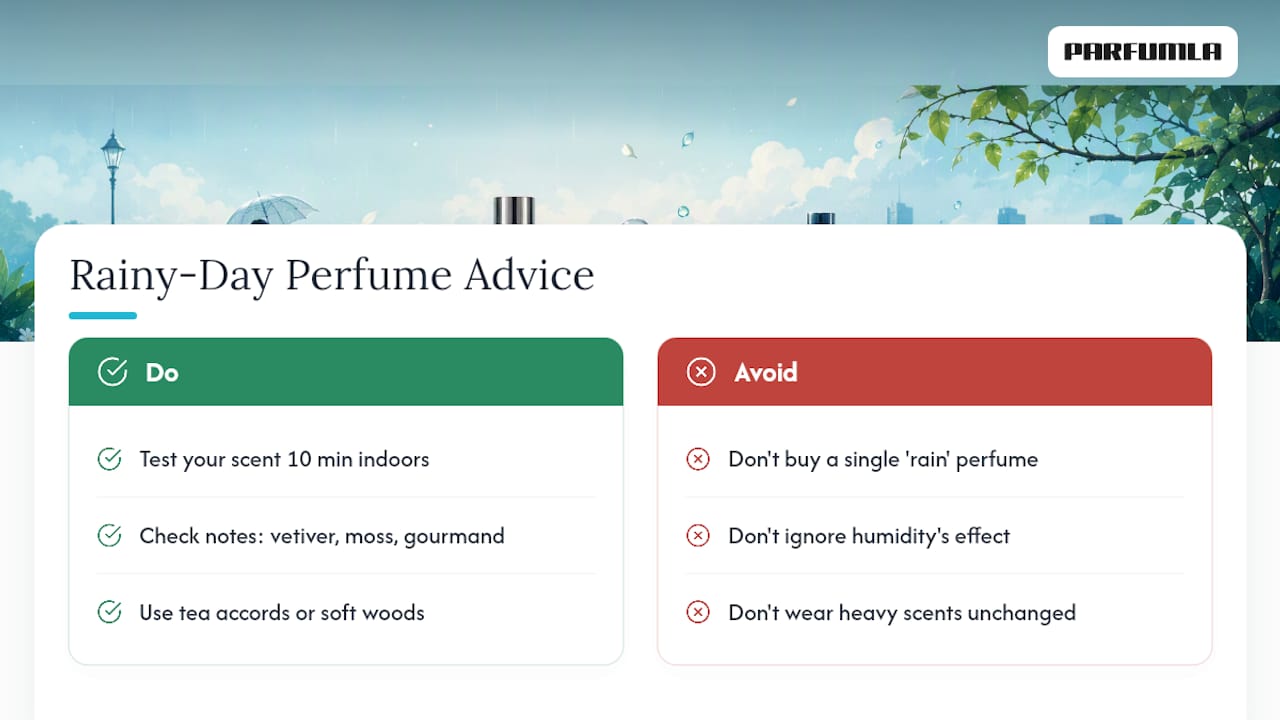
What's overrated: hunting for one single "rain perfume" to buy and wear on repeat. What matters more is understanding note behavior, vetiver and moss bloom, gourmands turn syrupy, so you can adjust whatever is already in your collection. The reader's first move shouldn't be buying something new. It should be testing what you own at ten minutes indoors on a humid day and noticing what changes.
Petrichor as a category deserves the attention it's getting, but it's not the only answer. Tea accords and soft woods do quieter, equally effective work for the indoor, cabin-retreat mood that most rainy days actually call for.
— Parfumla
Sources
The claims in this guide draw on a handful of sources worth reading directly if you want more detail on how weather changes perfume chemistry and which accords perfumers reach for.
- Perfumes for Rainy Days ~ Columns
- The 15 Best Petrichor Scents of 2026, According to an Editor
- Best Layering for Rainy Season: Tea, Petrichor, Musks | WhatScent Magazine
- Petrichor and why perfumes that smell like rain are trending
FAQ
What is the best perfume that actually smells like rain?
Fragrances built around vetiver, oakmoss, and ozonic or mineral accords come closest to the actual smell of rain, since these ingredients are what perfumers use to construct petrichor impressions without relying on musty geosmin itself.
What is the best perfume for rainy season?
Low-sillage compositions built on soft woods, tea accords, or light petrichor bases perform best, because humid air naturally boosts projection and a restrained starting point avoids becoming overpowering indoors.
What is the best petrichor perfume?
There isn't one single best bottle, since petrichor-style effects appear across niche and mainstream fragrances alike, but editors point to vetiver, patchouli, oakmoss, and violet leaf as the accord combination to search for. Parfumla's catalog lets you filter by these specific notes across thousands of options.
What perfume smells like rain?
Any fragrance leaning on vetiver, galbanum, oakmoss, or ozonic aroma chemicals will read as rain-like, since these are the building blocks perfumers use to recreate the wet-earth petrichor effect synthetically.
Should I apply rainy-day perfume differently than usual?
Yes. Use one spray fewer than your usual amount and test for ten minutes indoors before deciding, since moisture in the air slows evaporation and extends projection, which can make a normally moderate fragrance feel much stronger than expected.