
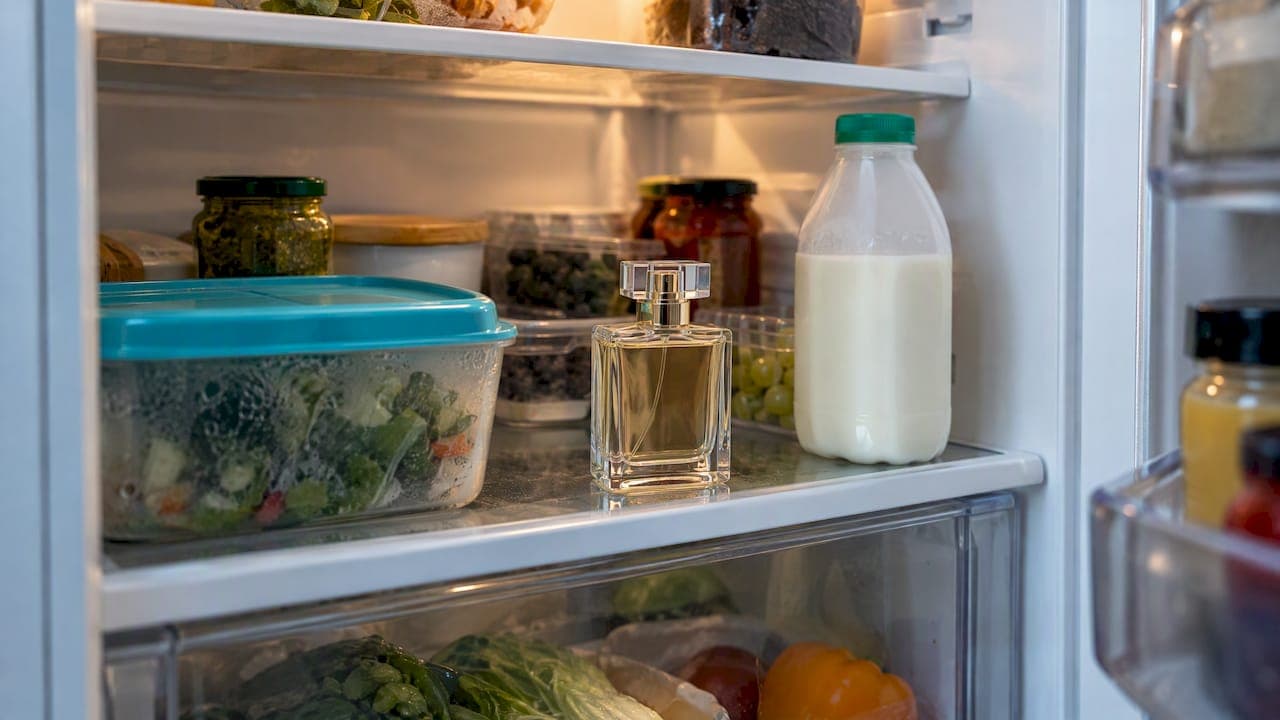
For most people, no. A standard kitchen fridge is colder and damper than a fragrance is designed for, and the repeated trips between cold and room temperature can do more harm than the cool does good. What your perfume needs is a cool, dark, stable spot, and a drawer or closet away from windows usually does the job.
The longer answer has a few exceptions, and they are worth knowing, especially if you live somewhere hot or you own bottles you would hate to lose. Below you will find what a fridge does to the liquid, what temperature range to aim for, when a wine cooler makes sense, and how to store everything else.
TL;DR
- A household fridge runs about 3 to 5°C (37 to 41°F) with high humidity, which is too cold for most fragrances and can cloud the liquid.
- The real enemies are heat, light, air and swings in temperature. Steady room temperature in a dark closet beats a fridge for nearly everyone.
- If your home gets very hot, a wine cooler or a mini fridge set to a gentle temperature is the only cold option worth considering.
- The bathroom is the worst place for a bottle. Keep boxes, caps and sprayers closed and bottles upright.
- When a bottle is nearly empty, moving the last of it to a smaller atomizer slows oxidation.
Table of Contents
- Why people put perfume in the fridge
- What a regular fridge does to perfume
- What perfume really needs
- Where to store perfume at home
- When cold storage makes sense
- Our perspective at Parfumla
- How long does perfume last, and how to tell it has turned
- Does perfume last longer in the cold?
- Slowing oxidation once a bottle is half empty
- Small habits that add years
- Buying so storage matters less
- FAQ
- Sources
Why people put perfume in the fridge
The logic is sound on the surface. Perfume breaks down through oxidation, and chemical reactions slow when things get colder. Light, heat, air and moisture are the usual culprits, so a cold, dark box looks like the ideal vault.
The idea gets a boost in summer, when a bedroom can sit well above comfortable temperatures. It also spreads among collectors who own expensive or discontinued bottles and want to stretch their life.
The trouble is that "cooler is better" only holds up to a point. Perfume is a blend of aromatic compounds, alcohol and sometimes heavy materials such as resins and musks. That blend was formulated to stay uniform at ordinary room temperatures, not at the temperature of your milk.
What a regular fridge does to perfume
Cold and humidity work against the formula
Domestic fridges run at roughly 3 to 5°C (37 to 41°F), with humidity of 70 to 85%, according to a fragrance shelf-life guide. The same source notes that fragrances are formulated to stay homogenous at standard room temperature, 15 to 25°C (59 to 77°F).

Below that range, some ingredients can start to drop out of solution. The guide describes natural waxes, heavy resins and high-molecular-weight musks as the likely culprits, which may leave cloudiness or crystals at the bottom of the bottle. If you see haze after a stay in the fridge, the scent may no longer smell the way it did, and the change may not reverse.
Taking it in and out causes thermal shock
The second problem is less obvious. If you keep a bottle cold and pull it out every morning, the liquid and the air inside it expand and contract with each trip. According to one storage guide, this can pull fresh oxygen in past the seal and speed up oxidation, which is exactly what you were trying to prevent.
In plain terms: a fridge that stays constant and is rarely opened is less risky than a fridge you use daily. A bottle you wear every day is a poor candidate for cold storage.
Condensation on the bottle
A cold bottle meets warm, humid air and gets wet. That moisture can sit around the cap and sprayer and wet the box and label. It is a minor annoyance for a bottle you keep for a month, and a real nuisance for a collection you want to keep looking pristine.
What perfume really needs
The pattern across sources is consistent. Fragrance is sensitive to heat, light and oxygen, and once a bottle is opened, its aromatic compounds gradually begin to oxidize. Heat, UV rays and humidity accelerate the process.
That gives you a short checklist:
- Stable temperature. Avoid swings more than any single number.
- Darkness. Direct sun is the fastest way to damage a bottle, especially a clear glass one.
- Low humidity. Dry air is kinder to labels, boxes and sprayers.
- Minimal air. Keep the cap on, and keep the bottle upright.
The best temperature to store perfume
A sensible target is the cool end of room temperature. One perfume retailer's guide gives 60 to 70°F (15 to 21°C) as a comfortable window with minimal swings, and the shelf-life guide above gives 15 to 25°C (59 to 77°F) as the range fragrances are built for. In practice, anywhere in the low 60s to low 70s °F is a good home for your bottles.
If you want an exact figure, the same shelf-life guide says 12 to 15°C is what professional fragrance stabilization uses, with controlled humidity. That is a storage-facility setting, not something you need to chase at home. Consistency matters more than hitting a precise number.
Where to store perfume at home
| Spot | Verdict | Why |
|---|---|---|
| Closet shelf or dresser drawer | Best everyday choice | Dark, dry and usually steady |
| Original box, inside a cabinet | Excellent | Adds a layer against light and temperature shifts |
| Wine cooler at a gentle setting | Good for hot homes and collections | Stable cool temperature, as long as humidity is managed |
| Kitchen fridge | Usually not worth it | Too cold and humid, with cold-to-warm trips |
| Bathroom counter or cabinet | Avoid | Hot showers and humidity |
| Windowsill or vanity in sun | Avoid | Light and heat |
| Car glovebox or trunk | Avoid | Temperature extremes |
The bathroom is often called the "perfume graveyard" because hot showers cause heat spikes and humidity, which degrade the oils quickly. If your bottles live on a bathroom shelf because they look nice there, move them.
For a deeper walk through room-by-room storage, our guide on how to store perfume covers wearers and collectors separately.
When cold storage makes sense
There are three cases where going cooler is reasonable.
You live in a very hot climate. The shelf-life guide advises against the fridge unless you live in an extremely hot climate, where the benefit starts to outweigh the risks. If your home regularly climbs into the 80s or 90s °F with no air conditioning, a cold option deserves a look.
You own rare or hard-to-replace bottles. A collector with limited editions might reasonably keep backups in a controlled spot. Just keep them sealed, in the box, and leave them alone.
You are storing backups, not daily wearers. The bottle you spray every morning should stay at room temperature, in a closet. The unopened spare can sit in the cooler spot.
A wine cooler, not the kitchen fridge
If you do go cold, a wine cooler or a small beauty fridge set to a gentle temperature is the safer cousin of the kitchen fridge. Even a retailer that sells perfume fridges concedes that a low-vibration beauty fridge on a moderate setting can hold temperature steadier than a room, while extremely cold conditions or constant swings are as stressful as heat.
A few rules make this work:
- Aim for the low 50s to mid 60s °F (roughly 12 to 18°C), not fridge-cold.
- Keep bottles in their boxes, caps on, upright.
- Check humidity if the unit has a gauge. Wine coolers are often designed for damp conditions that suit corks, not sprayers.
- Open it as rarely as you can.
- Never move a bottle straight from cold storage to your skin. Let it come up to room temperature first, for a few hours, in its box.
We go into setup details in when to refrigerate perfume.
Our perspective at Parfumla
We sell discounted fragrance, so we see the same two situations all the time. One is a shopper who buys a bottle, wears it down over a year or two, and wants to know why it smells a bit sharper than when it arrived. The other is someone building a small collection who wants to protect every bottle.

For the first person, a fridge is the wrong fix. Their bottle is almost always suffering from air, heat or a sunny shelf. Moving it to a closet, keeping the box and recapping it every time fixes most of what they notice. For the second person, the fridge debate comes down to climate and discipline. If their home stays cool, they gain little. If it does not, a gentle, stable cooler is a better answer than a kitchen fridge.
Our advice is boring on purpose: buy bottles you will actually wear, store them dark and steady, and use them within a sensible window. A fragrance that gets worn is never wasted. That is also why we offer decants and samples, so you can try a scent before committing to a large bottle you may not finish.
— Parfumla
How long does perfume last, and how to tell it has turned
There is no strict regulation on perfume shelf life. The general range after opening is 1 to 5 years, depending on storage. Many manufacturers suggest tossing a bottle one to three years after opening, though a bottle kept dark and stable can last longer. The Fragrance Foundation's president has said that lifespan depends on ingredients, storage and when it was unsealed.
Ingredients matter. Citrus top notes oxidize fastest, while woods and ambers hold up better. A light cologne of lemon and bergamot will tell you it is aging sooner than a dense amber.
Signs a bottle has turned:
- A sour, metallic or plastic-like smell, especially in the top notes
- A darker color than you remember
- Cloudiness or particles in the liquid
- A scent that fades much faster than it used to
If you see any of these, stop wearing it on your skin and replace it. For a fuller breakdown, see our piece on how perfume quality changes over 1 to 5 years.
Does perfume last longer in the cold?
This is a different question from storage. Perfume stored cold may age more slowly in theory, but perfume on your skin in cold weather tends to project less, because lower temperatures slow evaporation. If you have ever felt that a scent barely registers on a winter day, that is the reason. It is not a sign the bottle is damaged.
What matters for storage is that the bottle itself stays steady. Wearing a scent in winter or summer does not change what is inside the bottle.
Slowing oxidation once a bottle is half empty
Air is the quiet factor. As you use a bottle, the headspace grows, and a half-empty bottle holds more oxygen that speeds up oxidation. Experts recommend moving the remaining liquid into a smaller travel atomizer to reduce contact with air.
Here is how to do it well:
- Choose a clean atomizer sized close to the amount you have left.
- Transfer slowly, ideally with a small funnel or the bottle's own sprayer removed carefully.
- Fill it nearly to the top, then cap it.
- Label it with the name and date.
- Store it like any other bottle: dark, cool, upright.
The small bottle has the bonus of fitting in a bag. Our step-by-step on four safe ways to decant perfume covers the methods and the common spills. If you are curious how lighter products age in comparison, this look at body mist versus perfume explains why those two behave differently day to day.
Small habits that add years
- Keep the box. It blocks light and cushions temperature swings.
- Cap every time. Leaving a bottle uncapped lets alcohol and top notes escape.
- Stand it upright. One retailer guide notes that keeping bottles upright helps prevent leakage and evaporation. Check the claim against your own bottle, as sprayers vary.
- Do not shake. Shaking adds air and can stir the liquid.
- Do not warm it in your hand for minutes. Spray and put it back.
- Buy sizes you can finish. A 100 ml bottle you wear twice a week can outlast its best years.
Travel and heat
Heat is hardest on bottles that travel. A hot car or checked bag can push temperatures far past what your closet ever sees. If you fly with fragrance, carry-on limits matter, and we have written up the details in how to pack perfume for travel and the rules in bringing perfume on a plane.
Buying so storage matters less
Storage is easier when you buy fresh, authentic stock and the right size. If you want to buy original perfume online, look for a seller that guarantees authenticity and ships promptly, so the bottle has not sat in a warehouse for years. A reasonable test is whether the retailer offers samples or decants, since trying a scent first means you only commit to a full bottle you will use.
At Parfumla, we carry over 14,000 fragrances, with savings of up to 60% off retail prices and a 100% authenticity guarantee. If you are looking for the best price on a designer bottle, start with our women's fragrances, men's fragrances or unisex fragrances. To try before you commit, see our decants and samples. Buying a gift? Browse the gift sets, where smaller bottles suit a shelf or a drawer.
Not sure how to evaluate a scent before you buy? Our guide to testing perfume properly walks through it.
FAQ
Is it okay to store perfume in the fridge?
It is not harmful in every case, but it is rarely helpful. A kitchen fridge is colder and more humid than most fragrances are made for, and frequent moves in and out can pull in oxygen. A dark closet is the better default.
What is the best temperature to store perfume?
Aim for steady, cool room temperature, about 60 to 70°F (15 to 21°C). Stability matters more than the exact number, so avoid spots that heat up and cool down, such as bathrooms and sunny windowsills.
Can I wear 10-year-old perfume?
It depends on the bottle and how it was kept. Most manufacturers suggest replacing perfume one to three years after opening, though a well-stored bottle may last longer. If it smells sour, metallic or plastic-like, or looks cloudy or darker, do not put it on your skin.
How do I preserve perfume smell?
Keep it in its box, in a dark, dry, steady spot, with the cap on and the bottle upright. Avoid the bathroom and the car. When the bottle is half empty, consider moving the rest to a smaller atomizer to reduce air.
Sources
- Can Perfume Go Bad? Fragrance Shelf Life & Storage Guide
- How to Store Perfume in Summer: Expert Tips to Protect Your Fragrance
- Does Perfume Expire? (Well+Good)
- Should you store perfume in the fridge to make it last longer? (GQ India)
- The Signs Your Perfume Has Expired, According to Fragrance Experts (Yahoo)
- Should You Put Perfume in the Fridge?
- The Best Way to Store Perfume