

Yes, you can spray perfume on clothes, and the scent often lingers longer there than on skin. The catch is fabric. Washable cottons and wools usually handle a light mist well. Silk, satin and pale garments carry a risk of marks, so test a hidden spot first and keep the bottle at arm's length. This guide covers where to spray, how far away, which fabrics to skip, how to treat a mark if one shows up, and how to store your bottles so they smell the way you bought them.
TL;DR
- Mist washable fabrics lightly from a distance, and move the garment through the spray instead of soaking one spot.
- Skip silk, and test a hidden seam first on satin or light colors, because some formulas can leave marks.
- Perfume tends to last longer on fabric, but it needs skin and warmth to bloom, so many people use both.
- For a fresh mark, dab with cold water and never put the item in the dryer until the stain is gone.
- Keep bottles in their original boxes at a steady room temperature.
Table of Contents
- Should you spray perfume on clothes?
- Does perfume stain clothes?
- How to spray perfume on clothes, step by step
- Perfume on clothes vs skin
- Make the scent last longer, on skin or fabric
- What to do if perfume leaves a mark
- Our perspective
- Storing your bottles: boxes, light and temperature
- Choosing a scent that works on clothes
- Where to find the perfume you want
- A related habit: perfume in hair
- FAQ
- Sources
Should you spray perfume on clothes?
For most everyday garments, yes. Fragrance experts quoted by Byrdie say washable fabrics can be misted with care, while silk is best avoided because perfume oils can stain it. The same piece suggests moving the fabric through the mist, rather than aiming at one patch, so the coverage stays even.
There is a real upside. Perfumer Jérôme Epinette, quoted in Harper's Bazaar, says perfume generally lasts longer on fabric, especially natural materials. That makes clothing a handy place for a quick refresh before a long day, a dinner or a flight.
There is also a trade-off in how the scent behaves. The same Harper's Bazaar piece notes that perfume needs contact with skin and warmth to come alive. On fabric, a fragrance can smell flatter and more linear, because it lacks the body heat that opens up the top, heart and base notes. If you love how a composition develops, apply it to skin as well.
Does perfume stain clothes?
It can. Vogue reports that spraying perfume on clothing might discolor it, and Givaudan perfumer Jacques Huclier recommends applying it directly to skin. Harper's Bazaar adds that some formulas may stain, so test clothing first.
What decides whether you get a mark? A few things, based on what those experts describe:
- Fabric type. Silk is the one the experts single out. Satin is similar in how it shows marks, so treat it the same way.
- Color. Light and white garments show any discoloration most clearly.
- Formula. Richer, darker or oil-heavy perfumes are more likely to leave a trace than a clear, light cologne. Your bottle's color often hints at what is inside.
- Quantity and distance. A heavy burst from close range puts a concentrated, wet patch on one spot. A light mist from a distance does not.
The practical answer is a 10-second patch test. Spray the inside hem or a seam, let it dry fully, and look at it in daylight. If nothing changes, you are fine to proceed. If you are wearing something expensive and delicate, skip the test and spray your skin instead.
Fabrics at a glance
| Fabric | Spray directly? | Tip |
|---|---|---|
| Cotton, denim, linen | Usually fine | Light mist from a distance, test pale shades first |
| Wool, knitwear | Usually fine | Natural fibers tend to hold scent well |
| Polyester blends | Usually fine | Test a seam, scent may fade sooner |
| Silk | Avoid | Perfume oils can stain it |
| Satin, light-colored items | Test first | Hidden seam, dry, check in daylight |
| Leather, suede | Not advised | Spray the air, or your skin, instead |
The first rows follow the Byrdie and Harper's Bazaar guidance above. The leather line is our own caution: finishes vary, and the experts we cite do not address it, so we suggest skin or a scarf instead.
How to spray perfume on clothes, step by step
- Check the care label. If it says washable, you can correct a mistake later. Dry-clean-only pieces deserve a patch test or a skip.
- Test a hidden spot. Inside hem, wait until it dries.
- Hold the bottle at a distance. Vogue quotes Huclier on roughly five inches for skin. On fabric, many guides suggest going further out. One ranking guide recommends 8 to 12 inches for an even, light mist, which fits the idea of letting the spray spread rather than land in one wet spot.
- Mist, then move. Pass the garment through the spray or sweep the bottle across the fabric instead of holding it in place.
- Let it dry before dressing. Give it a minute. This also lowers the chance of damp patches touching skin.
- Start with one or two sprays. Vogue notes two or three sprays are generally enough once you know a fragrance. Strong, concentrated perfumes need even less.
Where to spray on your outfit
Scarves, the inner lining of a jacket, the inside of a collar and the hem of a sweater work well. They sit near your body, so warmth helps the scent move, and they are less visible if a mark does appear. Avoid the front of a pale shirt, where a spot would be seen from across a room.
Perfume on clothes vs skin
Neither is simply better. They do different jobs.
| Skin | Clothes | |
|---|---|---|
| How it develops | Opens up with body heat, shows all the notes | Flatter, more linear, fewer changes |
| Longevity | Varies with skin, often shorter on dry skin | Tends to last longer, especially on natural fibers |
| Risk | Skin sensitivity for some people | Staining on delicate or pale fabric |
| Best for | Wearing a scent as the perfumer composed it | A quick top-up or a trail from a scarf or coat |
A balanced routine many fragrance lovers use: one or two sprays on pulse points, then a single light mist on a coat, scarf or sweater. You get the full development on skin and the staying power of fabric. If you want to read more on how fragrance behaves differently on skin and on other surfaces, this look at how fragrance behaves on skin is a good companion.
Sensitive skin is a different case. If a perfume irritates you, a light mist on clothes can be a gentler way to enjoy it, but our guide to perfume for sensitive skin explains how to choose and wear fragrance more comfortably in the first place.
Make the scent last longer, on skin or fabric
If you want more life from every spray, think about what the scent is clinging to.
On skin: Vogue's advice is to apply unscented moisturizer first, then spray lightly about five inches away at pulse points, without rubbing. Rubbing wrists together is a habit many people have, and the experts we cite advise against it. The Guardian explains that unscented lotion, or a little Vaseline, gives dry skin a more oil-rich surface for fragrance to cling to. Harper's Bazaar agrees that hydrated skin holds scent better, and it recommends an unscented lotion so aromas do not compete. If you are choosing a lotion, it helps to know what unscented and fragrance-free labels mean, since the two are not the same thing.
By fragrance family: The Guardian also reports that citrus and lighter florals generally fade faster than woods, resins and tobacco, whose heavier molecules evaporate more slowly. If a fresh citrus cologne vanishes by lunch, a quick refresh on a scarf can help. If your skin is oily or you want fewer sprays, see how to shop perfume for oily skin.
Layering: Pairing a body product and perfume from the same family can extend wear without piling on more spray. Our guide to fragrance layering combinations shows pairings that work.
Format: Concentration matters as well. Compare perfume oil and spray if longevity is your priority. Oils are applied differently and are not a good fit for spraying on fabric, so keep them for skin.

What to do if perfume leaves a mark
Don't panic, and don't rub. Speed and temperature matter most.
- Fresh mark: gently dab with cold water. Purex advises against hot water because it may set the stain.
- Older, dried mark: Purex suggests sponging with a mixture of vinegar and water.
- Wash: Tide's guidance is to pretreat the mark, then wash at the highest temperature the care label allows. Tide's guidance is published in Spanish: pretreating perfume stains. If the mark remains, repeat the pretreatment before drying.
- Check before the dryer: Purex also stresses confirming the stain is gone first. Dryer heat can lock a mark in. You can read its steps in its guide to removing perfume and cologne stains.
For silk or dry-clean-only items, skip the home remedies and take the piece to a dry cleaner, pointing out the spot.
Our perspective
Fragrance should be enjoyed, not worried over. At Parfumla we see the same pattern from shoppers: they love a scent, then wonder how to wear it. Our view is simple: wear it on your skin to hear the whole composition, and use a light mist on a scarf or coat to carry it through the day.
We built our catalog around that kind of wearing. Our selection runs from well-known houses to rare, niche compositions, and every bottle is authentic. Because we also offer travel sprays and samples, you can find out how a scent behaves on skin, on a sweater and on a scarf before you commit to a full bottle. That is the most dependable way to learn what suits you.
If you are new to fragrance, start with one or two sprays and add more only if you want it. Good perfume is designed to project, and a little goes a long way.
Parfumla
Storing your bottles: boxes, light and temperature
You spray less often than you think, so a bottle can sit for a long while. Storage keeps it fresh.
Should you keep perfume boxes? Yes. Vogue reports perfumer Francis Kurkdjian recommends keeping perfume at about 70°F (roughly 21°C), in its original box, and away from rapid changes between cold and hot. The box is a free shield against light and temperature swings, so keep it, especially if the bottle is clear.
Dark vs clear bottles: Tinted glass lets less light through than clear glass, so a darker bottle is a reasonable extra layer of protection. A clear bottle is still fine for everyday use when it lives in its box and in a cool, dim place, such as a drawer or closet, rather than a sunny windowsill or a bathroom shelf that heats up after every shower.
How long do bottles last? Hindustan Times quotes fragrance experts who put typical perfume performance at roughly three to five years, and note that darkening color, an oily feel or a changed smell can signal deterioration. Our own storage plan for wearers and collectors goes through the details, and if you have heard about chilling fragrance, read when to refrigerate perfume first.
If you carry a small amount to refresh your clothes on the go, a travel spray is easier than a full bottle. Here is how to decant perfume for travel without harming the scent.

Choosing a scent that works on clothes
Some compositions suit fabric better than others, and testing on a paper strip or your skin first saves money. Our step-by-step guide to testing perfume properly walks through it. A few pointers:
- Woods, resins and ambers hold on fabric, as the Guardian's note about heavier molecules suggests. Try a scarf with a woody unisex scent.
- Citrus and light florals fade sooner, so plan on a refresh. A light cologne is also less likely to weigh down a shirt. See our comparison of eau fraîche and cologne.
- Gourmand and heavy florals can feel strong in a closed coat, so use one spray, not three.
If you want to browse by who is wearing it, our women's, men's and unisex collections are organized to make that simple.
Where to find the perfume you want
If you already know your signature scent, the question becomes where to buy it. Many readers search for how to buy Gucci perfume online, the best price for a favorite designer fragrance, or where to buy original perfume from a house like Creed. Our approach at Parfumla is to source directly from trusted distributors and stand behind 100% authenticity, with discounted pricing across more than 14,000 fragrances and reliable shipping across the US and EU.
We also list travel sprays and samples, so you can try a composition on a scarf and on skin before buying the full size. Browse the Parfumla homepage to search by brand, or go straight to gift ideas if you are shopping for someone else.
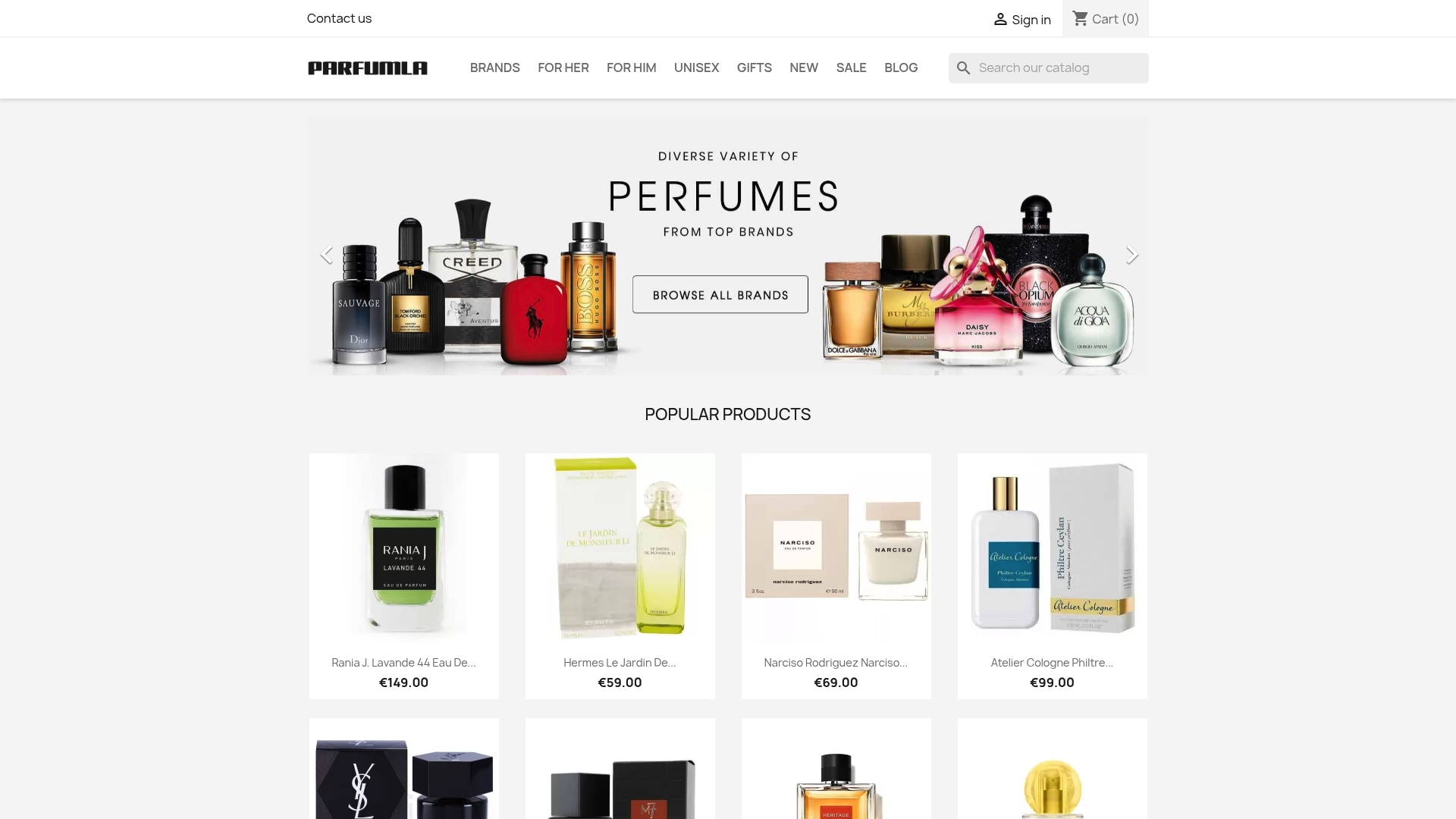
If you want a place to start, our unisex range includes Ex Nihilo Citizen X, Ex Nihilo Fleur Narcotique and Escentric 02, and for women, ArteOlfatto Tuberose Vanilla.
A related habit: perfume in hair
Spraying hair is another shortcut people try, but alcohol-based perfume is not made for it. See our guide to perfume in hair, which covers safer ways to test and enjoy fragrance near your hair.
FAQ
Is it better to spray perfume on clothes or on skin?
Skin shows a perfume as it was composed, because warmth helps the notes develop. Clothes can hold the scent longer, particularly natural fabrics. Many people use both: one or two sprays on skin, one light mist on a coat or scarf.
Does perfume stain clothes?
It can. Vogue reports that perfume may discolor clothing, and Harper's Bazaar advises testing first because some formulas stain. Silk is the fabric experts say to avoid, and light colors show any mark most. A patch test on a hidden seam tells you quickly.
How far away should I hold the bottle?
For skin, Vogue quotes a perfumer recommending about five inches. For clothes, hold the bottle farther back, around 8 to 12 inches, so the mist spreads out. Move the garment through the spray instead of aiming at one spot.
How do I get perfume out of clothes?
Dab a fresh mark gently with cold water, since hot water may set it. For an older mark, sponge with a vinegar and water mixture, then wash following the care label. Check that the stain is gone before using the dryer.
Should I keep perfume boxes?
Yes. Perfumer Francis Kurkdjian recommends keeping perfume in its original box at about 70°F, away from sudden temperature changes. The box also helps shield the bottle from light, which matters most with clear glass.
Sources
- How to Apply Perfume Like a Fragrance Expert, Byrdie
- 8 Common Mistakes We Make When Wearing Perfume, Vogue
- How to Apply Perfume Like an Expert, Harper's Bazaar
- How to Remove Perfume & Cologne Stains, Purex
- Cómo remover las manchas de perfume, Tide
- All about perfumes 101, Hindustan Times
- Fragrance vs Essential Oil: Heat vs Skin Safety
- Fragrance-Free vs Unscented: What Skincare Labels Mean