
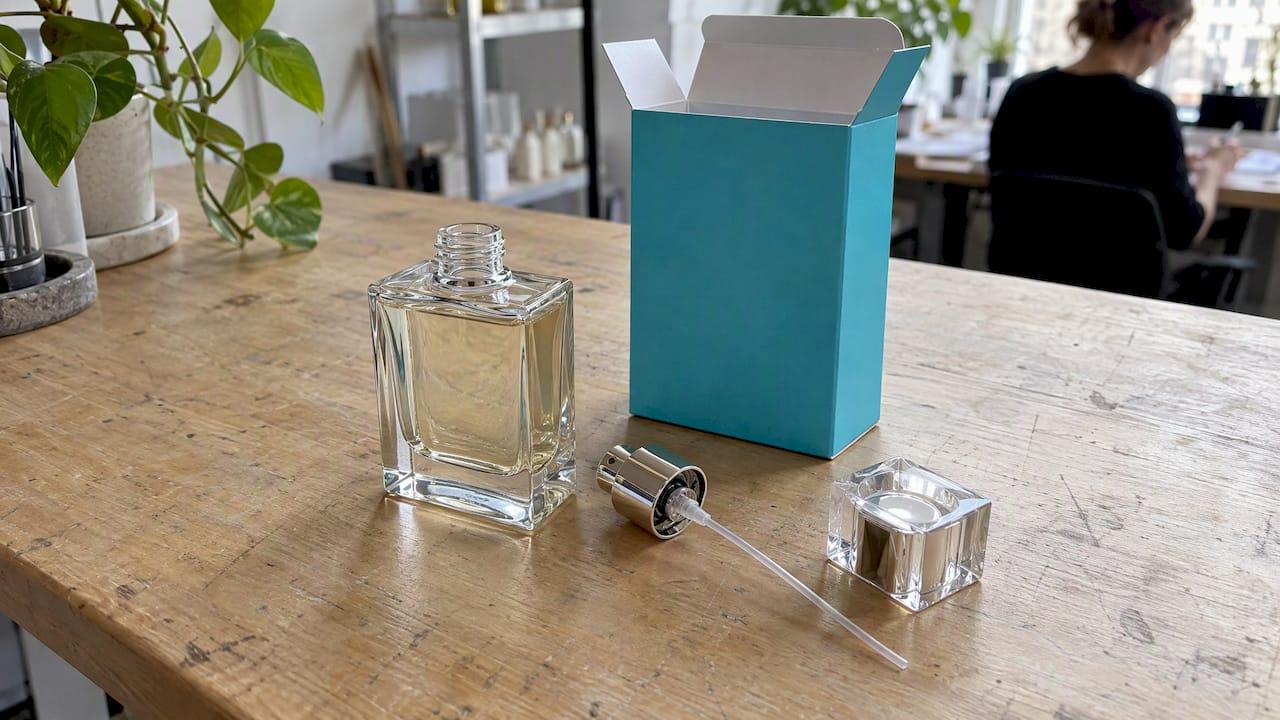
Sustainable perfume packaging means a bottle, cap, pump and box that use less material, can be refilled or recycled, and back every green claim with proof. Most of it is still a work in progress: a perfume bottle mixes glass, metal, plastic and sometimes magnets in one small object, and that mix is what makes recycling hard. Below you'll find what to look for on a label, how the common materials compare, how to recycle an empty bottle, and how to buy perfume online without adding waste.
TL;DR
- Look for specific, verifiable claims such as FSC paper or ISCC PLUS recycled content, not vague words like "eco-friendly."
- Glass protects fragrance best but is heavy and often hard to recycle once pumps, collars and coatings are attached. Refills and decants cut the most waste.
- Recycle by separating parts, emptying the bottle and checking your local program, because rules differ by city and country.
- Protective shipping packaging matters too: a broken bottle is the most wasteful package of all.
- Sample sizes let you test a scent before committing to a full bottle you may never finish.
Table of Contents
- What makes perfume packaging sustainable
- Claims you can trust, and claims to question
- Materials compared: glass, paper, pulp, aluminum and bioplastics
- Protecting the scent without excess packaging
- How to recycle perfume bottles
- Perspective: the greenest bottle is the one you finish
- Shipping: protect the bottle, cut the filler
- A buyer's checklist for lower-waste perfume
- Where to buy authentic perfume with less waste
- FAQ
- Sources
What makes perfume packaging sustainable
Three things matter more than any logo: the material, whether the package can be refilled or taken apart, and whether the claim can be checked.

According to a 2026 industry guide on perfume packaging, sustainable design rests on material innovation, refillable formats and verified claims. The same guide points shoppers to ISCC PLUS certification for recycled or bio-based content and FSC certification for paper and cardboard, instead of trusting words like "eco-friendly."
It helps to know what ISCC PLUS actually tells you. It tracks recycled or bio-based content through the supply chain using mass-balance accounting, so the certified amount is credited to the product even when the physical molecules are mixed. That is more reliable than a leaf icon, but it is not the same as saying every gram in your cap is recycled. One example from the industry: a cosmetics maker's renewable-feedstock cap was calculated to cut CO2-e by 51% against comparable caps, using ISCC PLUS traceability. The figure is a company calculation for one component, not a promise about a whole bottle.
Design for disassembly
Recyclability is not only a property of the material. One glass supplier argues that it is a deliberate design decision, and that parts which separate easily at end of life are the ones that get recycled. A bottle with a glued metal collar and a crimped pump is hard to sort. A bottle whose cap, sprayer and glass come apart by hand is far easier.
Claims you can trust, and claims to question
In the United States, green marketing is covered by the FTC. Its guidance on eco-friendly claims says that biodegradable claims for items headed to a landfill should explain how long and how completely they break down, and that compostable claims need proof the item composts safely at home or a clear disclosure that it does not.
Put that to work at the shelf or on a product page:
| Claim on the box | What to check |
|---|---|
| "Eco-friendly" or "green" | Nothing specific is promised. Look for the material, the percentage and the certifier. |
| "Recyclable" | Which part? Box, glass, pump and cap are often different answers. |
| "Biodegradable" | How fast, in what conditions, and how much of it? |
| "Compostable" | Home composting or industrial only? |
| "Recycled content" | What share, and is it certified (for example ISCC PLUS)? |
| "FSC" paper | Look for the license mark on the carton itself. |
A useful habit: if a claim does not name a material, a percentage or a certifier, treat it as marketing. If you want a parallel from another category, this overview of sustainable packaging claims in personal care shows the same questions applied to a different product.
Materials compared: glass, paper, pulp, aluminum and bioplastics
No material wins on every count. The honest comparison is a set of trade-offs.
| Material | Strengths | Trade-offs |
|---|---|---|
| Glass | Very low oxygen and vapor permeability, keeps scent stable | Heavy to ship and fragile; small, coated or mixed-part bottles rarely recycle cleanly |
| Aluminum | Highly recyclable, blocks light and air | Energy-intensive to produce; may need an internal lacquer to be compatible with alcohol-based perfume |
| Uncoated paperboard | Recyclable, light, suits outer cartons | Gives no protection to the liquid itself |
| Molded pulp | Recyclable, replaces plastic inserts and trays | Looks and feels different from a glossy box |
| PLA bioplastic | Plant-based | Usually needs industrial composting; may act like ordinary plastic in a home compost bin or landfill |
| Coated or film-laminated boxes | Glossy, premium look | Often cannot be recycled because coating and paper separate into different streams or contaminate each other |
The glass, pulp, PLA and laminated-box points come from a 2026 sourcing guide for sustainable perfume packaging. The aluminum points come from a 2024 academic review of cosmetic packaging, which notes that aluminum is highly recyclable and blocks light and air, but costs a lot of energy to make and may need internal lacquers.
Why glass is still the default
Fragrance is a volatile mix of alcohol and aromatic compounds. Glass has extremely low oxygen and vapor permeability, while plastics let more oxygen and perfume volatiles through and some absorb fragrance. So swapping a bottle for a lighter plastic can save weight and still shorten the life of the scent, which creates its own waste. The sustainable choice is usually glass that is made to last, paired with a smaller box.
Protecting the scent without excess packaging
Packaging has a job: keep the fragrance intact from the factory to the last spray. Sustainable does not mean flimsy.
Two features do most of the protecting. Airless pump technology stops ambient air from entering, and opaque or dark glass such as amber, cobalt or violet filters light, according to a 2025 packaging guide. The same guide suggests cutting excess by right-sizing packs or dropping secondary packaging altogether.
Refill systems are the other big lever, with a catch. Guidance on refillable perfume bottles describes direct-to-valve refills as safer for scent integrity than pour-in formats, since they limit air exposure and oxidation during transfer. It also warns that refill systems need precise engineering, because a poorly sealed component can leak or let the product evaporate. If you refill at home, the result is only as good as the seal.
You can also protect your own bottle. Heat, light and air are the enemies, which is why our guide to storing perfume for years matters: a bottle that stays good gets finished instead of thrown away.
How to recycle perfume bottles
Here is the practical part, and the honest one. Glass perfume bottles are rarely collected for recycling in most places, because they are small, often coated, and mixed with metal and plastic in the cap and collar. That does not mean you should give up. It means you should prepare the bottle well and check what your local program takes.
- Finish the perfume, or move it. A bottle with liquid in it is a contamination problem. If you won't wear the rest, decanting into a travel atomizer is better than binning it. Our guide to safe ways to decant perfume covers it.
- Separate the parts. Pull off the cap and, if it comes away, the sprayer. Metal collars and plastic pumps usually belong in different streams from the glass.
- Empty and let it air out. Residue and smell can get a bottle rejected.
- Recycle the cardboard box. Plain paperboard is the easiest part. If the box has a plastic film, foil or heavy coating, it may not be accepted.
- Check your local rules. Call or look up your city or county program before you put the glass in the bin. If the program does not take it, look for a reuse option such as a refill, a craft use or a take-back scheme.
Why the rules differ from place to place
Collection is local. In the US, your city or county decides what goes in the curbside bin, and the answer for a small coated glass bottle can differ across the same state. Elsewhere, national law sets the frame: Spain's Real Decreto 1055/2022, for example, sets packaging-waste recycling targets of at least 65% by weight by 2025 and 70% by 2030 under extended producer responsibility. Because we ship to readers in both the US and the EU, the same bottle can have a different best answer depending on where you live.
Perspective: the greenest bottle is the one you finish
We sell more than 14,000 fragrances, and we see the same pattern in what customers return to us with: the most wasteful perfume purchase is not the one in a plastic cap. It is the full bottle bought on impulse, worn twice, and left to turn in a drawer.
That is why we stock travel sprays and decants alongside full bottles. Trying a scent in a small size before committing means fewer unfinished bottles, fewer boxes, and less glass in the bin. It is also why we care about how an order arrives. A bottle that breaks in transit wastes the perfume, the glass, the box and a second shipment, so protective packing is part of sustainability, not the opposite of it.
Our advice: buy fewer bottles, sample first, store them well, and recycle what you can. Be cautious of any brand that sells you a green story without naming a material or a certifier.
— Parfumla
Shipping: protect the bottle, cut the filler
Online buyers often worry about the box that arrives around the box. Good shipping packaging uses a snug fit, a paper or pulp cushion rather than loose plastic, and no more void space than needed. Oversized parcels full of fill are wasteful, but a thin parcel that lets glass hit glass is worse. The packaging principles behind protecting fragile luxury goods in transit apply to perfume as well: cushion the item, stop it from moving and keep the outer box strong.

Fragrance also has shipping rules of its own because of its alcohol content. Our pages on delivery and shipping and perfume shipping rules explain what to expect when an order crosses a border.
A buyer's checklist for lower-waste perfume
- Sample before you buy. A 2 mL decant or travel spray costs far less than a bottle you dislike. See how this works in our piece on trying emerging brands with a decant.
- Choose the simpler box. Uncoated paperboard or molded pulp is easier to recycle than a laminated, magnetic or foam-lined presentation case.
- Prefer separable parts. Caps and pumps that come off by hand improve your odds of recycling.
- Ask for specifics. A brand that says "FSC paper" or "certified recycled content" is giving you something checkable.
- Match the size to your use. A 100 ml bottle is no saving if you wear a scent twice a year. Our online perfume shopping checklist walks through the decision.
- Store it well. Cool, dark and sealed keeps the scent true for years.
Where to buy authentic perfume with less waste
If you want to buy perfume online and keep waste down, start with a small size and move up only for the scents you reach for. At Parfumla you can buy authentic European fragrances from established houses and niche creators, and test many of them as travel sprays or samples first. Browse women's fragrances, men's fragrances, unisex scents or gift ideas, or start from our main store.
If you are exploring niche perfume, a unisex pick such as the Tom Ford Italian Cypress Eau De Parfum 50ml is a measured size for a scent you want to know before you commit to a larger bottle.
FAQ
Is glass perfume packaging sustainable?
Glass protects fragrance very well and does not absorb scent, so it keeps the perfume stable longer. Its weaknesses are weight and the fact that small bottles with attached pumps and collars are often not collected for recycling. It is most sustainable when the bottle is refilled, reused or separated into parts and checked against local rules.
Can I put an empty perfume bottle in my recycling bin?
Sometimes. Empty it, remove the cap and sprayer where you can, and check your city or county program, since acceptance of small coated glass varies. If it is not accepted, reuse or refill is the better route than throwing it in with general waste.
What does "eco-friendly" on perfume packaging really mean?
On its own, very little. The FTC advises that environmental claims should be specific and supported, so look for a named material, a percentage or a certification such as FSC for paper or ISCC PLUS for recycled or bio-based content.
Are compostable or biodegradable perfume boxes better?
Only if the claim is specific. Plastics like PLA usually need industrial composting and may not break down in a home bin or landfill, so a plain recyclable paperboard box is often the safer choice.
How can I reduce perfume packaging waste when I shop online?
Buy a sample or travel spray first, choose the smaller bottle if you wear a scent rarely, and pick products with simple, separable packaging. Fewer unfinished bottles saves more material than any single pack change.
Sources
- How Sustainable is Perfume Packaging? (Safic-Alcan)
- Eco-Friendly and Green Marketing Claims (FTC)
- Taking sustainability to the next level with Boticário (Borealis)
- Sustainable Perfume Packaging: Spec and Sourcing Guide (Nuvole Glass)
- Cosmetic Packaging: European Regulatory Aspects (MDPI, 2024)
- A 2025 Expert Guide: 7 Rules for Matching Packaging Material (HeyPack)
- Glass bottles or plastic for perfume (Fusen Glass)
- The Complete Guide to Refillable Perfume Bottles (Custom Packing Co.)
- Real Decreto 1055/2022 (BOE)
- Luxury watch packaging standards