

A fragrance family is a broad classification system that groups perfumes by their dominant scent character and overall mood. Think of it as the taxonomy of the perfume world. Just as music genres help you predict what a song will sound like before you hear it, fragrance family definitions tell you what emotional territory a perfume occupies before you ever spray it. Knowing these categories transforms how you shop, gift, and talk about scent. You stop saying "I like that one" and start saying "I gravitate toward woody ambers" — which is a far more useful thing to know.
What is a fragrance family, and why does it matter?
A fragrance family groups perfumes by overall character and dominant mood, while individual notes are the specific ingredients inside. This distinction matters more than most people realize. Rose is a note. Floral is a family. A perfume can contain rose, jasmine, and peony and still be classified as woody if its base accord dominates with sandalwood and vetiver.
A single perfume typically incorporates notes from 2–4 families, but it gets classified by the dominant accord that emerges after the top notes fade. That final stage, called the dry-down, is the true fingerprint of the fragrance. This is why two perfumes can share identical notes like vanilla or cedar but smell completely different due to overall structure and dominant family character.
Knowing what are olfactory families, the technical term used by perfumers and industry professionals, gives you a shared vocabulary. When a sales associate asks what family you prefer, you can answer with confidence. When you're buying a gift online without smelling the bottle, family knowledge becomes your best guide.
What are the main types of fragrance families?
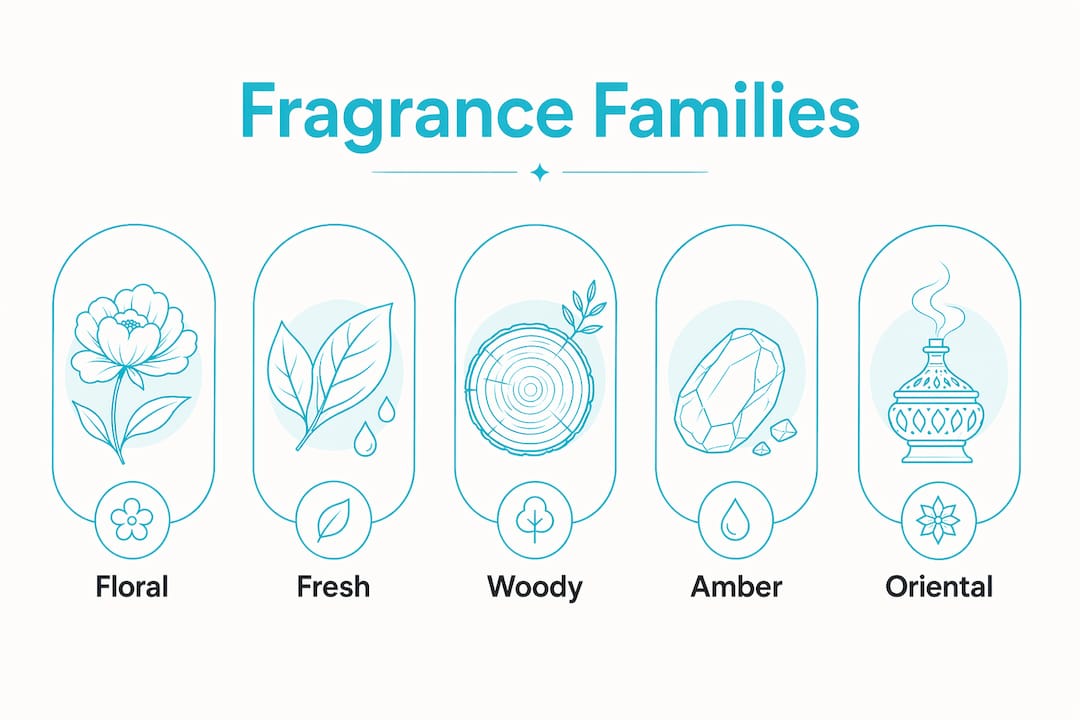
Modern perfume taxonomy lists 7–10 families, but the industry widely recognizes four core categories. Perfumer Michael Edwards' Fragrance Wheel organizes the scent world into four main families with 14 subfamilies branching from them. Here is how each one reads on the skin.
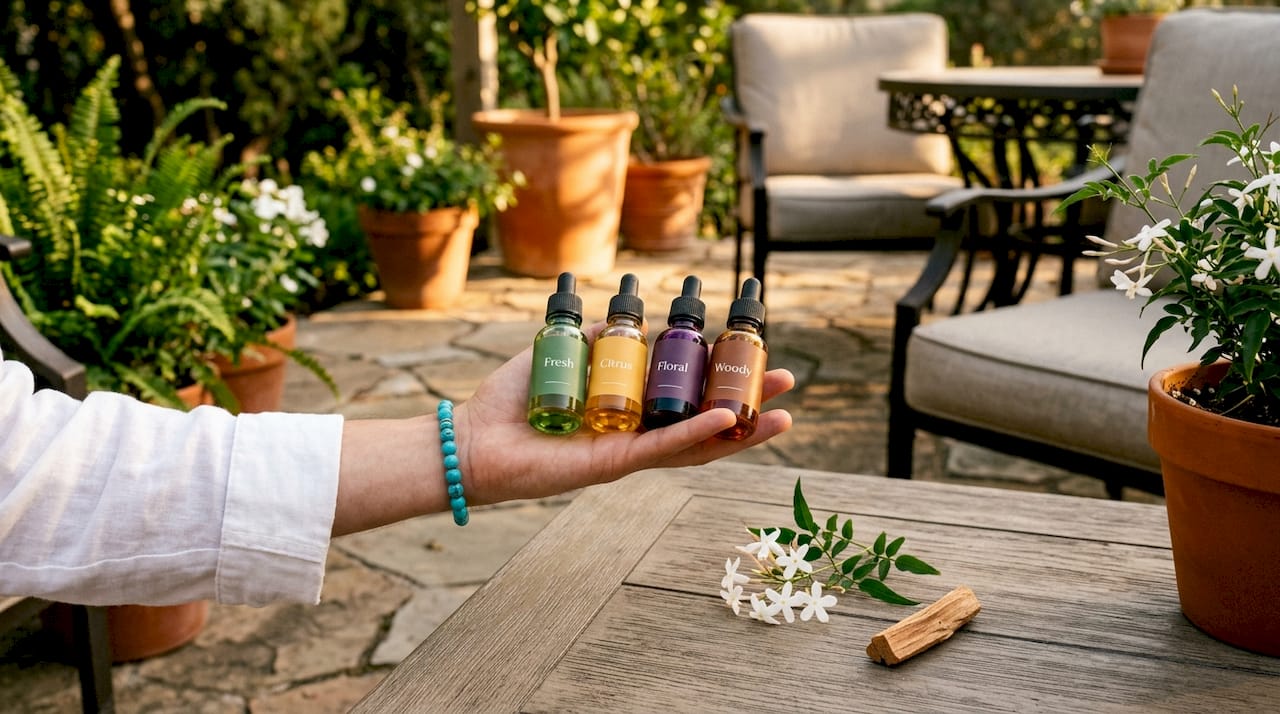
Floral The largest and most popular family in women's perfumery. Floral perfumes range from airy and powdery to dense and dramatic, depending on which flowers anchor the blend. Soft florals like Guerlain Eau de Lingerie lean powdery and intimate. Rich florals like Christian Dior J'adore Le Jasmin push toward lush, full-bodied elegance. Floral scents evoke romance, femininity, and softness across the board.
Fresh Fresh scents evoke clarity, energy, and brightness, making them the go-to for daytime and warm-weather wear. This family breaks into four subfamilies: citrus (lemon, bergamot, grapefruit), aquatic (sea salt, ozonic notes), green (cut grass, herbs), and fruity (peach, pear, apple). Salvatore Ferragamo Incanto Heaven is a textbook fresh floral that bridges both families cleanly.
Woody Woody fragrances anchor themselves in materials like sandalwood, cedarwood, vetiver, and patchouli. They read as grounded, sophisticated, and often gender-neutral. Lacoste Essential sits in the aromatic woody space, pairing herbs with a dry wood base. Woody scents work across seasons and tend to age well on the skin.
Amber (Oriental) Amber scents carry a sensual, mysterious aura built from balsamic resins, vanilla, benzoin, and warm spices. They feel cozy and enveloping, which is why they dominate evening and cold-weather wear. Gourmand fragrances, a modern subfamily, push amber into edible territory with notes like caramel, chocolate, and tonka bean.
| Family | Key notes | Mood | Best occasion |
|---|---|---|---|
| Floral | Rose, jasmine, peony | Romantic, elegant | Day or evening |
| Fresh | Citrus, sea salt, green | Energetic, clean | Daytime, warm weather |
| Woody | Sandalwood, cedar, vetiver | Grounded, sophisticated | All seasons |
| Amber | Vanilla, benzoin, resins | Warm, sensual | Evening, cold weather |
Pro Tip: When testing a new fragrance, wait at least 20 minutes before deciding. The top notes you smell first are often citrus or aldehydes that burn off quickly. The family you actually belong to is revealed in the dry-down.
How to identify fragrance families in perfumes
Recognizing a fragrance family in practice takes a bit of method. Here is a reliable process for any tester or online buyer.
- Smell the top notes first. These are the opening burst you get in the first 5–10 minutes. They are often citrus, light herbs, or aldehydes. They signal the family's direction but rarely define it.
- Wait for the heart notes. After 15–20 minutes, the middle notes emerge. Florals, spices, and fruits live here. This is where you start to sense the family character taking shape.
- Judge by the dry-down. The base notes, typically woods, resins, musks, and vanilla, are what remain after an hour. Classification depends on the dominant accord after dry-down, not on what you smelled first. This is the family.
- Read the fragrance pyramid. Most product pages, including those on Parfumla, list top, heart, and base notes. Scan the base notes first. Heavy woods and resins point to woody or amber. Light musks and citrus bases point to fresh.
- Check the subfamilies. If a perfume is labeled "floral woody musk," the first word is the dominant family. The others are supporting characters. Use this to predict how the scent will wear.
Understanding how fragrance notes work across different scented products, from perfumes to candles, also sharpens your ability to recognize families by ingredient. The same bergamot note that opens a fresh cologne also opens a citrus candle. Training your nose on one product category helps in the other.
Pro Tip: When shopping online, filter by base notes rather than top notes. Base notes are what you will actually live with all day. A perfume that opens with lemon but dries down to amber is an amber fragrance, not a fresh one.
Popular fragrance families and what they say about personal style
Fragrance families correlate with personality and style preferences in ways that are consistent enough to be useful, even if they are not absolute rules. Floral wearers tend to gravitate toward romance and softness. Woody wearers often prefer depth and understatement. Fresh wearers signal energy and approachability. Amber wearers lean into warmth and mystery.
Personal fragrance preference also evolves with age. Younger wearers tend to favor fruity and vanilla-forward scents. More experienced fragrance lovers often migrate toward complex florals, Chypre structures, and dense woods. This is not a rule, but it is a pattern worth knowing when you are buying a gift.
Here is how to use family associations practically:
- Gifting a romantic partner: Floral or amber. Christian Dior J'adore Le Jasmin and similar rich florals read as intimate and considered.
- Gifting a colleague or friend: Fresh or light floral. These are universally wearable and unlikely to overwhelm.
- Gifting someone with a bold, artistic personality: Woody or niche amber. Ex Nihilo Fleur Narcotique, a floral-fruity hybrid, works well here.
- Buying for yourself: Start with the family you already love, then explore the adjacent subfamily. If you wear fresh, try aromatic woody next.
Fragrance families produce distinct emotional responses: fresh for clarity, floral for elegance, woody for depth, and amber for warmth. These responses are real and consistent across wearers. Use them as a starting point, not a personality test. The goal is to find a scent that feels like you, and knowing the families gets you there faster. You can also explore why perfume becomes a style signature to understand how family choices build into a personal identity over time.
Common misconceptions about fragrance families
Several misunderstandings trip up even enthusiastic fragrance buyers. Clearing them up makes you a sharper shopper.
- "If it has rose in it, it's a floral." Not necessarily. A perfume with rose, oud, and patchouli at the base is a woody oriental, not a floral. The note does not define the family. The dominant accord does.
- "Fragrance families are fixed and universal." They are not. Modern Chypres are often hybrids because EU restrictions on oakmoss since 2009 forced reformulations of classic structures. The Chypre you smell today is not the Chypre from 1970. Regulatory changes reshape entire families over time.
- "Men's fragrances are woody, women's are floral." This was a marketing convention, not a rule. Gucci Bamboo, Ex Nihilo Vetiver Moloko, and Escentric Molecules Escentric 03 all blur or ignore gender lines entirely. Wear what works on your skin.
- "Two perfumes with the same notes smell the same." Two perfumes can share identical notes but smell completely different because overall structure and proportions determine the family character, not the ingredient list alone.
"The most interesting scents exist where family boundaries overlap. Fragrance classification is best used as a map for exploration, not a rigid sorting system."
These overlap zones, sometimes called bridges, are where modern perfumery gets creative. A floral-woody-amber like Narciso Rodriguez Eau de Parfum does not fit neatly into one box. That is a feature, not a flaw.
Key takeaways
A fragrance family is the single most useful tool for navigating the perfume world, whether you are shopping for yourself or choosing a gift.
| Point | Details |
|---|---|
| Family vs. note | A family is the overall character; a note is one ingredient. Never confuse the two. |
| Dry-down decides | Judge a fragrance's family by its base accord, not its opening spray. |
| Four core families | Floral, Fresh, Woody, and Amber cover the majority of commercial and niche perfumes. |
| Families guide gifting | Match family mood to occasion: fresh for casual, amber for evening, floral for romance. |
| Families are flexible | Treat them as a starting map, not a strict label. The best discoveries happen at the borders. |
Why fragrance families changed how I shop
I spent years buying perfumes based on bottle design and brand reputation. The results were inconsistent at best. Once I started thinking in families, everything clicked. I realized I was an amber-woody person who kept accidentally buying fresh scents because they smelled good in the store. The dry-down told a different story every time.
The most useful shift was learning to find a signature scent by working within a family first, then pushing toward its edges. I started with sandalwood-heavy woods, moved toward spicy ambers, and eventually landed on floral-woody hybrids as my sweet spot. That process took months, but understanding families cut the trial-and-error in half.
For gifting, families are even more valuable. You cannot always smell a perfume before you buy it online. But if you know someone loves warm, cozy scents, you know to look in the amber family. If they wear light, clean fragrances every day, you stay in fresh or soft floral. The scent and memory connection is real. Giving someone a fragrance in the family they already love lands differently than a random choice. It feels like you actually paid attention.
One thing I would push back on: do not let family labels make you timid. The most memorable fragrances I own sit right at the border between two families. A woody floral that reads differently in summer than winter. An amber that opens with citrus and surprises you every time. Families are the beginning of the conversation, not the end of it.
— Hamster777
Discover your fragrance family at Parfumla
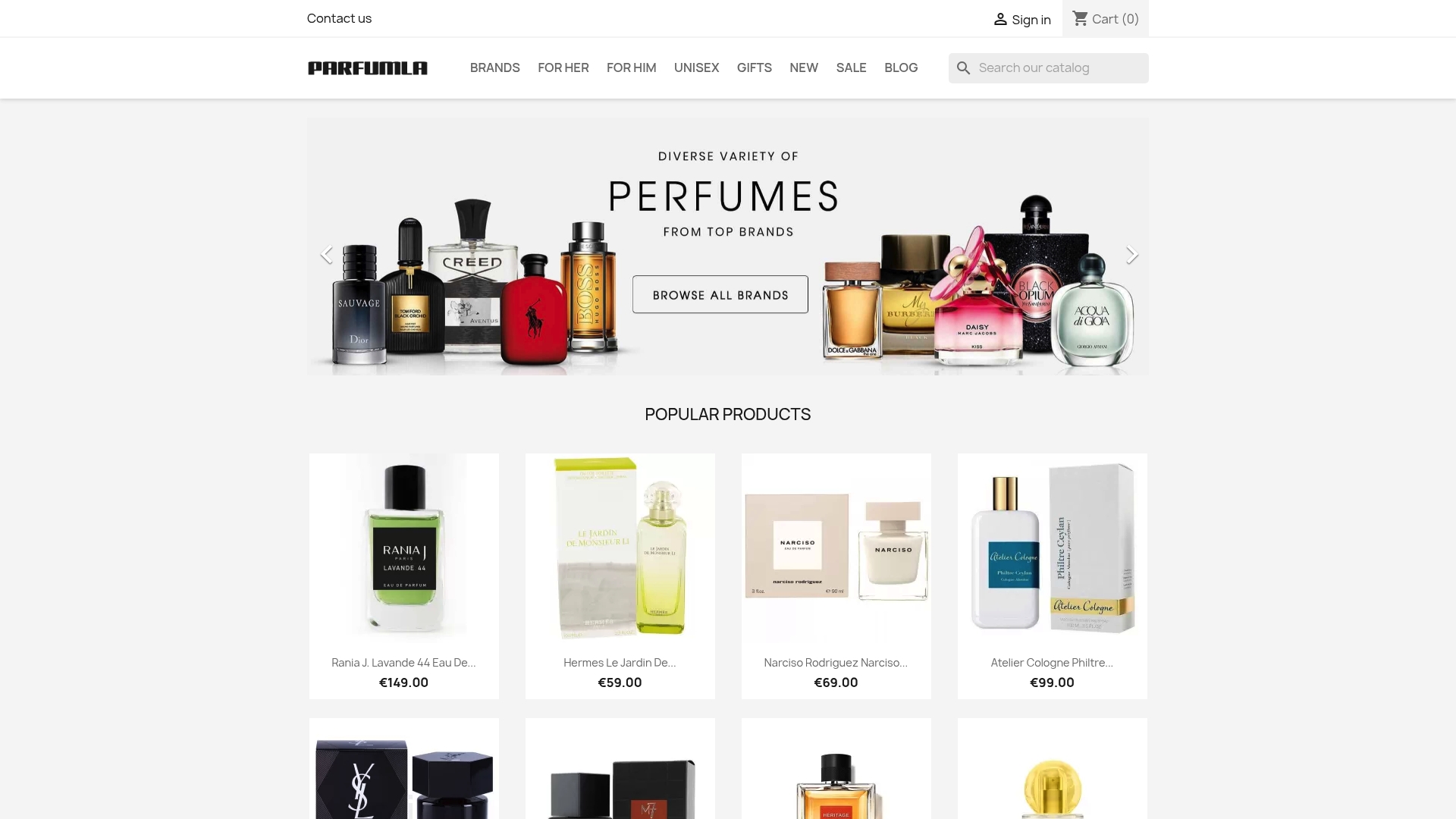
Parfumla carries over 14,000 perfumes across every major fragrance family, from soft florals to dense ambers, at up to 60% off retail prices. If you are exploring the floral family, the Guerlain Eau de Lingerie is a powdery, intimate starting point that consistently earns strong reviews. For a richer floral statement, Christian Dior J'adore Le Jasmin delivers the full lush-floral experience at a fraction of department store pricing. Parfumla's detailed product reviews make it easy to read the dry-down character before you buy, so you shop by family with confidence rather than guesswork.
FAQ
What is a fragrance family in simple terms?
A fragrance family is a broad category that groups perfumes by their dominant scent character and mood. The four main families are Floral, Fresh, Woody, and Amber.
How many fragrance families are there?
Modern perfume taxonomy recognizes 7–10 families depending on the system used. Michael Edwards' Fragrance Wheel organizes scent into 4 main families with 14 subfamilies.
How do I identify which fragrance family a perfume belongs to?
Judge the family by the dry-down, the scent that remains after an hour on skin. The dominant base accord, not the opening notes, determines the family classification.
Can a perfume belong to more than one fragrance family?
Yes. Most perfumes blend notes from multiple families. The classification reflects the dominant accord, so a floral-woody-amber is primarily amber if the base resins and woods dominate the dry-down.
Do fragrance families match personality types?
Families correlate with style preferences but are not personality tests. Experts treat them as starting points for exploration, not fixed identity labels. The most interesting fragrances often sit at the border between two families.