

A scent trail is the invisible path of fragrance molecules left in the air as you move through a space. In perfumery, this effect is known as sillage (pronounced "see-yazh"), a French term borrowed from the word for a ship's wake. Sillage is distinct from projection, which describes how far a scent radiates outward from your body while you stand still. Understanding the difference between these two concepts changes how you choose and wear perfume. Whether you are new to fragrance or a seasoned collector, knowing how scent trails work shapes every purchasing decision you make.
What is a scent trail in perfumery?
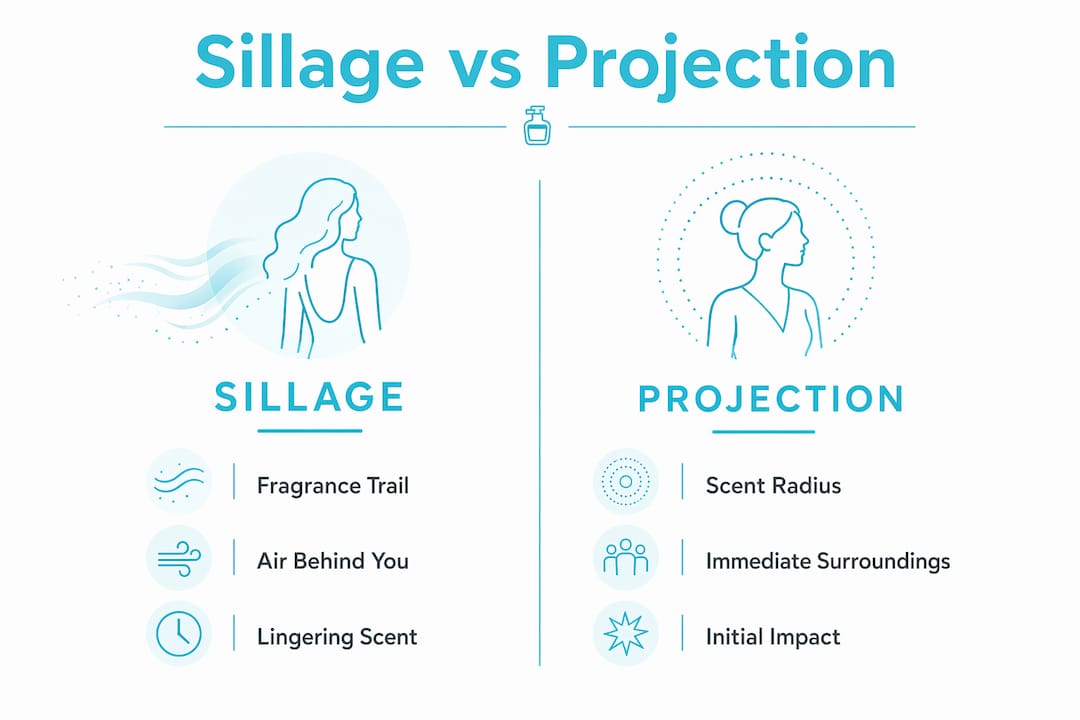
A scent trail, or sillage, is the invisible fragrance path left behind by a moving person. It is not the same as the cloud of scent you project while standing in one place. Sillage is temporal and directional. It exists in the space you just left.

The chemistry behind this is straightforward. Perfume molecules have different levels of volatility. Top notes, like citrus and light florals, evaporate within minutes. Base notes, such as musk, amber, and sandalwood, linger far longer and contribute most to the trail you leave behind. Movement accelerates diffusion by pushing molecules off your skin and into the surrounding air.
Body heat plays a critical role. Warm skin speeds up evaporation, which releases more molecules into the air column behind you as you walk. Airflow from movement then carries those molecules outward. This is why a scent trail is often noticed only after you leave a room. Without your physical presence as a visual anchor, the brain focuses entirely on the lingering fragrance.
One counterintuitive fact: higher perfume concentration does not always produce a stronger trail. Eau de Toilette (5–15% fragrance oil) often creates more noticeable sillage than Extrait de Parfum (20–40%) because the higher alcohol content in lighter concentrations evaporates faster and disperses molecules more widely. Extrait sits closer to the skin and radiates inward rather than outward.
Pro Tip: If you want a strong scent trail, choose an Eau de Toilette with heavy base notes like musk or oud rather than reaching for the most concentrated formula on the shelf.
Sillage, projection, and longevity compared
| Term | Definition | Key characteristic |
|---|---|---|
| Sillage | The fragrance trail left in the air behind a moving person | Temporal, directional, noticed after departure |
| Projection | The radius of scent around a stationary wearer | Spatial, immediate, perceived while present |
| Longevity | How long a fragrance lasts on skin | Time-based, independent of trail or radius |
A fragrance can have high projection but low sillage, or vice versa. These are separate qualities, and perfumers design for each one deliberately.
How do animals use scent trails for communication?
Animals use scent trails as a primary communication tool, and the biological mechanics parallel what happens with perfume in surprising ways.
The clearest example is ants. Trail pheromones in social insects are chemical signals deposited from exocrine glands to guide colony members toward food sources. The strength of the signal scales with food quality. A richer food source triggers more repeated deposition, which reinforces the trail's intensity. This dynamic renewal mirrors how a perfume trail strengthens with movement and repeated presence.
Key examples of scent trail function in animals:
- Ants deposit pheromones in blotch-like patterns along foraging routes. Repeated passes by multiple workers intensify the signal, creating a reliable chemical highway.
- Tracking dogs do not follow a single continuous line of scent. They interpret a complex shifting plume of volatile compounds, switching between ground scent and air scent to locate a person.
- Reptiles in captivity benefit from scent trail enrichment that simulates natural exploratory behavior. Dragging prey scent along a path encourages movement and mental engagement in animals with limited roaming space.
- Territorial mammals use scent marking along borders to communicate presence and ownership to rivals without direct confrontation.
The contrast between animal and human scent trails is instructive. Animal pheromones are precise chemical signals with one function. Human scent is a layered blend of skin chemistry, sweat compounds, and artificial fragrance molecules. Tracking dogs sample intermittent signals rather than a clean line because human scent is genuinely complex and variable. Perfume adds another layer of intentional chemistry on top of that natural signature.
How do personal factors shape your scent trail?
Your skin is not a neutral surface. It actively changes how a fragrance behaves, which directly affects the trail you leave.
Skin temperature is the biggest variable. Warmer skin accelerates evaporation and pushes more molecules into the air. People who run warm naturally produce stronger trails. Dry skin absorbs fragrance faster and holds less on the surface, which reduces sillage. Moisturizing before application creates a barrier that slows absorption and extends the trail. Understanding your fragrance concentration options helps you match the formula to your skin type.
How you apply perfume matters as much as what you apply. These techniques directly influence trail strength:
- Pulse points first. Wrists, neck, and the inside of elbows radiate heat. Apply here to maximize diffusion while moving.
- Add hair application. Hair holds fragrance up to twice as long as skin due to its porous structure. Spraying lightly on hair creates a trail that lasts through an entire day.
- Layer with a matching body lotion. Fragrance layering extends longevity and adds depth to the base notes that anchor your trail.
- Avoid rubbing. Rubbing wrists together breaks down top note molecules and shortens the scent's arc.
- Choose the right concentration. Eau de Parfum (15–20% oil) balances projection and trail well for most social settings. Eau de Toilette works better for active environments where movement amplifies diffusion.
Pro Tip: For office or daytime wear, apply Eau de Toilette to your hair and neck rather than your wrists. The trail will be present but not aggressive, which reads as polished rather than overpowering.
The social dimension of sillage matters. Moderate scent trails are perceived as elegant and memorable. Very strong projection can feel intrusive in close spaces like elevators or meeting rooms. The goal is a trail that makes people turn their heads after you pass, not one that announces your arrival from across the room.
How to build a scent trail that leaves a lasting impression
Creating a deliberate scent trail is less about spraying more and more about spraying smarter.
- Choose base-note-heavy fragrances. Musk, amber, vetiver, and sandalwood are the building blocks of lasting trails. These molecules are large, slow to evaporate, and cling to fabric and hair. Fragrances like Narciso Rodriguez Eau de Toilette are built around musk and consistently earn praise for strong sillage.
- Time your application. Apply perfume 15–20 minutes before leaving the house. This allows top notes to settle and base notes to bind to your skin, which produces a cleaner, more consistent trail.
- Spray clothing as well as skin. Fabric holds fragrance longer than skin. A light spray on a scarf or collar creates a trail that outlasts the skin application by hours.
- Avoid over-spraying. More than three or four sprays rarely improves sillage. It increases projection to the point of being antisocial and can actually muddy the fragrance's character.
- Match trail intensity to environment. Outdoor events and evening occasions support stronger trails. Offices, healthcare settings, and crowded public spaces call for restraint.
Scent is part of your personal style in the same way clothing and posture are. A well-managed trail becomes a signature. People remember it without being able to name it, which is exactly the effect worth creating.
Key takeaways
A scent trail is the fragrance path left in the air behind a moving person, shaped by perfume concentration, skin chemistry, and application technique.
| Point | Details |
|---|---|
| Sillage vs. projection | Sillage is the trail behind you; projection is the scent radius around you while stationary. |
| Concentration paradox | Eau de Toilette often produces stronger trails than Extrait de Parfum due to higher alcohol content aiding dispersion. |
| Base notes anchor trails | Musk, amber, and woods evaporate slowly and create the lasting part of any scent trail. |
| Hair holds scent longest | Applying perfume to hair extends trail duration significantly due to hair's porous structure. |
| Moderate trails read as elegant | Strong projection can feel intrusive; a subtle, lingering trail is the social ideal. |
Scent trails as invisible signatures
I have spent years testing fragrances, and the single most underrated concept in perfumery is sillage. Most people obsess over how a fragrance smells on their wrist in a store. Almost nobody thinks about what they leave behind.
The trail is the part other people actually experience. You are already gone when they notice it. That moment, when someone catches your scent in an empty hallway or an elevator you just stepped out of, is the most powerful impression a fragrance can make. It is memory without context. The brain files it as something worth remembering.
What I have noticed is that movement is the real amplifier. A perfume that smells quiet and intimate when you are sitting still can become genuinely striking when you walk through a room. This is why I always test a fragrance while moving, not while standing at a counter. Walk down a hallway, then turn around and walk back through the air you just displaced. That is your actual trail.
The biological parallel to ants reinforces something I find genuinely useful: trail strength depends on repetition and renewal. Wearing the same fragrance consistently builds a stronger association in the minds of people around you. It is not just chemistry. It is a style signature that compounds over time.
My practical advice is to choose one fragrance for each major context in your life and wear it consistently. Let the trail do the work. Subtlety, not volume, is what makes a scent memorable.
— Hamster777
Finding fragrances built for a lasting trail
Parfumla carries over 14,000 fragrances, including options specifically suited for strong sillage across different concentration levels.

For musk-forward trails with proven sillage, the Narciso Rodriguez Eau de Toilette for women is a consistent performer. For a richer, longer-lasting option, the Ex Nihilo Venenum Kiss Eau de Parfum delivers deep base notes that anchor a trail for hours. Parfumla offers both at up to 60% off retail prices, with detailed reviews to help you match concentration and note profile to the trail intensity you want. Shipping covers both the US and EU, so finding your signature scent is straightforward wherever you are.
FAQ
What is the scent trail definition in perfumery?
A scent trail, known as sillage, is the invisible path of fragrance molecules left in the air by a person as they move. It is distinct from projection, which describes the scent radius around a stationary wearer.
How do scent trails work on different skin types?
Dry skin absorbs fragrance faster and produces a weaker trail. Moisturizing before application slows absorption and helps fragrance molecules stay on the surface longer, which strengthens the trail.
Does Eau de Parfum create a better scent trail than Eau de Toilette?
Not necessarily. Eau de Toilette often creates a stronger trail because its higher alcohol content disperses molecules more widely. Extrait de Parfum sits closer to the skin and radiates less outward.
Why do people notice your perfume after you leave the room?
The brain focuses more clearly on a lingering fragrance once the visual distraction of your presence is removed. Movement and body heat push molecules into the air, and those molecules remain after you depart.
What fragrance notes create the strongest scent trails?
Base notes like musk, amber, vetiver, and sandalwood evaporate slowly and cling to fabric and hair. These are the notes that define a lasting trail long after top and middle notes have faded.