

What is fragrance projection?
Fragrance projection is the distance a scent radiates outward from your skin while you're standing still. Picture an invisible bubble surrounding you, one that others can detect before they ever get close enough to shake your hand. That bubble is your projection radius.
The concept is simpler than it sounds. When you spray a perfume, volatile molecules lift off your skin and disperse into the surrounding air. The lighter those molecules, the farther they travel. Ideal daily wear projection generally falls in a moderate range, while anything that extends well beyond that tends to feel aggressive in shared spaces like offices or elevators.
Here's what fragrance projection actually means in practice:
- Scent bubble: The radius of detectable fragrance around your body while you're stationary
- Projection strength: Ranges from skin-close (someone needs to lean in) to room-filling (detectable from across a space)
- Daily wear sweet spot: A 2–3 foot projection radius is widely accepted as comfortable for most social and professional settings
- Peak timing: Projection is strongest in the first hour or two after application, then softens as the scent settles into drydown
- Not a flaw: A fragrance that pulls closer to the skin over time is behaving exactly as designed
Projection is one of the core performance metrics fragrance enthusiasts use to evaluate a scent, alongside sillage and longevity. Knowing what it is helps you choose the right fragrance for the right room.
Projection vs. sillage vs. longevity: what's the actual difference?

These three terms get tangled constantly, and the confusion is understandable. They all describe how a fragrance performs, but they measure completely different things.
Projection, sillage, and longevity describe three separate parts of the wearing experience. Projection is the scent radius around your body at any given moment. Sillage (pronounced "see-YAHZH") is the trail you leave behind as you move through a room. Longevity is simply how long the fragrance stays detectable on your skin, hair, or fabric.
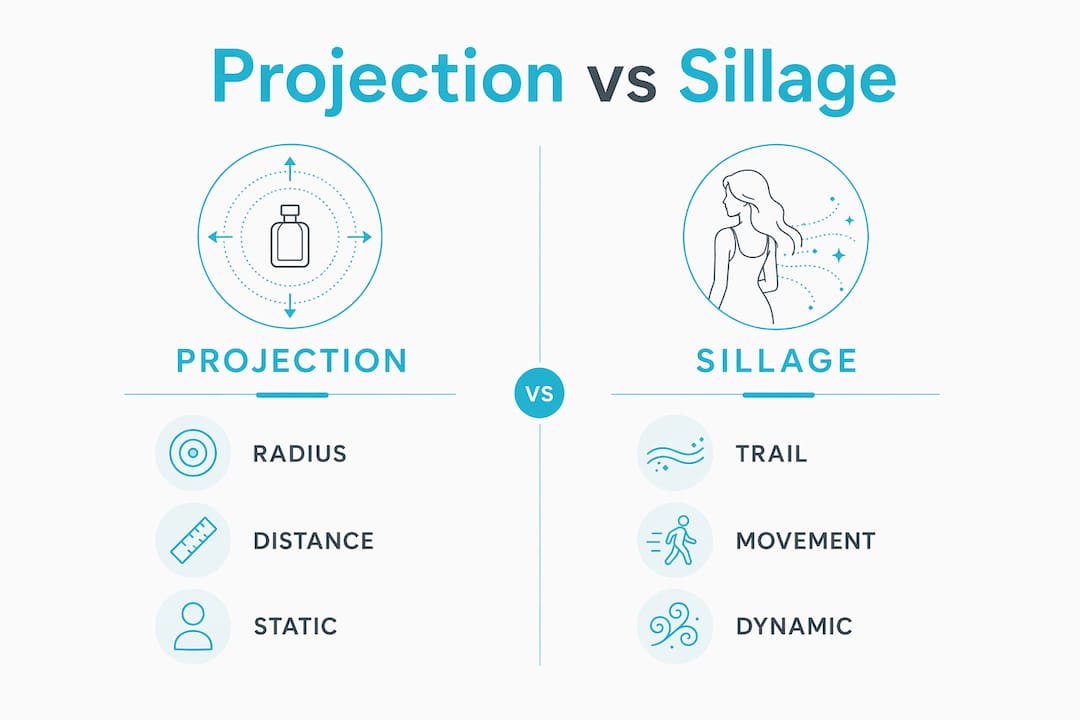
A perfume can project strongly for the first hour and still fade quickly. Another can cling to a sweater for two days with almost no room-filling presence. Projection is a snapshot of how far the scent extends right now; sillage is the story it leaves in your wake.
| Term | What it measures | How to observe it |
|---|---|---|
| Projection | Scent radius while stationary | Ask someone at arm's length, then farther, during the first two hours |
| Sillage | Trail left behind as you move | Walk through a hallway and check whether the scent lingers after you |
| Longevity | How long the scent stays detectable | Smell skin, blotter, and fabric after four, eight, and twelve hours |
Key distinctions worth keeping straight:
- A fragrance with high projection but poor longevity fills a room fast, then disappears within a few hours
- A fragrance with low projection but strong longevity stays close to the skin all day without announcing itself
- Sillage depends on movement. No movement, no trail. Projection exists whether you're walking or standing still
- Projection and sillage are related but measure different scent performance aspects
Understanding these distinctions changes how you shop. When someone says a fragrance "doesn't last," they might mean poor longevity, weak projection, or both. Those require different solutions.
What actually affects how far your scent projects?
Projection isn't fixed at the factory. Several variables push it up or pull it down, and most of them are within your control.
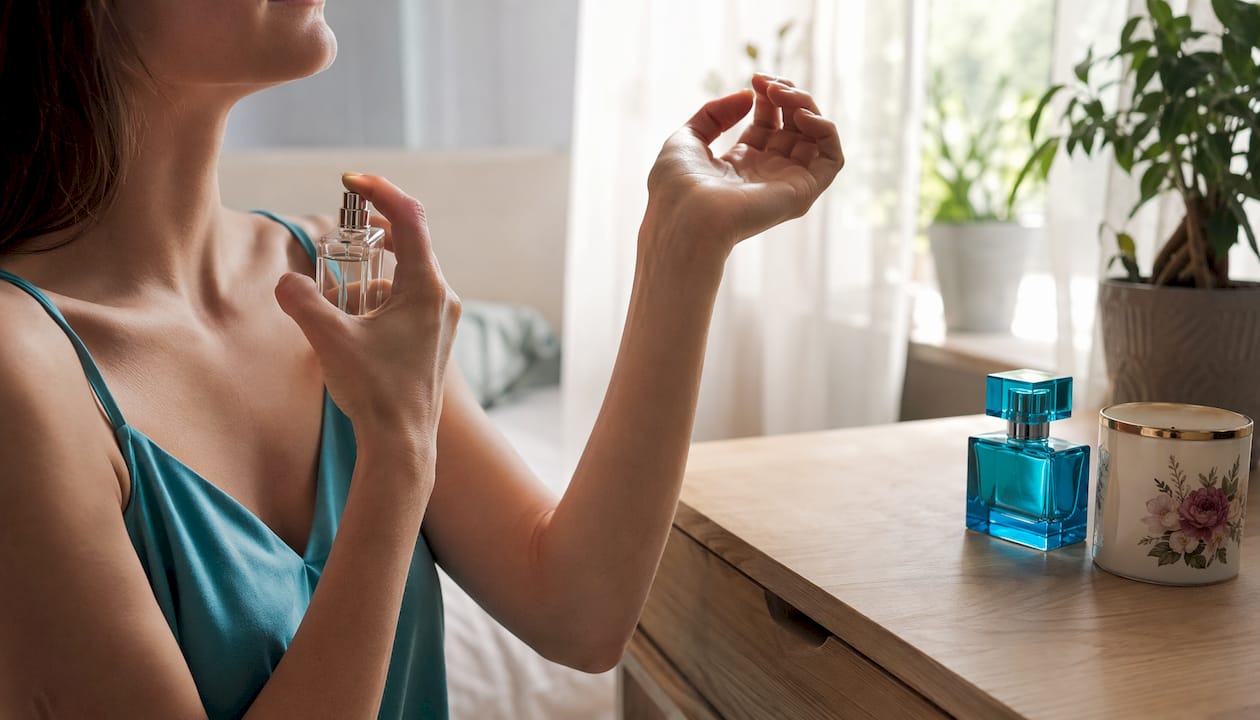
Formulation and molecular weight are the starting point. Volatile ingredients, alcohol level, spray pattern, temperature, humidity, skin warmth, and the structure of the fragrance formula all influence how far a scent travels. Sparkling top notes, think citrus and aldehydes, lift quickly and project fast. Heavy base notes like musks and woods tend to sit closer to the skin and project more softly.
Your skin and environment matter more than most people expect. Moisturized skin holds fragrance molecules longer and projects more consistently than dry skin. Pulse points, your wrists, neck, and chest, generate body heat that actively pushes molecules into the air. Warm, humid weather amplifies projection naturally, which is why a fragrance that feels moderate in January can feel overwhelming in July.
Factors that affect scent reach, summarized:
- Concentration: Eau de Parfum (EDP) formulas typically project more than Eau de Toilette (EDT) because they carry a higher percentage of fragrance oil
- Skin chemistry: Oily skin tends to hold and project fragrance better than dry skin
- Application points: Pulse points amplify diffusion; applying to hair or clothing extends both projection and sillage
- Temperature: Heat expands fragrance molecules and increases their reach
- Humidity: Moisture in the air helps carry scent farther
- Number of sprays: More sprays increase projection, up to a point where it becomes intrusive
- Fragrance age: An older bottle may have lost some of its most volatile top notes, reducing early projection
Pro Tip: If you want stronger projection without adding more sprays, apply an unscented moisturizer to your pulse points before spraying. Hydrated skin holds fragrance molecules longer and diffuses them more evenly.
How to test your fragrance's projection at home or in a store
Testing projection accurately takes about five minutes and requires nothing more than a willing helper. The key is timing: projection is most accurately measured within the first two hours of application, when top and heart notes are working at full intensity.
The arm's length test is the quickest self-check. Spray your fragrance normally, wait about 15 minutes for the alcohol to settle, then extend your arm fully. If you can detect the scent clearly at that distance, the fragrance is projecting. If you can't smell it until your wrist is near your nose, it's sitting close to the skin.
The bubble test gives you a more precise radius and works best with a helper. Here's how to run it:
- Apply your fragrance to pulse points as you normally would
- Wait 15–20 minutes for the initial alcohol burst to settle
- Stand still in a neutral-smelling room, away from candles, cooking, or other fragrances
- Have your helper stand about 10 feet away, then walk slowly toward you
- Note the exact distance at which they first detect your scent
- That distance is your current projection radius
For online perfume shopping, where you can't test before buying, check community reviews that specifically mention projection distance rather than just scent description.
Conditions that affect accurate testing:
- Avoid testing outdoors on windy days, since air movement distorts the radius
- Don't test immediately after spraying. The alcohol spike inflates perceived projection
- Test at different times: once at 30 minutes, once at 90 minutes, to see how projection changes through the drydown
- Room temperature matters: a cold room compresses projection; a warm room expands it
How to improve your fragrance's projection
If your scent isn't carrying as far as you'd like, a few targeted adjustments usually fix it without requiring a new bottle.
The most reliable method is targeting pulse points deliberately. Wrists, the base of the throat, behind the ears, and the inner elbows all generate enough heat to push fragrance molecules outward. Spraying on clothing, particularly on a scarf or collar, extends projection further because fabric holds molecules differently than skin.
Moisturizing before you spray is the single most underrated technique. Dry skin absorbs fragrance quickly and projects weakly. Apply an unscented lotion or body oil to pulse points, let it absorb for a minute, then spray on top. The difference in projection radius is often noticeable.
Practical tips for better projection:
- Add one or two sprays to your usual count, but stay within a range that won't overwhelm a room
- Layer with an unscented base: body lotion or oil under the fragrance extends both projection and longevity
- Choose the right concentration: EDP formulas project more than EDT versions of the same scent
- Apply to hair or a scarf for a softer, longer-lasting diffusion that moves with you
- Match the fragrance to the climate: heavy orientals and spicy compositions project naturally in cool, dry air; light aquatics and florals work better in heat and humidity
- Avoid rubbing your wrists together after spraying, since friction breaks down the top notes that drive early projection
Pro Tip: For office or daytime wear, aim for a projection radius of about 2–3 feet. For evenings or outdoor settings where you want more presence, pulse points on the neck and chest, combined with a spray on clothing, give you that extra reach without going overboard.
Fragrance families and notes that project well
Not all scents are built to project equally. The fragrance family, the dominant notes, and the concentration all shape how far a scent travels.
Citrus and aromatic fragrances tend to project quickly and brightly in the first hour. Bergamot, lemon, grapefruit, and neroli are all highly volatile, which means they lift off the skin fast and fill nearby air immediately. The tradeoff is that they also fade faster than heavier compositions.
Spicy and oriental fragrances project differently: slower to open, but with a warmth that carries well in cool air. Notes like black pepper, cardamom, oud, and amber have enough molecular weight to project steadily through the heart and base phases, long after the top notes have burned off.
Fragrance profiles known for strong projection:
- Citrus top notes (bergamot, lemon, yuzu): fast, bright, high early projection
- Aromatic herbs (lavender, rosemary, sage): clean, moderate projection that reads as fresh rather than loud
- Spices (pepper, cardamom, clove): warm projection that carries well in cool or dry conditions
- Florals (jasmine, tuberose, ylang-ylang): moderate to strong projection depending on concentration; heavier florals project more than light petals
- Woody and resinous bases (oud, sandalwood, amber): lower projection radius but excellent longevity and sillage
- Musks: synthetic musks like Iso E Super project softly but persistently, creating a skin-close aura rather than a room-filling presence
Concentration and projection are directly linked. An EDP version of a fragrance typically projects further than its EDT counterpart because the higher oil concentration means more aromatic molecules available to diffuse. If you want stronger projection from a fragrance you already own, the EDP version is usually the most direct upgrade.
What perfumers and scientists know about projection that most wearers don't
Fragrance projection isn't just a subjective impression. Researchers have modeled it mathematically using Fick's second law for radial diffusion, treating the wearer as a point source and predicting how concentration drops with distance over time. The model accounts for molecular weight, volatility, and environmental conditions, and it confirms what experienced wearers already sense: lighter molecules travel farther, faster, and concentration falls off as distance increases.
Perfumers design projection intentionally. Fragrance designers consider projection intensity as part of the scent's lifecycle, crafting an olfactory arc that evolves from a pronounced public presence in the opening to a more intimate, skin-close experience during drydown. That arc isn't a sign of poor quality. It's the design.
Key industry insights on projection:
- Projection peaks early: The first 1–2 hours correspond to top and heart note volatility; drydown pulls the scent closer to the skin
- Radial diffusion is isotropic: Fragrance molecules spread in all directions at roughly equal rates, which is why the scent bubble is roughly spherical rather than directional
- A moderate radius is the accepted daily wear standard in the fragrance community, with anything beyond that considered strong
- Temperature and air movement are the two environmental variables that most affect real-world projection, independent of the formula itself
- Practical testing beats theory: Even with predictive models, the bubble test and arm's length test remain the most reliable ways to assess how a specific fragrance performs on your skin
The gap between how a fragrance projects on a blotter and how it projects on skin is real and often large. Skin chemistry, body temperature, and the oils naturally present on your skin all alter diffusion in ways no lab model fully captures. Testing on skin, in the conditions where you'll actually wear the fragrance, is the only way to know for certain.
Key Takeaways
Fragrance projection is the measurable radius of scent around a stationary wearer, distinct from sillage and longevity, and shaped by formulation, skin, and environment.
| Point | Details |
|---|---|
| Projection defined | The distance scent radiates from your skin while stationary, forming an invisible scent bubble around you. |
| Daily wear standard | A 2–3 foot projection radius is widely accepted as comfortable for most social and professional settings. |
| Projection vs. sillage | Projection is a stationary scent radius; sillage is the trail left behind as you move. |
| Peak timing | Projection is strongest in the first 1–2 hours after application, then softens during drydown. |
| Improve projection | Moisturize pulse points before spraying and target heat-generating areas like the neck, wrists, and chest. |
Find fragrances that project exactly the way you want
Understanding projection changes how you shop. A fragrance that reads as "weak" on a blotter might project beautifully on warm skin, and one that smells moderate in a store can fill a room in July heat. The only way to know is to test on skin, in real conditions.
Parfumla carries over 14,000 perfumes, including EDPs and EDTs across every fragrance family, at up to 60% off retail prices. Whether you're looking for a soft skin scent for the office or a bold projector for evenings, you can find it without paying full price. The NARCISO RODRIGUEZ Eau De Parfum For Women is a strong example of a fragrance that balances projection and longevity well, projecting warmly in the opening and settling into a close, lasting drydown. For something with a more distinctive projection profile, the Ex Nihilo Venenum Kiss EDP delivers a rich, room-aware presence from the first spray.
Browse the full catalog at Parfumla and use what you now know about projection to shop with a clearer idea of what you're actually looking for.