

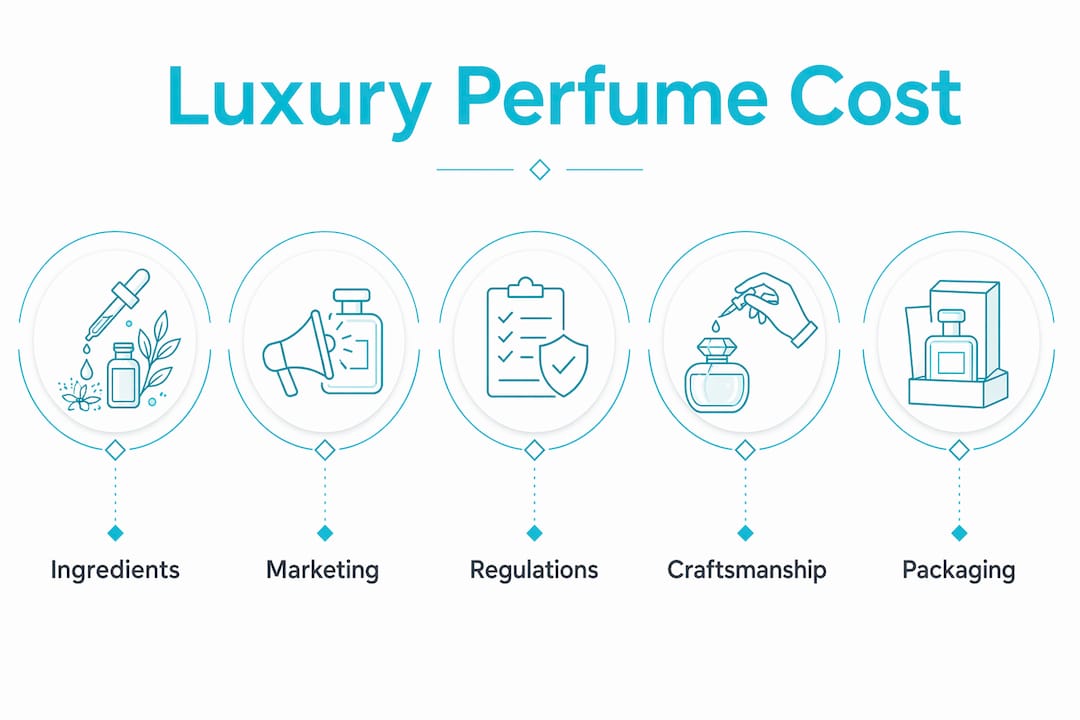
Luxury perfume pricing is defined by far more than the liquid inside the bottle. The reason why luxury perfumes cost so much comes down to a layered structure of ingredient sourcing, marketing spend, regulatory compliance, packaging, and artisanal production. Each factor compounds the next, and the result is a retail price that often has little to do with how much the fragrance itself actually costs to make. Understanding luxury fragrance pricing means separating what you see from what you are actually paying for.
Why luxury perfumes cost so much: the ingredient truth
The most common assumption is that high prices mean rare, expensive ingredients. That is partially true, but the relationship is more complicated than most buyers realize.
Natural aromatic materials are genuinely costly. Natural rose absolute from Bulgaria costs approximately $8,000 per kilogram, while synthetic rose costs around $50 per kilogram. Fine oud oil can reach $30,000 per kilogram. These are not marketing numbers. They reflect real supply constraints, labor-intensive harvesting, and volatile agricultural yields. A single kilogram of Bulgarian rose absolute requires roughly 3.5 to 4 metric tons of rose petals, harvested by hand at dawn before the heat destroys the volatile compounds.

However, most designer fragrances from houses like Chanel, Dior, or Giorgio Armani use a blend of natural and synthetic materials. Synthetics allow perfumers to replicate rare scents at a fraction of the cost while maintaining consistency across millions of bottles. The result is that ingredient cost is not the primary driver of retail price for most mass-market designer fragrances.
Concentration also matters. An Eau de Parfum carries a higher percentage of aromatic concentrate than an Eau de Toilette, which increases raw material costs per bottle. Niche houses like Maison Francis Kurkdjian or Creed often use higher concentrations and more natural materials, which genuinely justifies a portion of their premium.
- Natural absolutes like jasmine, oud, and Bulgarian rose are 10 to 50 times more expensive than their synthetic counterparts
- Higher fragrance concentration means more raw material per bottle, raising production cost
- Ingredient sourcing relationships and geographic origin affect price and quality
- Synthetic ingredients allow consistency and cost control in mass-market production
Pro Tip: When comparing two perfumes at different price points, check the concentration level first. An Eau de Parfum at $120 may contain more aromatic material than an Eau de Toilette at $90, making the higher price more justified than it first appears.
What role do marketing, branding, and packaging play in perfume pricing?
This is where the real money goes, and most buyers have no idea.
For a designer fragrance retailing around €120, the aromatic liquid accounts for only 3 to 8% of the retail price. Marketing accounts for 25 to 40%, and distribution plus retailer margins add another 30 to 40%. That means the scent itself is the smallest financial component of what you buy. The brand story, the advertising campaign, and the shelf space cost more than the perfume.
Consider what goes into launching a fragrance from a house like Lancôme or Yves Saint Laurent:
- Celebrity contracts and endorsement fees, which can run into the tens of millions of dollars for a single campaign
- Global advertising across print, digital, television, and in-store displays
- Retailer placement fees and sales commissions at department stores like Nordstrom or Sephora
- Bottle and packaging design, which signals luxury but is not the largest cost driver
In one detailed breakdown of a $100 designer perfume, the fragrance concentrate costs $2, packaging costs $6, sales commission $6, marketing $8, and retailer overhead and profit $40. The remaining amount covers licensing, distribution logistics, and brand overhead. That $2 of actual scent carries a $100 price tag because of everything built around it.
"Marketing budgets in designer fragrances can exceed the combined cost of ingredients, bottle, and packaging by 2 to 3 times." This is not a flaw in the system. It is the system.
The bottle itself is a deliberate signal. A heavy glass flacon from Baccarat or a sculptural design from Thierry Mugler communicates exclusivity before the cap comes off. Packaging costs are real but secondary. The celebrity influence on pricing is often the single largest invisible cost embedded in a designer fragrance's retail price.
How do regulatory compliance and safety testing add to luxury perfume costs?
Regulatory costs are the least glamorous reason for high perfume prices, but they are non-trivial and growing.
In the European Union, every cosmetic product including perfume must have a Cosmetic Product Safety Report (CPSR) before it can be sold legally under EU Cosmetics Regulation 1223/2009. CPSR costs range from €400 to over €2,000 depending on formula complexity. A brand launching 10 new fragrances in a year faces a meaningful compliance budget before a single bottle reaches a shelf.
The allergen labeling requirements add another layer. In 2023, the EU introduced 56 new fragrance allergens via EU Commission Regulation (EU) 2023/1545, requiring brands to update supplier documentation, reformulate where necessary, and revise label copy across their entire catalog. Each update requires new safety assessments and documentation. For a niche house with a small team, this is a significant operational burden.
| Regulatory requirement | Estimated cost impact |
|---|---|
| CPSR for a simple formula | €400 to €600 per product |
| CPSR for a complex formula | €2,000 or more per product |
| Allergen documentation update | Variable; affects entire product line |
| Label reformulation compliance | Ongoing operational overhead |
Pro Tip: If you buy fragrances from small niche brands, a portion of the price reflects compliance costs that larger houses absorb more easily at scale. This is one reason niche perfumes from boutique houses can cost more per milliliter than designer alternatives.
Larger brands like LVMH or Coty spread these costs across hundreds of products and global legal teams. Smaller independent perfumers carry the same regulatory burden with far fewer resources, which pushes their per-unit costs higher.
How does production scale and craftsmanship influence luxury perfume pricing?
The difference between a mass-market fragrance and a niche luxury perfume is not just ingredients. It is the entire production philosophy.
Mass-market brands produce fragrances in batches of millions of units. That scale drives down per-unit costs through bulk ingredient purchasing, automated filling lines, and standardized quality control. A fragrance from a brand like Zara or H&M Beauty can retail for $20 to $30 because the economics of scale make it possible to produce at low cost without sacrificing consistency.
Niche houses produce in the thousands, not millions. Smaller batches mean higher setup costs per unit, more labor-intensive filling and quality checks, and less negotiating power with ingredient suppliers. Every bottle from a house like Amouage or Serge Lutens represents a higher fixed cost spread across fewer units.
The role of the master perfumer adds another dimension. Master perfumers invest decades in training, and their creative process involves olfactory storytelling across hundreds of aromatic molecules. A single fragrance may go through 50 to 100 iterations before it is approved. That development time is a real cost, and it is embedded in the final price.
- Small-batch production increases per-unit labor and quality control costs substantially
- Master perfumers' expertise and iterative development add intangible but real value
- Longer maceration and aging processes for certain fragrance types increase holding costs
- Niche houses prioritize ingredient quality over cost control, unlike mass-market producers
Aging and maceration also matter for certain fragrance families. Some perfumers allow the blended concentrate to rest for weeks or months before bottling, which improves scent integration but ties up capital and storage space. This is a holding cost that never appears on the label but is always in the price.
Key takeaways
Luxury perfume prices reflect a combination of ingredient sourcing, marketing investment, regulatory compliance, and production scale. No single factor explains the full cost.
| Point | Details |
|---|---|
| Ingredients are a small fraction | The aromatic liquid accounts for only 3 to 8% of a designer fragrance's retail price. |
| Marketing dominates the cost | Advertising, celebrity contracts, and retailer margins account for 55 to 80% of retail price. |
| Regulatory costs are real | EU CPSR compliance alone costs €400 to €2,000 per product, with ongoing allergen updates adding more. |
| Scale determines per-unit cost | Niche houses producing thousands of units pay far more per bottle than mass-market brands producing millions. |
| Craftsmanship adds intangible value | Master perfumers' decades of training and iterative development are embedded in every niche fragrance price. |
The price myth I keep seeing repeated
I have spent years reading fragrance reviews, talking to perfumers, and comparing bottles across price points. The most persistent myth I encounter is that a higher price always means purer or more natural ingredients. It does not.
High price often reflects business model and marketing strategy more than ingredient quality. A $300 designer fragrance from a major fashion house may contain less natural material than a $150 bottle from an independent niche perfumer. The fashion house is paying for its global advertising budget, its celebrity ambassador, and its department store real estate. The niche perfumer is paying for Bulgarian rose and hand-filled bottles.
What I find more useful than price as a quality signal is understanding the house behind the fragrance. Brands like Maison Margiela Replica, Diptyque, and Byredo are transparent about their creative process. That transparency is worth something. A fragrance from a closeout sale at 40% off retail is not a lesser fragrance. It is the same liquid with a different price tag, often because the retailer needs to move inventory.
The honest takeaway is this: price tells you about positioning, not purity. Learn to read the house, the concentration, and the ingredient list. That is how you decide whether a luxury fragrance is worth it for you.
— Hamster777
Explore luxury fragrances at prices that make sense
Understanding why luxury perfumes cost so much makes it easier to shop with confidence. At Parfumla, you get access to over 14,000 fragrances, including niche, designer, and celebrity scents, at up to 60% off retail prices. The same ingredient quality and craftsmanship you have read about here is available without the inflated marketing markup. Whether you want to try the unisex Ex Nihilo Venenum Kiss or the iconic Christian Dior Addict Eau Delice, Parfumla ships reliably across the US and EU with detailed reviews to guide every purchase.
FAQ
Why is the actual fragrance such a small part of the price?
The aromatic liquid in a designer perfume accounts for only 3 to 8% of the retail price. The majority of the cost goes to marketing, retailer margins, distribution, and packaging.
Are niche perfumes more expensive because of better ingredients?
Often yes, but not always. Niche houses typically use higher concentrations of natural materials and produce in smaller batches, both of which raise per-unit costs. However, some niche pricing also reflects brand positioning rather than ingredient quality alone.
What does a Cosmetic Product Safety Report cost?
A CPSR required under EU Cosmetics Regulation 1223/2009 costs between €400 and €600 for simple formulas and over €2,000 for complex ones. These costs apply per product and must be updated when formulas or regulations change.
Do celebrity-endorsed perfumes cost more because of the endorsement?
Yes. Marketing budgets for designer fragrances, including celebrity contracts and global campaigns, can account for 25 to 40% of the retail price. That cost is built into every bottle sold under that campaign.
Are luxury perfumes worth the price?
It depends on what you are paying for. If the craftsmanship, natural ingredients, and small-batch production of a niche house matter to you, the price is justified. If you are paying primarily for a brand name and its advertising, you may find equal quality at a lower price point through retailers like Parfumla that discount retail markups significantly.