

A signature scent is defined as a fragrance so consistently linked to your identity that others recognize you by it before you enter a room. This is why perfume becomes a style signature: smell connects directly to the brain's emotional and memory centers, embedding associations that clothing and accessories simply cannot replicate. Unlike a handbag or a haircut, your scent reaches people before they see you. It lingers after you leave. Neuroscience explains this phenomenon clearly, and once you understand the mechanism, choosing a fragrance becomes one of the most deliberate style decisions you can make.
Why perfume becomes a style signature: the brain science
The olfactory system is the only sensory pathway that routes directly to the limbic system, which includes the amygdala and hippocampus. Every other sense passes through the thalamus first, adding a cognitive filtering step. Smell skips that step entirely. The result is that scent triggers emotion and memory faster and more viscerally than any visual or auditory cue. That neurological shortcut is the foundation of every signature scent.
How the amygdala and hippocampus lock in scent memories
The amygdala assigns emotional weight to experiences. The hippocampus converts those experiences into long-term memory. When you spray a fragrance repeatedly in emotionally significant moments, both structures encode that scent as personally meaningful. Over time, the brain stops processing it as just a smell. It processes it as you.

Research confirms that olfactory-hippocampal pathways reshape with repeated odor exposure, increasing selectivity for familiar scents. This means the more consistently you wear a fragrance, the more distinctly your brain and the brains of people around you recognize it as yours. Familiarity is not passive. It is an active neural process.
How others learn to associate a scent with you
Social recognition through scent is not accidental. A Nature Communications study found that olfactory neurons encode odor-valence pairings through associative learning. When someone repeatedly encounters your fragrance alongside your presence, their brain assigns emotional meaning to that scent. It becomes a learned signal. This is why people say a perfume "smells like" a specific person they know.
- The brain's basal forebrain neurons link scent to emotional context through glutamatergic projection pathways
- Repeated co-exposure of scent and person builds a conditioned association in the observer's memory
- That association persists even when the person is absent, which is why your scent can trigger someone's memory of you hours later
Pro Tip: Wear your candidate signature scent for at least two full weeks before deciding. Your brain needs repeated exposure across different emotional states to form a genuine neural association, not just an initial positive reaction.
Does consistency actually build a scent identity?
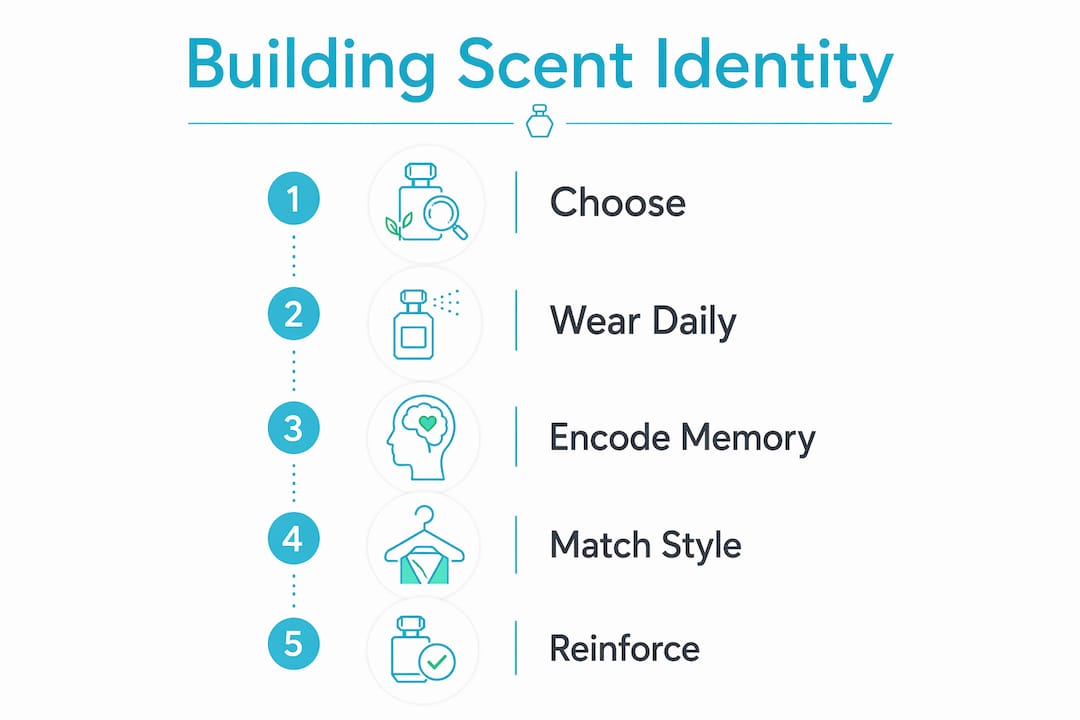
Consistency is the single most important factor in forming a true personal fragrance statement. A fragrance worn once at a party is a pleasant memory. A fragrance worn every day for six months becomes part of how people mentally represent you.
An eLife study on olfactory learning and neural plasticity shows that repeated exposure in stable, personally meaningful contexts sharpens odor selectivity along cortico-hippocampal circuits. The brain does not just get used to a scent. It builds a more precise, more emotionally loaded representation of it. That precision is what separates a signature scent from a scent you simply enjoy.
Here is how consistency builds scent identity in practice:
- Wear the fragrance in your most personally significant contexts first. Morning routines, work environments, and social settings where you feel most like yourself create the strongest encoding conditions.
- Avoid switching fragrances daily during the formation period. Rotating between five perfumes prevents any single scent from accumulating the neural weight needed for signature status.
- Wear it across varied environments. Testing a fragrance only at home limits the brain's ability to generalize the association. Wear it at work, outdoors, and in social settings to confirm it holds up emotionally.
- Pay attention to how others respond. When people start commenting that a scent "smells like you," the associative learning process in their brains is already working.
A mismatch between scent and identity weakens the signature effect even when the fragrance itself is beautiful. Consumer EEG data shows that incongruent scents produce poor long-term memory and lower favorability scores over time, despite generating immediate pleasure. Liking a scent's notes is not enough. The scent has to fit who you are.
Does your scent match your style energy?
Scent congruence with personal identity is the difference between a fragrance you wear and a fragrance that becomes you. Fashion houses have understood this for decades. Maison Margiela's Replica line maps scents to specific emotional memories and environments. Chanel No. 5 was designed to project a particular kind of femininity that aligned with Coco Chanel's own aesthetic identity. These are not accidents of marketing. They reflect a real psychological principle.
A Sungkyunkwan University EEG study found that congruent scents enhance emotional stability and long-term memory encoding compared to incongruent ones. The brain responds differently to a scent that fits versus one that clashes with the wearer's projected identity. Congruence amplifies the signature effect. Incongruence dilutes it.
| Style Energy | Scent Profile That Fits | What to Avoid |
|---|---|---|
| Minimalist, clean aesthetic | White musks, light woods, aquatics | Heavy orientals, dense resins |
| Bold, maximalist fashion | Spicy ouds, rich florals, dark ambers | Sheer, barely-there aquatics |
| Natural, earthy personal style | Vetiver, green notes, earthy patchouli | Synthetic musks, sharp citrus |
| Romantic, feminine expression | Rose, jasmine, soft powder | Harsh woods, cold aquatics |
Pro Tip: Before committing to a signature scent, ask yourself: does this fragrance feel like an extension of how I dress and move through the world? If the answer is "I just really like it," keep testing. Liking is not the same as identity fit.
Fashion culture in 2026 treats fragrance and fashion as unified self-expression systems. Scent profiles are now mapped to style aesthetics the same way color palettes are matched to skin tone. This is not a trend. It is a recognition of something the brain has always done.
How culture and fashion amplify scent as a style statement
The cultural dimension of fragrance as a personal style statement has accelerated significantly. Fashion houses now debut scents alongside runway collections, treating perfume as an extension of the season's visual identity rather than a separate product category. The impact of fragrance on identity is no longer a private, personal matter. It is a public, social one.
Several forces are driving this shift:
- Fashion house integration: Brands like Valentino, Bottega Veneta, and Byredo release fragrances that mirror the emotional tone of their clothing lines, reinforcing the idea that scent completes an outfit rather than accessorizes it. You can read more about this in Parfumla's guide on how perfume completes an outfit.
- Celebrity signature scents as cultural shorthand: Figures like Rihanna, Ariana Grande, and Lady Gaga have built fragrance identities that fans adopt as style statements. The celebrity scent phenomenon shows how a fragrance can carry an entire identity narrative.
- Niche fragrance culture: The rise of houses like Ex Nihilo, Escentric Molecules, and Byredo has created a fragrance-literate consumer base that treats scent selection with the same seriousness as wardrobe curation.
- Social media and scent communities: Platforms like Reddit's r/fragrance and TikTok's #perfumetok have made fragrance a visible, discussed, and shared style category, amplifying its role as a personal branding tool.
NYC's fashion culture, for example, treats personal style as a layered system where scent operates alongside clothing, grooming, and posture as a coherent identity signal. The invisible layer of your style is often the most memorable one.
Key takeaways
A fragrance becomes a true style signature only when it aligns with your identity, is worn consistently, and is encoded through the brain's olfactory-emotional pathways over time.
| Point | Details |
|---|---|
| Scent bypasses cognitive filters | Smell routes directly to the amygdala and hippocampus, creating faster and stronger emotional memory than visual cues. |
| Consistency builds neural identity | Repeated wear in meaningful contexts sharpens the brain's odor representation, turning a fragrance into a personal signature. |
| Identity fit matters more than preference | Congruent scents produce stronger long-term memory and emotional stability than scents you simply enjoy. |
| Others learn your scent through association | Associative learning in observers' brains links your fragrance to your presence, making scent a social identity signal. |
| Culture reinforces fragrance as style | Fashion houses, celebrity culture, and niche fragrance communities now treat scent as equal to clothing in personal expression. |
What i've learned about choosing a signature scent
Most people approach fragrance shopping the wrong way. They walk into a store, spray three things on paper strips, and buy whatever smells best in that moment. That method produces a perfume you like. It does not produce a signature scent.
The research on olfactory neural plasticity changed how I think about this. A fragrance needs time and context to reveal whether it truly fits your identity. I have tested scents that smelled extraordinary on first spray and felt completely wrong after two weeks of daily wear. The reverse has also happened: a fragrance that seemed unremarkable at first became deeply personal after wearing it through a significant period of my life.
My honest advice is to treat signature scent selection like wardrobe building, not impulse buying. Sample widely, but commit slowly. Wear a candidate fragrance to work, to dinner, on a quiet Sunday morning. Notice whether it feels like an extension of who you are or a costume you are trying on. The scent and personal style connection is real, but it requires honest self-assessment to get right.
Also: your signature scent is allowed to evolve. The fragrance that defined you at 25 may not fit who you are at 40. That is not inconsistency. That is your identity growing, and your scent reflecting it.
— Hamster777
Find your signature scent at Parfumla
Knowing the science behind a signature scent is only half the work. The other half is finding the fragrance that actually fits your identity and style energy.
Parfumla carries over 14,000 perfumes, from niche houses like Ex Nihilo to iconic names like NARCISO RODRIGUEZ and Christian Dior, at up to 60% off retail prices. Whether you are drawn to a clean, elegant signature or something bolder and more distinctive, Parfumla's detailed reviews and broad catalog make it easier to find the right fit without overpaying. The Ex Nihilo Venenum Kiss EDP is a strong example of a fragrance built for identity-forward wearers. Parfumla ships reliably across the US and EU, so your next signature scent is never far away.
FAQ
What makes a perfume a style signature?
A perfume becomes a style signature when it is worn consistently enough that the brain, both yours and others', encodes it as emotionally linked to your identity. The olfactory system's direct connection to the amygdala and hippocampus makes this encoding faster and more durable than visual identity cues.
How long does it take to establish a signature scent?
Neurological research on olfactory-hippocampal pathways suggests that meaningful odor associations require repeated exposure across varied contexts over several weeks. Wearing a fragrance consistently for two to four weeks in personally significant settings is a reliable minimum for testing true identity fit.
Why does a scent smell different on different people?
Identical perfumes smell differently meaningful to different people because personal experience shapes the learned associations and emotional valence the brain assigns to each scent. Skin chemistry affects projection, but the deeper difference is the unique emotional context each person brings to the fragrance.
Does scent-identity mismatch actually matter?
EEG research from Sungkyunkwan University shows that incongruent scents, those that do not align with the wearer's projected identity, produce weaker long-term memory and lower favorability over time despite generating immediate pleasure. Identity fit is not a soft preference. It is a measurable factor in whether a fragrance becomes a true signature.
Can a signature scent change over time?
A signature scent can and should evolve as your identity and style develop. Olfactory neural plasticity means the brain continuously updates its odor representations based on new experiences and contexts, so a fragrance that no longer fits your current identity will feel less resonant over time.