
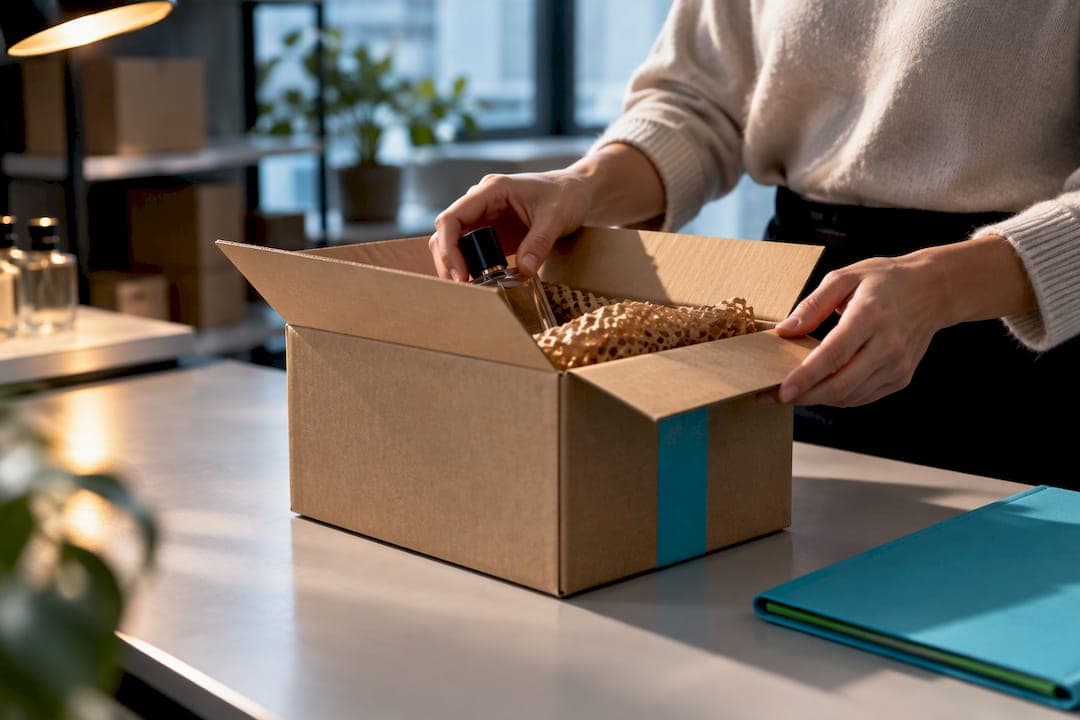
Yes, you can ship perfume, but it counts as a dangerous good because of its alcohol content, so it travels under specific volume limits, packaging rules, and carrier restrictions rather than as an ordinary parcel. Ground shipping within one country is usually the simplest path. Air and international shipments require checking the DOT and IATA classification first, confirming your carrier accepts the product, and packing it to meet dangerous goods standards. Buyers who want to skip this altogether can order from a retailer that already handles compliant shipping.
TL;DR:
- Perfume, due to its alcohol content, is classified as a dangerous good and requires compliance with specific volume, packaging, and carrier restrictions.
- Domestic ground shipping is generally simplest at around 16 fluid ounces per item, but international and air shipments demand proper classification, certification, and labeling.
- Incorrect classification or improper packaging is a common cause of shipment rejection or border delays, so verifying the proper shipping name and documentation is essential.
- Carrier policies vary: USPS limits perfume to ground transport with volume caps; UPS and FedEx require business accounts and may need dangerous goods training; DHL often supports international shipping but needs validation and absorbent packaging.
- Shipping perfume internationally involves careful customs checks, correct paperwork, and selecting carriers or specialists familiar with hazardous goods regulations to prevent border holds.
Table of Contents
- Why perfume counts as a dangerous good under DOT and IATA
- What USPS, UPS, FedEx, and DHL actually allow
- Crossing borders: customs, carrier approval, and paperwork
- Packing and labeling perfume so it actually clears
- Limited quantity versus excepted quantity: which one applies
- Your step-by-step shipment checklist
- Reading the SDS correctly before you ship anything
- What we tell sellers and shoppers about shipping perfume
- Skip the paperwork: order from a seller who already handles compliance
- Where to confirm the current rules
- Sources
- FAQ
Why perfume counts as a dangerous good under DOT and IATA
Most perfumes are alcohol-based, which puts them in Class 3, flammable liquids, under both the U.S. Department of Transportation's hazardous materials rules and the International Air Transport Association's Dangerous Goods Regulations. The proper shipping name matters more than people assume. A true fragrance product, where scent is the primary function, is generally described as UN1266, Perfumery Products. A cosmetic that merely contains fragrance as a minor ingredient does not automatically qualify for that name and may need to ship as Flammable Liquid, N.O.S. instead.
This distinction has real consequences for how a package moves:
- Domestic land transport falls under 49 CFR, enforced by the Pipeline and Hazardous Materials Safety Administration, and generally allows more flexibility for small-volume shipments.
- Air transport falls under IATA's rules, which are stricter and often require a trained shipper, a dangerous goods declaration, or specific packaging certifications.
- Full hazmat training and certification are required for anyone shipping in bulk or outside the limited or excepted quantity thresholds described later in this guide.
- Small parcels within limited quantity limits can often move without a certified shipper, provided the package is marked and packed correctly.
Getting this classification wrong is the single most common reason a shipment gets rejected at a carrier counter or held at a border. Before you book anything, know which proper shipping name applies to your specific bottle.
What USPS, UPS, FedEx, and DHL actually allow
Carrier policy varies more than most first-time shippers expect, and each one applies its own layer of restriction on top of the federal rules.
USPS accepts perfume only for ground transport, never air, and only from an authorized shipper. Many sellers cite a domestic limit around 16 fluid ounces per item, though the exact figure and packaging conditions depend on packing group and container type, so confirm current limits directly with USPS before shipping. Our own guide to the 16 ounce domestic limit walks through when overseas shipping becomes possible at all.
UPS and FedEx will move perfume domestically and internationally, but typically require a business shipping account, and larger volumes may require dangerous goods training for the person preparing the shipment. Both carriers publish per-package quantity limits that shift depending on packing group, so check the applicable service guide before your first shipment rather than assuming last year's limit still applies.
DHL is generally the most workable option for international perfume shipments, but it requires dangerous goods validation for many routes and recommends absorbent packaging sized to the full volume of the inner container, a point covered in DHL's own shipping guidance.
Before booking with any carrier, resolve these questions:
- Does this carrier accept perfume for my specific origin and destination pair?
- Do I need a business account or dangerous goods certification for this volume?
- What per-bottle or per-package limit applies to my packing group?
- Is ground the only option, or does this carrier support air for hazardous liquids?
Crossing borders: customs, carrier approval, and paperwork
A carrier accepting your package at the counter does not mean the destination country will let it in. Import rules for alcohol-based fragrances vary by country, and they override whatever your shipping label says. Verify destination permissibility using a carrier's own country lookup tool, such as DHL's MyGTS, or the destination country's customs portal directly, before you commit to a shipping method.
Once you've confirmed the shipment is legal at both ends, four practical decisions shape how the rest of the process goes:
- Gather the right paperwork. A commercial invoice with an accurate product description, a safety data sheet, and, for air shipments, a dangerous goods declaration, are the documents most likely to be requested.
- Choose a DG-approved courier or specialist. Not every courier validates dangerous goods shipments for every lane, so confirm this before printing a label.
- Consider a specialist 3PL for volume. A small business shipping regularly benefits from a fulfillment partner who already handles dangerous goods paperwork, rather than training in-house staff for occasional shipments.
- Decide who pays duties. Delivered Duty Paid means you collect duties upfront and the recipient pays nothing extra; Delivered Duty Unpaid leaves the recipient responsible for customs charges on arrival, which can delay delivery if they're unprepared.
Skipping the destination check is the fastest way to have an otherwise well-packed, properly labeled shipment turned back at the border.
Packing and labeling perfume so it actually clears
A compliant package starts on the inside. Seal the bottle's cap with tape, wrap it in plastic film, and place it inside a resealable bag before adding cushioning. This keeps a cracked cap or a jostled bottle from becoming a leak that ruins the whole shipment.
From there, follow the box-in-box method that dangerous goods packaging is built around:
- Wrap and bag each bottle individually, sealing the cap first.
- Add absorbent material sized to absorb the entire volume of the bottle, a requirement carried over from IATA and IMO packaging standards.
- Place the wrapped bottle inside a rigid inner box, then inside a sturdy outer shipping box with cushioning on all sides.
- Affix the correct mark, either the Limited Quantity diamond or an Excepted Quantity marking, depending on which threshold your shipment falls under.
- Attach orientation arrows and a fragile label so handlers know to keep the package upright.
For commercial shipments, include a safety data sheet and an invoice with an accurate product description, plus any dangerous goods paperwork your carrier requires for the route. Our TSA-safe packing steps cover the same sealing and cushioning principles for travelers, which translate directly to shipping.
Pro Tip: Test your packed box with a drop from waist height before you ship anything valuable. A cracked inner bottle inside good outer packaging still ruins the box and anything shipped alongside it.
Limited quantity versus excepted quantity: which one applies
These two provisions exist to let smaller shipments move without the full weight of dangerous goods paperwork, but they aren't interchangeable. Limited quantity applies to somewhat larger volumes and still requires the diamond-shaped Limited Quantity mark on the outer box. Excepted quantity covers smaller volumes per inner packaging and carries lighter marking requirements, though it still demands proper inner packaging and labeling.
The exact numeric thresholds depend on packing group and the specific regulation in force, whether that's 49 CFR domestically or IATA's rules for air, so confirm the current figure against the regulating text before you ship rather than relying on a number you saw in a forum.
What changes operationally between the two:
- Limited quantity shipments typically skip a full dangerous goods declaration but still need correct marking and packaging.
- Excepted quantity shipments require even less paperwork but cap the volume per inner container more tightly.
- Exceeding either threshold pushes your shipment into full dangerous goods territory, meaning certified training, complete declarations, and often higher shipping costs.
- Carriers may cap total package weight or per-vehicle quantity separately from the regulatory thresholds, so check both.
Your step-by-step shipment checklist
Follows this order and you'll catch most problems before they cost you a rejected package or a customs hold.
- Check the safety data sheet for the proper shipping name, UN number, and packing group.
- Measure your total volume against the limited or excepted quantity threshold that applies to your packing group.
- Confirm your carrier accepts perfume for your specific origin, destination, and service level.
- Pack using the box-in-box method with sized absorbent material and a sealed inner bag.
- Affix the correct marking, Limited Quantity or Excepted Quantity, along with orientation and fragile labels.
- Prepare paperwork, including an SDS, invoice, and any required dangerous goods declaration for air shipments.
- Book with a dangerous goods capable carrier or 3PL if your volume or route requires certified handling.
- Buy tracking and insurance before handing off the package, since a lost or damaged hazardous shipment is harder to claim without documentation.
Pro Tip: Keep a copy of the SDS and your carrier's acceptance confirmation with your own records. If a package gets held at customs or questioned by a carrier, having that documentation ready saves days.
Reading the SDS correctly before you ship anything

The safety data sheet is where classification questions get answered, and four fields matter most: the proper shipping name, the UN number, the packing group, and the flash point. These determine whether your product ships as UN1266 or under a different flammable liquid classification.
A PHMSA letter of interpretation addressed this directly:
UN1266 (Perfumery products) applies only when the product's primary function is as a perfume. Applying that classification to cosmetics where fragrance is a secondary characteristic is not appropriate.
This matters because misclassifying a scented lotion or body spray as UN1266 to simplify paperwork can create legal exposure and lead to carrier refusal down the line. When your SDS is unclear or your product sits in a gray area between cosmetic and fragrance, ask the manufacturer for a classification statement or consult a certified dangerous goods preparer rather than guessing.
What we tell sellers and shoppers about shipping perfume
Some sellers overcomplicate shipments that qualify for limited quantity treatment. For consumer-sized orders, limited quantity shipping is usually the simplest legal path, and it avoids the cost of full dangerous goods declarations. For international orders specifically, we recommend letting the seller manage classification and paperwork, as explained in pedidos discretos internacionales, since a single misclassified customs form can hold a shipment for weeks.
— Parfumla
Skip the paperwork: order from a seller who already handles compliance
If everything above sounds like more than you want to manage for a bottle of perfume, buying from an established retailer removes the shipping question entirely. Some retailers carry a large selection of fragrances with reliable shipping built for US and EU delivery. That means the classification, packaging, and carrier compliance work described in this guide is handled before your order ever leaves the warehouse.
If you're not ready to commit to a full bottle, our Decants & Samples selection lets you try a scent before buying, and shoppers looking to buy perfume online can browse women's fragrances, men's fragrances, or gift sets for the best price on original perfume without touching a single shipping label. Start browsing and find your next bottle.
Where to confirm the current rules
Regulations and carrier policies change, so verify anything time-sensitive directly at the source:
- PHMSA's letter of interpretation clarifies when UN1266 applies to perfumery products.
- IATA's Dangerous Goods Regulations cover air transport classification and packaging requirements.
- DHL's international shipping guidance details absorbent packaging and destination validation tools.
- Destination customs portals give the final word on whether a specific country allows fragrance imports.
Sources
- PHMSA letter of interpretation (20-0011) on UN1266 and perfumery products
- IATA — Dangerous Goods Regulations (DGR)
- DHL — How to ship perfume internationally
FAQ
What are the USPS rules for shipping perfume?
USPS accepts perfume for ground shipment only, never air, and typically limits domestic packages to smaller volumes per item under its hazardous materials guidance. Check our breakdown of the 16 ounce domestic limit for when international shipping through USPS becomes an option at all.
Is perfume allowed to be mailed?
Yes, perfume can be mailed, but it's classified as a dangerous good because of its alcohol content, so it must ship under specific volume limits and packaging rules rather than as a standard parcel. The available shipping method, ground versus air, depends on the carrier and the destination.
Do I need a hazmat label for shipping perfume?
Most consumer-sized perfume shipments qualify for limited quantity or excepted quantity provisions, which require a specific diamond-shaped mark rather than a full hazmat label. Shipments exceeding those thresholds need complete dangerous goods labeling and documentation.
What is the best way to ship perfume?
For domestic shipments, ground service through a carrier that confirms acceptance for your packing group is usually the simplest legal option. For international orders, using a dangerous goods approved courier or buying from a retailer that already manages compliant shipping avoids the paperwork entirely.